








Fifty years ago, Thurgood Marshall appeared on the “Today” show to discuss school segregation. In Jackson, Mississippi, however, viewers who tuned in expecting to see Judge Marshall instead saw two words: “Cable Difficulty.” At the height of the civil rights movement, news blackouts across the country kept countless Americans from seeing the shocking images of men, women, and children being attacked by dogs and beaten by batons.
Flash-forward to the recent protests in the aftermath of the killings of Michael Brown and Eric Garner.
As police cracked down, they banned news helicopters from relaying images from the air and limited camera crews on the ground. Nonetheless, tens of thousands of Americans – including reporters – took to social media to document the protests. Videos shown on nightly news of officers firing tear gas were recorded on cellphones and uploaded to YouTube; locations of die-ins, protests and spontaneous rallies were circulated on Facebook and Twitter.
%22Ferguson%2C%20Staten%20Island%20and%20cities%20around%20the%20world%20%E2%80%93%20from%20Tehran%20to%20Beijing%20%E2%80%93%20underscore%20this%20inextricable%20link%20between%20Internet%20Rights%20and%20Civil%20Rights.%22′
But imagine if Internet access to these images and information was restricted, or disparately available. Would the communities who took to the streets, channeling decades of oppression and injustice, have captured the attention of the American public? Would the protests have sparked a national conversation on systemic racism or police accountability?
Ferguson, Staten Island and cities around the world – from Tehran to Beijing – underscore this inextricable link between Internet Rights and Civil Rights. The Internet is now our central platform for engaging in dialogue about the most important issues facing our country. It’s where we share our views, speak out against injustice, and express our hopes for the future. Conversation is both transmitted online, as well as generated.
But the truth is, a free and open Internet is now at risk — endangering our rights as citizens and the freedoms that define the promise of this country. Without a renewed commitment to Internet Rights, we risk undermining the very core of our democracy, setting ourselves on a course for a modern-day news blackout.
Indeed, we’ve seen the power of the Internet in helping to catalyze large-scale social movements across the Middle East and Asia. But we’ve also seen deafening effects on civic participation when leaders censor or restrict the free flow of information online. As the U.S. finds itself in a pivotal moment, we must bear in mind the transformative power of this technology, and the concomitant responsibility to keep it free and equal.
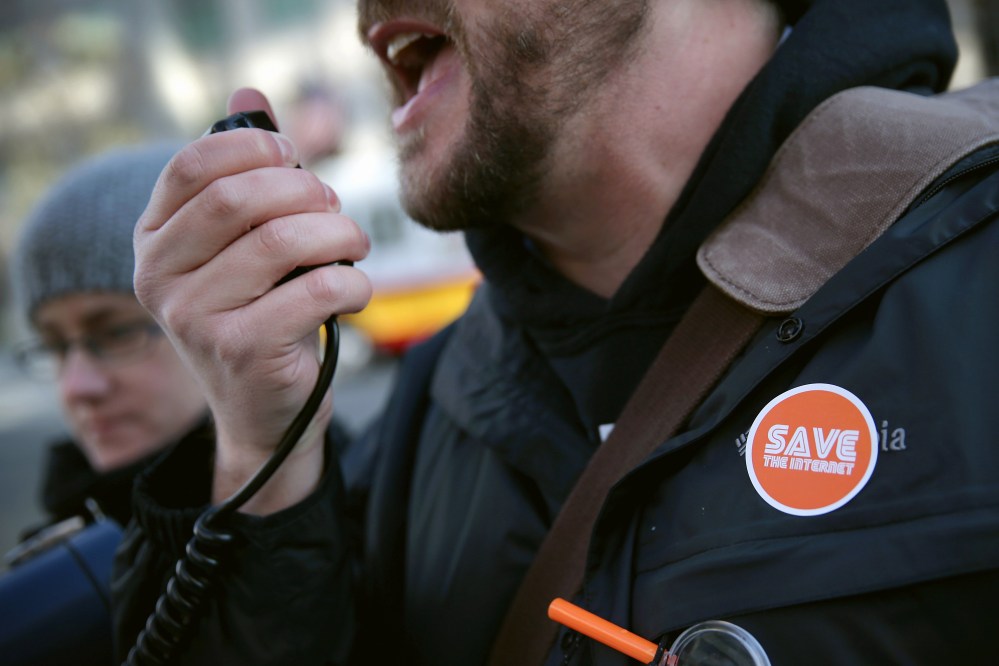
Currently, the Federal Communications Commission is considering rule changes that would allow the segregation of Internet traffic into a tiered system, in which content and ideas from corporations that pay more could travel more quickly, while ideas from average citizens could be stuck in the slow lane. If effected, service providers could impose new fees and even block certain content to bolster their bottom line.
[Editor’s note: Comcast, a cable company and Internet service provider, is the parent company of msnbc.]
Such a system is more than a departure from net neutrality – it’s a threat to free expression. It could discriminate against individuals like those in Missouri, first-time organizers who shared their grief over social media with the world. And it would not just affect the future of technology, but of our civil rights.
%22Our%20national%20debate%20over%20the%20future%20of%20the%20Internet%20has%20focused%20almost%20exclusively%20on%20its%20impact%20on%20our%20lives%20as%20consumers%2C%20not%20as%20citizens%22′ Yet still, our national debate over the future of the Internet has focused almost exclusively on its impact on our lives as consumers, not as citizens. While President Obama’s recent call for the “strongest possible rules to protect net neutrality” garnered headlines, it is the regulators, Internet providers and large companies who are shaping the conversation, not Internet users. With this much at stake, we need a different way forward. As a start, the FCC ought to demonstrate its commitment to the common good by restoring so-called Title II protection, reclassifying Internet Service Providers as common carriers responsible for sending and receiving information at uniform speeds. Such a move would safeguard the free exchange of information, make it harder to discriminate among ideas, and provide greater competition. Moreover, we must strengthen our work to protect Internet Rights. Fortunately, Americans already have an instinctive understanding of what’s at stake. In a recent survey, 80% opposed Internet providers being able to create slow lanes and fast lanes for web content based on who can pay more. As Americans, we need to become louder, and the FCC must listen to these concerns. We have come a long way since the television blackouts of the civil rights movement. But not far enough. Fifty years later, we risk incorporating a new kind of inequality and discrimination into the global medium of our age. For our citizens, for our democracy, and for our country, we can’t let that happen. Darren Walker, president of Ford Foundation.
Darren Walker Recommended


