








Aspiring terrorists in the United States should probably avoid expressing their ambitions on Instagram.
Twenty-year-old California community college student Nicholas Teausant learned the perils of social media firsthand after he was arrested on terrorism charges last Monday. His use of social media is cited prominently in the FBI’s criminal complaint, which describes Teausant posting pictures under the name “bigolsmurf,” declaring his desire to “join Allah’s army” and seeking “The Mujahid’s Handbook,” identified by the FBI as a “how-to guide for becoming a lone wolf terrorist,” compiled from Al Qaeda’s Inspire magazine. On ask.fm, a Q-and-A social networking site, he allegedly told strangers of his desire to “go fight in Syria.”
Based on the FBI affidavit, that desire is ultimately how he got caught — attempting to cross the Canadian border, allegedly believing he was about to join Al Qaeda affiliates fighting against Syrian dictator Bashar al-Assad. Instead, he had really just fallen into a trap set by an FBI informant and an undercover agent. Charged with attempting to provide material support to a terrorist group, Teausant is now facing up to 15 years in prison if convicted. The U.S. Attorney’s office in Sacramento said that it was not clear if Teausant had been assigned a defense attorney.
The Teausant case is the latest of hundreds of cases where the FBI relies on sting operations that snare suspects who hold radical views but questionable competence and often have no formal ties to terror groups. The strategy is both to catch potential aspiring terrorists and to sow distrust in extremist communities and prevent them from recruiting inside the U.S. According to a forthcoming study from the Center on National Security at the Fordham University School of law, about 30 percent — 110 defendants out of 380 — of terrorism defendants have been targeted through the use of a sting operation or informant since the 9/11/2001 terrorist attacks.
“This is the preventive strategy, this is what it looks like,” says Karen Greenberg, director of the Center on National Security at the Fordham University School of Law. “Over time, the suspect’s acts turn out to be more and more remote from acts of violence themselves, and more like potential beginning steps in a direction that might or might not someday take the suspect in the direction of jihadi violence.”
The government may be particularly concerned about Americans being drawn into Syria’s civil war — NBC News has reported that as many as 60 Americans may have found their way to the fighting there.
Operations like these have raised criticisms of entrapment from those who argue that many of the suspects would never have gone beyond the realm of fantasy had they not had the misfortune of being targeted by an FBI informant. But the cases have thus far held up in court, in large part because the suspect is given opportunities to back out and doesn’t.
Mike German, a former FBI agent who has worked undercover operations and is now with the Brennan Center, said he couldn’t comment specifically on Teausant’s case but offered that “a case where someone is expressing troubling views that wouldn’t necessarily result in action absent the government’s intervention, and for the government to push them towards a plot rather than push them towards mental health counseling or some other method of addressing whatever concerns exist is inappropriate.”
Inappropriate may not be the same as entrapment.
“When you’re looking at an undercover informant case, where the government agent is involved in some undercover capacity, the big question is predisposition,” German says. “People think entrapment means you can’t trick someone into doing something but that’s not what that means, the government is allowed to induce people as long as they’re predisposed.”
Attempting to show predisposition may explain the FBI’s citation of social media in its criminal complaint against Teausant.
Teausant left behind a social media footprint so large it could pool water. A blog linked to his Google+ account, which shares photos from a Facebook page a law enforcement official confirmed as Teausant’s, discusses a conversion to Islam after feeling unmoved by his experiences at church. A Tumblr featuring his name and photo, directing users to the “bigolsmurf” Instagram account identified in the FBI affidavit, recounts the user’s “soul being ripped in half” by a breakup and an “i’m heartbroken” playlist that features Lonely Island and Lil’ Wayne. The tumblr also mentions the user’s recent conversion to Islam and his attempt to join the Army National Guard.
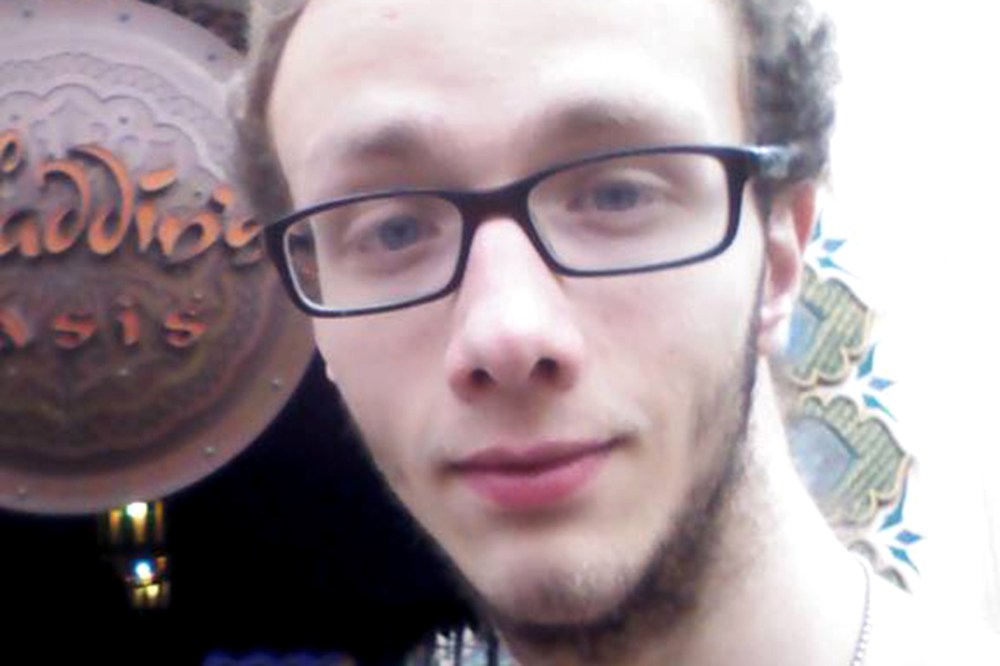
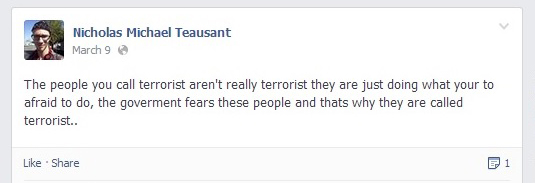
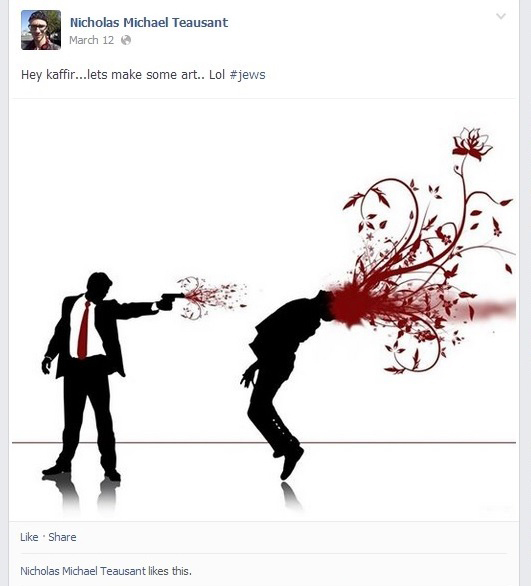
“You can really trace this guy’s evolution through his social media postings, you can see exactly what he was thinking during parts of his radicalization, it’s really striking,” says Daveed Gartenstein-Ross, an assistant professor in Georgetown University’s security studies program who studies radicalization. This isn’t the first case in which a terror suspect has had an obvious online presence, but it may be one of the more personal and extensive. “It’s a really good question as to why have this online presence,” says Garteinstein-Ross. “There’s no good answer, part of it is it’s just what these guys are used to.” A Facebook page a law enforcement official confirmed as Teausant’s was filled with musings on religion, terrorism, and even gun control. Ironic pictures of himself standing in front of the “Aladdin Oasis” at Disneyland and expressing his desire to have a Star Wars themed wedding are posted alongside images from fundamentalist groups and the Free Syrian Army, which is at war with the group Teausant allegedly sought to join. Agitated and confused messages from friends and family sit at the bottom of posts expressing anti-Semitism and rationalizing terrorists as people who are “just doing what your to afraid to do.” Yet that same Facebook page, according to communications cited in the FBI affidavit, was used to exchange messages with other users with whom he allegedly hatched a plan to bomb the Los Angeles rail system, but was called off after Teausant “heard about someone being identified and arrested by the FBI through contact on Facebook.” Teausant does not face any charges in connection with that allegation. None of this sounds like the work of a terrorist mastermind. According to the criminal complaint, when Teausant discussed his involvement in online radical forums with a friend at a local student mosque, the friend asked “what’s wrong with you?” Teausant eventually ended up in the company of an FBI informant, the complaint states, with whom he allegedly shared the aforementioned plan to attack the LA rail system and a desire to strike his young daughter’s daycare, which he described as being at a “Zionist Reform Church.” In the exchanges described in the complaint, Teausant mangles the name of the terrorist group he wanted to join, and talks up his skill with firearms imparted to him by his time in the Army National Guard and how he could train others how to shoot. But Teausant may have been overstating his skill-set — the California National Guard released a statement a day after his arraignment saying that Teausant had never even attended basic training. “This is a real case of trying to find the line between aspirational and operational,” says Greenberg. “Is this our plan, just to see how far these kids will go?”
Adam Serwer Recommended


