








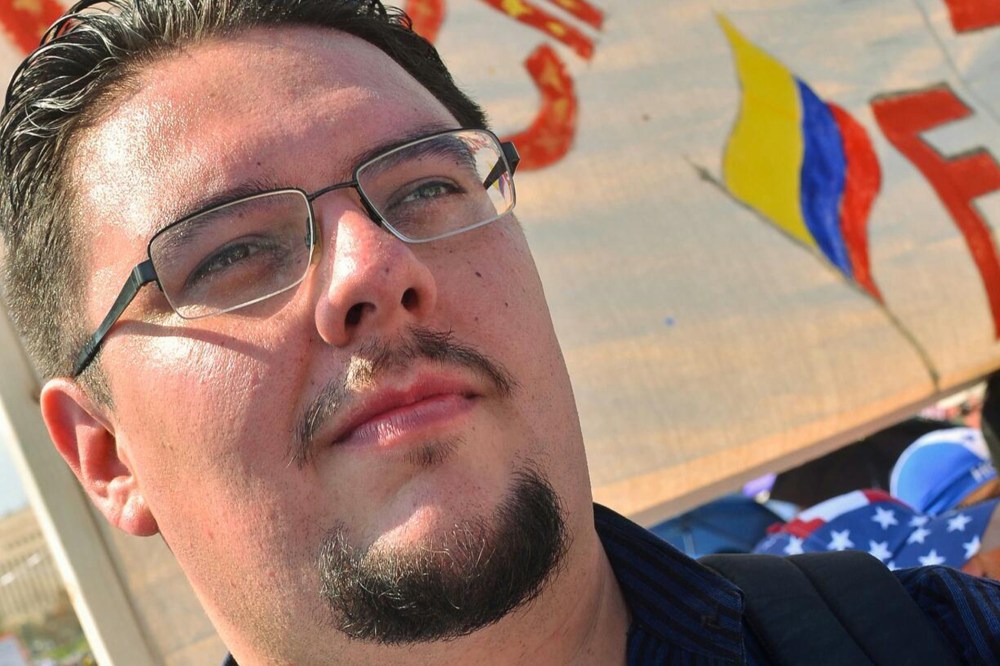
Sept. 15 marked the start of National Hispanic Heritage Month — or, as it is known in Spanish, Mes de la Herencia Hispana — a time when the United States pays tribute to the history, culture and contributions of past and present Hispanic Americans.
According to the 2010 Census, 50.5 million Americans identify as Hispanic — and that number is growing. Immigration has long been a part of America’s national history, and the role that immigrants have played — and still play — in building this country is one of the reasons “the American dream” is still shared around the world today. America is a place where new beginnings and new lives are possible.
Over the next month, msnbc.com will be profiling outstanding Hispanic activists who are making a difference in the fight for immigration reform and who are providing critical support services to undocumented communities.
%22From%20the%20death%20of%20Michael%20Brown%20to%20the%20inhumane%20treatment%20and%20deportation%20of%20Josue%20Sandoval%20in%20Missouri%2C%20these%20are%20prime%20examples%20of%20what%20happens%20to%20communities%20of%20color%20living%20under%20a%20broken%20enforcement%20system.%22′
Name: Eddie Carmona
City/State: Washington, D.C.
Occupation/Organization: Campaign manager, PICO National Network
How did you get involved with immigration advocacy?
My grandfather came to this country with all of his sons, including my father, to work the fields in California’s Central Valley. Growing up, my dad would talk to me about the inhumane conditions he lived and worked in as a farmworker. In 2003, while I attended UC Davis, I worked with a student organization named Hermanos Macehual, providing academic and social support to UC Davis students. I also worked at local migrant camps surrounding the university. Heading into my senior year, I traveled to Chiapas, Mexico, to study the effects of free trade agreements and migration in the region. Upon my return to the states in 2005, I began work as a community organizer with the PICO National Network in Santa Ana and Costa Mesa, California, and worked with undocumented families to combat local anti-immigrant policies like 287(g). Since that time, I have worked with organizers in-state to pass landmark bills like the California TRUST Act and legislation to make driver’s licenses accessible for undocumented immigrants. In 2013, I moved to Washington, D.C., to run PICO National Network’s Campaign for Citizenship.
Give us a sense of what your day looks like:
The first thing I do when I wake up is to check and see which deportation cases we are fighting across the country. This is one of my highest priorities as it keeps me grounded in the stories of families and the reason why we need immigration reform and administrative relief. I spend a significant amount of time coordinating our national immigration campaign, talking to local organizers and working with volunteers and staff to ensure alignment of our strategy and tactics across the board. This looks like phone calls, group meetings, and one-on-ones with our team members and allies. I also spend time ensuring we have the most up to date political intelligence by conducting meetings with staffers on the Hill and coordinating our D.C. presence with allies in the immigration movement. Lastly, like any other manager/director, I coordinate our work with funders and travel to our states across the country at least once a month to ensure I stay connected with our grassroots base.
What is the biggest misconception about immigration reform/undocumented immigrants?
The biggest misconception about immigration reform/undocumented immigrants is that we don’t matter. Both parties have shown that they take the immigrant/Latino vote for granted and have made political calculations to not act on reform and administrative relief this cycle because they think Latinos will not turn out to vote. That’s why PICO is working to mobilize 1 million low income Latino, Black, API, and other communities of color through our Let My People Vote campaign. Building our power for 2016 and beyond, we are urging people to turn their anger into action, by showing up at the polls and making sure both parties are held accountable for their inaction on issues of great importance to the Latino community and other communities of color.
What is your expectation of President Obama and Congress in regard to the border crisis?
Our expectation of President Obama and Congress is that they treat our brothers and sisters crossing the border with dignity and respect. While many are fleeing violence in their own countries, we are receiving children and adults crossing the border with absolute hatred and disdain. I expect both Congress and the president to do what’s right for a change and stop playing politics with the lives of immigrants. Do the right thing and stop running from your responsibility. As people of faith, we expect no less from all of our elected officials. What type of help is most needed on the ground and how can one get involved? We need to stop the mass incarceration and mass deportation of both the undocumented community and our young black and brown men. Visit our website www.piconetwork.org to find a local PICO federation in your community and get involved to stand up against local and national policies that reinforce mass incarceration/deportation. Lastly, we need to get out and vote for candidates that represent our best interest whether it be on immigration, mass incarceration or something else. We need to make sure that our elected officials hear from the community on issues that directly impact us. From Ferguson, Missouri, to Costa Mesa, California, we must continue the faithful fight for our families. Was there ever an instance where you felt defeated? What made you keep going? From opponents of immigration reform (Republicans) to lack of action by our “supposed” champions (Democrats), there have been many instances where I have felt defeated. Since the beginning of my work in 2005, I have experienced moments of disappointment and disillusionment with both parties on immigration. But what keeps me going is knowing that every day 1,100 people will be deported across this country. In many cases these are people that sit in our congregations on the weekends. These are families that are being torn apart by a system that was created to oppress communities of color. What keeps me going is knowing that we are at a point in history in this country where communities of color are being treated as “throw aways”. From the death of Michael Brown to the inhumane treatment and deportation of Josue Sandoval in Missouri, these are prime examples of what happens to communities of color living under a broken enforcement system. These real stories, these families, these communities are what keep me going. Stay in touch with Eddie on Twitter @PICOEddie and Facebook. Faith leaders arrested at Ferguson police department. Standing by for more information #FergusonOctober #BlackLivesMatter Ppl of all races, ages, faith gathered f/ #FergusonOctober #MassMeeting in #STL @OBS_StL @handsupunited_ @Sojourners pic.twitter.com/qCV5Mgy0ql
Traci Lee
Alicia Maule Recommended


