








We are witnessing an impoverished notion of debate in our society. On a daily basis, we see the two ways in which our ability to debate important issues is breaking down.
First, America’s public square has seen a coarsening of our collective discourse. Presidential debates and campaigns should be great educative moments for society. Instead we have experienced a vulgarization of the discussion that seems to find new depths as each week unfolds. The offensive and threatening language directed particularly at ethnic minorities — in particular Muslims and Latinos — returns us to a time before our legal, educational and broadcasting organizations embraced the clear meaning of our foundational documents. Sensitivity as to nuance and civility is all but missing.
%22The%20First%20Amendment%20protects%20our%20right%20to%20protest%20%E2%80%94%20not%20a%20right%20to%20disrupt.%20It%20defends%20our%20right%20to%20be%20heard%20%E2%80%94%20not%20a%20right%20to%20keep%20others%20from%20being%20heard.%22′
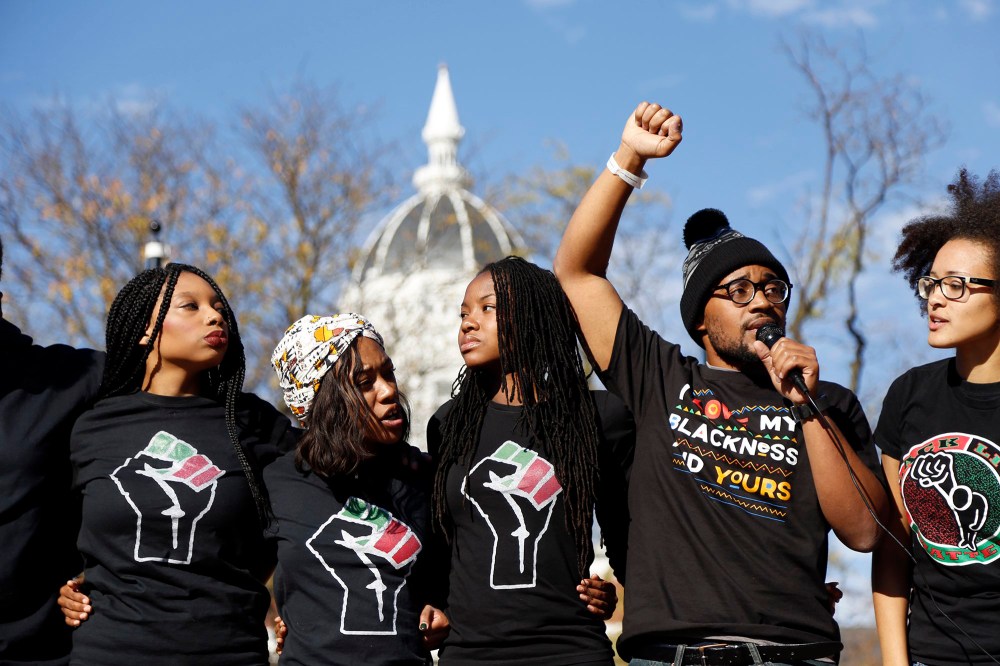
But if the public square has seen a lack of sensitivity, then many college campuses have seen the opposite effect: Like the proverbial canaries in a mine, our students seem to be the ones absorbing in a personal way the hate and opposing views with an urge to be protected, thus stifling dissent — as well as free speech. Just last week, students at Emory University, awoke to find pro-Trump messages in chalk around the center of campus. Many, instead of arguing against the substance of the Trump campaign, said that they felt threatened and demanded the the administration respond to their pain.
How do we tally seemingly opposing values to enable free speech yet foster a climate of mutual respect in our media and political rallies, as well as a sense of personal safety on our college campuses? Hampering free speech ignores our deeply held principles, yet threatening language menaces students and others. It is too easy to say that minority students should simply thicken their skin and “toughen up” and let it go at that. Justice Louis D. Brandeis gave half the solution a century ago: The answer to bad speech is more speech. And I would add the other half in our increasingly multicultural society: Let us engage in what I call “vigorous civility.”
“Vigorous civility” has a legal aspect and a social aspect. The legal side follows from our most basic freedoms. The twin rights of freedom of speech and freedom of assembly are guaranteed by our Constitution. Americans have the right to express their views as well as the right to gather to hear speakers of their choice. Those who oppose these views have a corresponding right to express that opposition and to protest, so long as they are in public venues and the rallies are open to the public.
RELATED: Obama calls for ‘cycle’ of campaign trail animosity to end
They do not, however, have a right to disrupt events. However, non-disruptive protest is clearly within their rights and that would include displaying signs, demonstrating peacefully and quietly inside the venue, and demonstrating in any lawful way outside the venue. The First Amendment protects our right to protest — not a right to disrupt. It defends our right to be heard — not a right to keep others from being heard.
“Vigorous civility” goes beyond simple protection of the strict legal rights of others; it embraces societal values as well. The fact that offensive language is and should be protected by the First Amendment does not mean that civil societies should engage in it. “Vigorous civility” includes two core principles.
%22We%20must%20disagree%20without%20questioning%20each%20other%E2%80%99s%20good%20faith%20and%20integrity.%22′ First, communities of robust disagreement must search for common ground. In some instances there may be a small overlap, but it is rare to find none. The goal here is not only achieving agreement on some issues; it is also the very process of civil discussion and debate that has a salutary effect on communal dialogue. Second, strong disagreement does not warrant delegitimization. This is not to say that there will not be hurt feelings or heated reactions during a serious conversation — there will be, especially on college campuses. But we must disagree without questioning each other’s good faith and integrity. Most of all, we must remember that campuses are places of learning, that our mission is to teach not to punish on the one side or overindulge on the other. The challenge of inclusion and diversity in an increasingly multi-ethnic and multicultural society requires that our colleges become miniature workshops of “vigorous civility.” As a civilized society, we enjoy an interwoven set of rights and responsibilities. All citizens, especially but not limited to those seeking positions of national leadership, and who already have national influence have a moral responsibility for the consequences of their words and a moral responsibility to shun speech that unnecessarily demeans others. Educators have the difficult job of adjudicating inevitable clashes that arise from the friction between diverse individuals who are just entering adulthood, who are looking for role models in this increasingly more diverse reality. To say that a form of expression is “protected speech” is an essential first question, but not the only question. There are forms of expression that may constitutionally be used, but that should not be used in a civilized society. Even as we debate the most important issues of the day, we must assert that there is a civil way for this debate to go forward. This is the essence of “vigorous civility.” Frederick M. Lawrence is Senior Research Scholar at Yale Law School and the former president of Brandeis University.
Frederick M. Lawrence Recommended


