








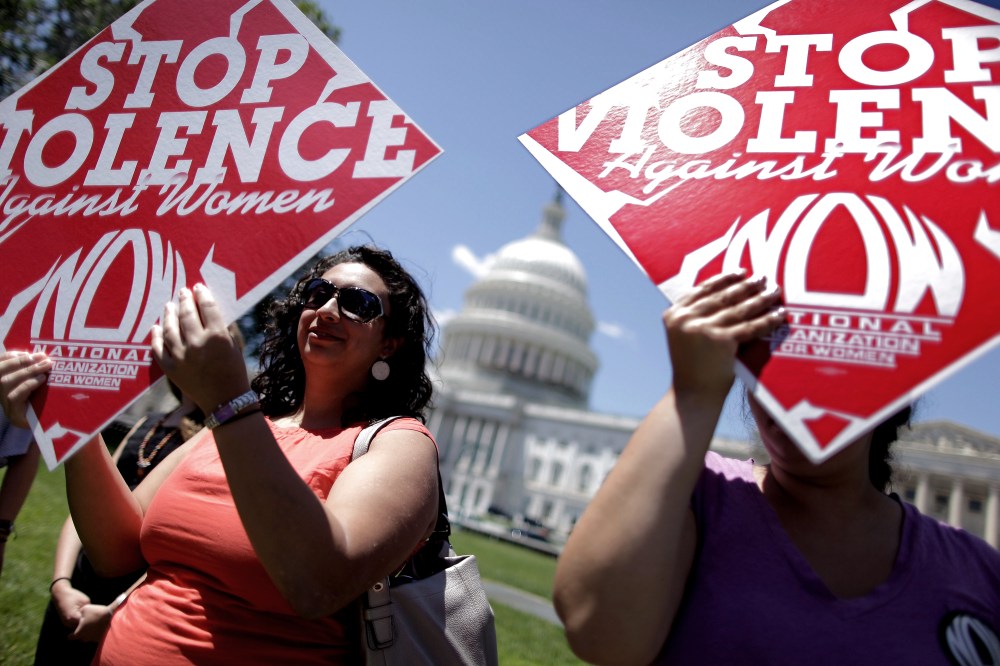
When Vice President Joe Biden celebrated the 20th anniversary of his signature piece of legislation, the Violence Against Women Act, last week, he announced a plan to attend to some unfinished business. Specifically, Biden said he would convene a summit to try and restore the ability of survivors of intimate partner violence to sue their abusers in federal court.
“I had written into the law a civil rights provision because I wanted women to be able to take control of their lives,” Biden said at an event with advocates on September 9, referring to the original 1994 version of the law. “No matter what the prosecutor said or did, even if a conviction, I wanted to be able to go into court and take away the car, the job, the money, whatever it was … because their civil rights had been violated.”
Biden’s proposed event has a name, Summit on Civil Rights and Equal Protection for Women, but no date. And such an effort faces more than one uphill battle: The measure he authored allowing survivors to sue would have to be restored in different form, because in 2000, a divided Supreme Court said it was unconstitutional.
The revised provision would also have to get through a recalcitrant Congress. And given the barriers to effective, victim-centered criminal prosecution – most recently on display in the Ray Rice case, where his wife Janay was arrested and briefly charged with assault despite having been knocked unconscious by the NFL star – it’s not clear that what’s known as a civil rights remedy is even a priority for survivors or advocates.
On some advocates’ wish-lists: Relying less on the courts and the criminal justice system, or more ways to hold institutions accountable, including through litigation. But the Supreme Court has also made institutional accountability that much harder in such cases.
In the audience listening to Biden that day was Julie Goldscheid, now a professor of law at the City University of New York. She represented Christy Brzonkala before the Supreme Court in 2000 in the case that struck down the civil rights remedy.
As a student at Virginia Tech, Brzonkala sued two varsity football players, Antonio Morrison and James Crawford, under that part of the Violence Against Women Act. Brzonkala hadn’t found the justice she sought from the university, even though Morrison “admitted to having sexual contact with her despite the fact that she had twice told him ‘no,’” in the words of the Supreme Court. A school investigation said there wasn’t enough evidence in the case of Crawford.
Morrison got a two-semester suspension for sexual assault – which, through a series of administrative interventions, got reduced to “using abusive language” and then to no time off at all. When Brzonkala found out Morrison would be back on campus and playing football, she dropped out – and sued under the civil rights remedy of the Violence Against Women Act. (She also filed a Title IX complaint against the university, which was later settled.)
Morrison was represented before the high court by the Center for Individual Rights, a conservative public-interest law firm which argued that the provision of VAWA under which Brzonkala had sued was unconstitutional. A conservative majority, led by Chief Justice William Rehnquist and including Justices Antonin Scalia, Clarence Thomas, Anthony Kennedy, and Sandra Day O’Connor, agreed. They struck down the civil rights remedy, which like many other federal laws had been justified under the Commerce Clause of the constitution as regulating interstate economic activity.
“Gender-motivated crimes of violence are not, in any sense, economic activity,” Rehnquist wrote.
Justice David Souter, joined by the court’s liberal justices, begged to differ. They quoted a Senate report that stated “gender-based violence bars its most likely targets–women–from full [participation] in the national economy.”
It was a blow to a key provision of VAWA, though it did not affect the bulk of the law, which was last reauthorized in 2013. The point of the civil rights remedy, Goldscheid told msnbc, had been to “help shift public perception of domestic and sexual violence from a private matter to a civil rights issue.”
Survivors of such violence often find little justice in criminal proceedings, whether they want to bring charges or not. “One of the limits of the criminal justice system is that the case is not controlled by the survivor,” said Goldscheid. “In the civil claim, the survivor would have control of the lawsuit.”
Another advantage of the federal law: Given the patchwork of state laws surrounding civil suits, survivors may live in a state that doesn’t allow them to sue for compensatory damages. The idea behind a federal law, explained Goldscheid, was that “their ability to recover shouldn’t depend on which state they lived in.” During the six-year period it existed, Goldscheid said, the civil rights remedy was used mostly successfully by about 60 survivors.
But the such remedies had critics among usual allies. For one thing, the same reasons that might induce a victim to not want to cooperate in an investigation against her intimate partner – including wanting to reconcile, or not wanting to be enmeshed in an often racially-biased judicial system – might apply. For another, said Caroline Bettinger-Lopez, a visiting professor at The University of Chicago Law School, “It’s subject to the same problem as domestic violence prosecution – it’s all focused on the perpetrator. It’s a way for the government to push aside the systemic issues and put it on an individual.” Systemic accountability became that much harder in 2005, thanks again to the Supreme Court with the tragic case of Castle Rock v. Gonzales. Jessica Gonzales had had a protection order against her estranged and abusive husband. When he kidnapped their three daughters, she repeatedly pleaded with the police department in her Colorado town to enforce the order, even telling them his location. She was ignored. Her husband showed up at the police station, shooting, and was killed in the shootout. The three girls’ dead bodies were found in the husband’s car. Gonzales sued the police department in federal court, but in a decision written by Justice Antonin Scalia, the Court held that she had no case against the police. As Scalia put it, “We do not believe these provisions of Colorado law truly made enforcement of restraining orders mandatory. A well established tradition of police discretion has long coexisted with apparently mandatory arrest statues.” (Justices John Paul Stevens and Ruth Bader Ginsburg dissented, saying that the whole point of mandatory arrest policies was that in domestic violence cases in particular, police discretion was supposed to be taken off the table.) “It definitely sent a message to law enforcement nationwide that restraining orders don’t need to be respected,” said Bettinger-Lopez, who has been working with Jessica Gonzales, now Jessica Lenahan, for a decade, including before the Inter-American Commission on Human Rights. “Individuals can still bring equal protection lawsuits against police departments, [but] the legal hurdles are high—a plaintiff must prove intentional discrimination,” Bettinger-Lopez said. Advocates have been cheered, however, by the Obama administration’s push to hold institutions accountable under Attorney General Eric Holder’s investigative powers at the Justice Department. That effort includes Title IX investigations of campuses for how they handle sexual assault, as well as an agreement recently reached with authorities in Missoula County, Montana after allegations the county had mishandled numerous sexual assault investigations. There have also been investigations of New Orleans, Puerto Rico, and Maricopa County, Arizona law enforcement agencies, including on how they have handled sexual assault. Of course, unless more specific mechanisms are written into law, as the civil rights remedies were, such investigations can vary by each administration’s priorities. That is unlikely to change. “If it’s politically challenging to find a hook to sue abusers,” said Bettinger-Lopez, “how much more challenging would it be to find a hook to sue the cops?”
Irin Carmon Recommended


