








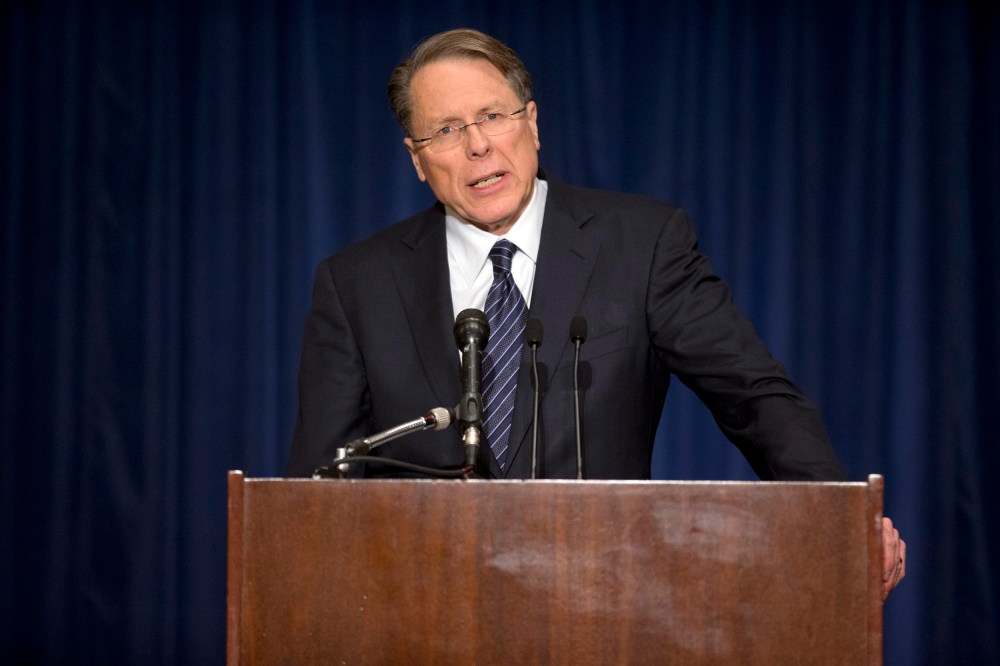
On Wednesday, the National Rifle Association’s chief executive officer for the past 22 years, Wayne LaPierre, will testify with other witnesses, including Mark Kelly, whose wife, former Rep. Gabrielle Giffords is still recovering from a bullet-wound to the head, before the Senate Judiciary Committee. Coming less than a week after Sen. Dianne Feinstein announced what would be, if passed, America’s most sweeping ban on “assault” or military-style semi-automatic weapons, and nearly seven weeks after the Newtown, Connecticut elementary school shooting shocked the nation, the stage is set to debate American gun policies.
NRA leaders have testified to Congress before, and they have supported –as strange as that may seem today– major gun control legislation. Today’s NRA, however, strikes a remarkably different tone. One whose interpretation of the Second Amendment seems to put it to the right of not only most Americans, including most gun owners, but also the Roberts Supreme Court and even Justice Antonin Scalia, the most conservative of the justices. The NRA’s current view of the Second Amendment places it closer to extremist groups such as the one that helped inspire America’s worst act of domestic terrorism.
“Absolutes do exist,” NRA Executive Vice-President and Chief Executive Officer Wayne LaPierre told supporters last week in Reno, Nevada. “We believe in our Bill of Rights. And we believe in our Second Amendment, all of our Second Amendment. Because we believe in the freedom and safety that it, and it alone, guarantees absolutely.”
Today’s generation of NRA leaders have long maintained that the Second Amendment guarantees citizens the right to access arms to be able to deter, if not overthrow, any future tyrannical government.
“Our Founding Fathers wrote the Second Amendment so Americans would never have to live in tyranny,” LaPierre told U.N. officials in July less than two weeks before the movie theater shooting in Aurora, Colorado left 12 people dead and 58 wounded. “When you ignore the right of good people to own firearms to protect their freedom, you become the enablers of future tyrants whose regimes will destroy millions and millions of defenseless lives.”
The old NRA, by comparison, sounds like another organization. Back in 1934 Prohibition had just ended and many Americans felt that the era of gangsters firing fully-automatic, drum-fed Tommy Guns, killing rivals and innocent bystanders alike, also needed to end. Sounding nothing LaPierre today, then-NRA chief executive officer Karl T. Frederick told Congress:
“I have never believed in the general practice of carrying weapons. I do not believe in the general promiscuous toting of guns. I think it should be sharply restricted and only under licenses.”
The National Firearms Act of 1934 was America’s first major federal gun control law, passed, in the words of one scholar, to “prevent the criminal class from using firearms.” The act tightly restricted short-barreled rifles and shotguns along with all fully-automatic weapons, and imposed taxation on their manufacture and distribution along with their registration down to every buyer.
Congress passed the nation’s next major gun law in the late 1960s, after guns undeniably helped foster some of the decade’s political tension and violence. The single, bolt-action rifle used to assassinate President John F. Kennedy had been bought by mail order through the NRA’s American Rifleman magazine. Soon, Black Panther leaders were attracting attention by openly carrying handguns and rifles in California. Other weapons were later used to assassinate both Martin Luther King, Jr., and Senator Robert Kennedy.
“We do not think that any sane American, who calls himself an American, can object to placing into this bill the instrument which killed the president of the United States,” the NRA’s then chief executive officer, ret. Gen. Franklin L. Orth, told Congress. The Gun Control Act of 1968 prohibited interstate arms sales, and imposed a complete ban on fully automatic weapons. “The National Rifle Association has been in support of workable, enforceable gun control legislation since its very inception in 1871,” Orth explained to the NRA’s own members in the March 1968 issue of American Rifleman.
But a group of hardliner gun rights advocates saw Ret. Gen Orth’s position as a sell-out of the Second Amendment, and they began plotting their way to power, prevailing in1977 at the NRA’s annual convention in Cincinnati. Soon the new leaders put up an abridged version of the Second Amendment at the NRA’s Washington, D.C. headquarters, heralding the people’s right to keep and bear arms while dropping the preceding clause in the same sentence referring to a well-regulated militia.
For the next two decades, the NRA’s internal debate boiled down to two questions. First, whether to try and repeal the ban on fully automatic weapons, or let it stand while allowing no other gun control regulations. Second, whether to openly talk about repealing the ban on fully automatic or military weapons. (A chronology of U.S. laws concerning “Fully-Automatic Firearms” compiled in 1999 and still posted on the website of the NRA’s lobbying wing is sympathetic to a Georgia man who unsuccessfully tried to register a fully-automatic weapon in 1986.)
One NRA board director, Neal Knox, openly campaigned to legalize fully-automatic weapons. A conspiracy theorist and gun magazine columnist, he warned that the assassinations of both Kennedy brothers and King that helped lead to their complete banning could well have been somehow staged with “drugs and evil intent” to disarm America. Today, as if to echo his bizarre theories, gun rights advocates are spreading elaborate theories on the Internet claiming that the shootings at Sandy Hook Elementary Schooland the shooting in Gifford’s Tucson district in 2011, were both connected and staged as part of a new plot to disarm America.
LaPierre became the NRA’s operations chief in 1991, right before a series of botched raids by U.S. agencies over illegal guns. In 1992 federal charges related to the sale of two illegal, sawed-off shotguns eventually led to a federal raid in Ruby Ridge, Idaho resulting in the wounding of two men, one of whom, Randy Weaver, was a white supremacist, and the killing of his wife and their son along with an agent of the U.S. Bureau of Alcohol, Tobacco and Firearms(ATF). But it was another federal siege, this one over illegal, fully-automatic firearms, less than a year later that became a call to arms for Second Amendment absolutists. In February 1993, federal ATF agents attempted to serve a search warrant for the fully-automatic firearms at the compound of a small religious sect known as the Branch Davidians in Waco, Texas. After a 50-day stand-off, ATF agents launched an assault, and the ensuing firefight–along with a fire of still unclear origins–resulted in the deaths of at least 74 people including 25 children. LaPierre wrote unambiguously in his first book, published in 1994: “[T]he people have a right…to take whatever measures necessary, including force, to abolish oppressive government.” The same year Congress passed a ten-year ban on assault weapons. The following spring, on April 13, 1995, LaPierre signed a fund-raising letter to NRA members: “The semiauto ban gives jack-booted government thugs more power to take away our constitutional rights, break in our doors, seize our guns, destroy our property, and even injure or kill us.” But the timing was unfortunate for his cause. Six days later, on the second anniversary of the Waco siege, Timothy McVeigh, a longtime NRA member who cited the Waco debacle as a motive, and an accomplice, used a fertilizer bomb hidden in a truck to blow up the federal building in Oklahoma City killing 168 people, including 19 children under the age of six, Within a month of the bombing, LaPierre apologized for his “jack-bootedthugs” reference, after former President George H.W. Bush, an NRA Life Member, resigned over the fund-raising letter. But few other NRA members followed suit. Instead, the NRA has increased from three million members in the 1990s to more than four million members today. In 2008 the Roberts court made a watershed decision in the District of Columbia v. Heller, reaffirmed in 2010 for the rest of the nation, to uphold an individual’s right to keep a gun, in this case a Glock semi-automatic pistol, in his home for self-defense. The NRA welcomed that part of the decision. But the majority decision written by Justice Scalia still allows for government controls such as regulating commercial gun sales, prohibiting guns from places like schools, and banning unspecified “dangerous and unusual weapons.” The NRA seems to have ignored that part of the decision. How far does the NRA’s absolutism go when it comes to the Second Amendment? “[T]here is no such thing as a free nation where police and military are allowed the force of arms but individual citizens are not,” wrote LaPierre in his 2003 book. Most police today carry semi-automatic pistols, and all U.S. military forces are equipped with fully-automatic rifles—following LaPierre’s logic that would require citizens to also have access to those weapons. So what should Chairman Patrick Leahy of Vermont, representing a rural, hunting and gun owning state, and other senators ask LaPierre Wednesday?
Frank Smyth Recommended


