








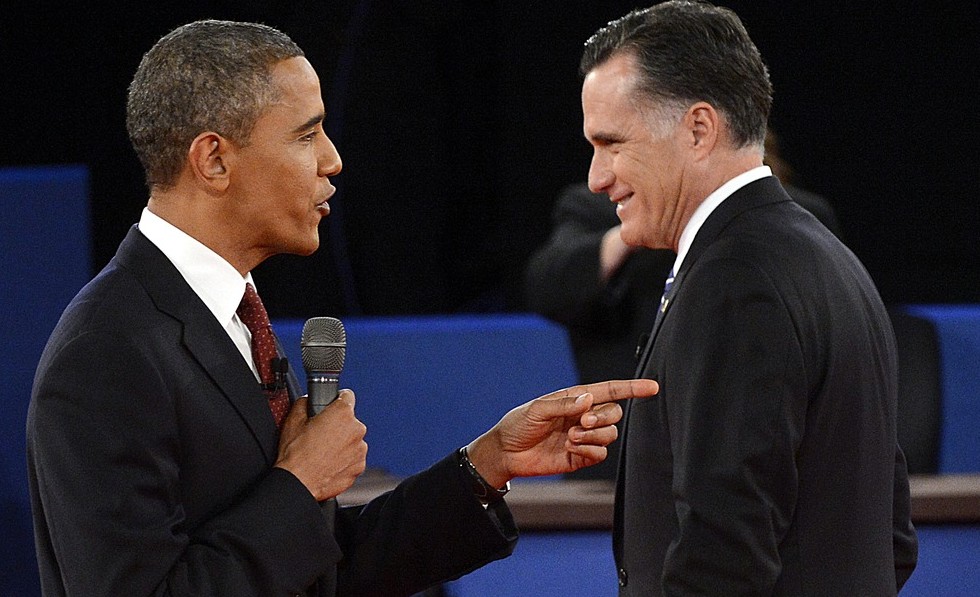
Everyone knows Barack Obama doesn’t get angry very often. But at Tuesday’s presidential debate, he got even.
Obama unveiled a series of detailed, slashing attacks on Mitt Romney, pressing the Republican presidential nominee on the holes in his tax plan and the size of his personal wealth.Democrats had complained that an image of a “Moderate Mitt” emerged from the first debate. For the rematch, the president introduced voters to Radical Romney, a right-winger who occupies a “more extreme place” than even former president George W. Bush.
Romney didn’t take anything lying down, though.
Deploying a classic debating technique, the Republican nominee repeatedly confronted Obama with leading questions. By lobbing aggressive inquiries, a candidate can set the agenda even after he stops talking, and if opponents don’t reply, they risk appearing evasive. The tactic does violate the debate rules. Few voters know that, however, and even fewer probably care. So Romney went on a tear.
He asked Obama whether the government should try to “lower gas prices.”
He asked Obama to quantify cuts to federal energy permits. Then he repeated the question five times, for good measure, in a string of interruptions that grew intensely awkward.
Romney questioned Obama on why he refused to “promote” a bill advancing legal immigration. “That’s a question I think the president will have a chance to answer right now,” Romney said, channeling a whiff of suspense about whether the trap would work. When it didn’t, Romney went further, suggesting that a nation of immigrants had his back: “I asked the president a question I think Hispanics and immigrants all over the nation have asked.”
Obama parried the pressure and largely stayed above the fray. He never bothered to mention that Romney was breaking the debate rules. Instead, the president turned to a bigger breach. Romney’s economic plan applies a “different set of rules” to “folks at the top,” Obama argued.
In a contrast from the first presidential debate, Obama brought his own debate tricks, too. He saved the most cutting attack of the night – Romney’s 47% remarks that trashed soldiers, veterans, and seniors as “victims” – for his closing statement. This left Romney with no opportunity for a rebuttal.
While much is made of the “big moments” in debates, a clear theme on debate night can also anchor voter perceptions of what an election is about.
At the first debate in Denver, for example, Romney marched Obama on to the terrain of taxes and government. There were over twice as many references to taxes as jobs (108 to 50) that night – a remarkable feat of framing in a recession election.
In Tuesday’s debate those numbers were roughly even. That sudden swing reflects a more disciplined performance by Obama. In his first answer of the night, in fact, Obama managed to say “jobs” eight times. The other key theme came from the bottom up: An adversarial question about inadequate security at the U.S. consulate in Libya lobbed at the president. What could have been a difficult topic for the incumbent – second-guessing the response to a tragic attack – swiftly morphed into an exchange that reinforced the president’s leadership, and exposed his challenger’s loose grip on the facts of foreign policy. Romney wrongly charged that Obama waited two weeks to declare the Libya attack an act of terror. The president crisply corrected him – “Get the transcript” – a point echoed by moderator Candy Crowley in an unusual, live fact-check. The dispute sealed Obama’s comeback as a debater, but it did much more than that. Voters will decide whether Romney was mistaken or lying, but the maneuver followed an earlier false attack Romney levied against the president immediately after the terror strike. This is reckless foreign policy and risky politics. In the end, the Libya discussion did more than any other topic to unearth that dark, recurring theme from Romney’s detractors in both parties: that he cares more about himself than any particular policy or any particular facts. This perception could be tough to shake in the final debate.
Ari Melber
Ari Melber, an Emmy Award-winning journalist, writer and attorney, is the host of “The Beat with Ari Melber” airing nightly at 6 p.m. ET on MSNBC. He also serves as MSNBC’s chief legal correspondent and an NBC News legal analyst. Before joining MSNBC, Melber practiced First Amendment law and served as a legislative aide in the U.S. Senate. He received a J.D. from Cornell Law School and is a member of the New York Bar. Recommended


