








In the end it may have been Kalief Browder’s short life and tragic death that finally freed the very young from isolation in American prison cages. At 16, he was accused of stealing a backpack and sent to New York’s infamous Rikers Island to await trial. During his stay he was brutalized by guards and inmates alike and spent nearly two years in solitary confinement.
A few years after being incarcerated, he was released — without a trial. From the day he stepped foot back into freedom, Browder’s life was a nightmare, unable to shake the terror of what he’d experienced behind bars and in that dark box, locked down for up to 23 hours a day. He started going to community college but had trouble staying in class. He tried killing himself on multiple occasions, but each time survived, ending up in a hospital psych ward.
RELATED: Obama to end solitary for juveniles in federal prisons
Then one day last summer, Browder, then 22, pushed an air-conditioning unit out of a second floor window at his parent’s home in the Bronx. He tied a cord around his neck and pushed himself through the window feet first.
Browder’s life, death and struggles after being released from jail sparked the kindling of criminal justice reform that had been simmering for years, drawing together wide bi-partisan support for cinching the pipeline to prison that has funneled through it countless young men and women from poor communities across the country.
On Monday, when Obama called for an end to the practice of solitary confinement for juveniles, he did so evoking Browder’s name.
“Solitary confinement gained popularity in the United States in the early 1800s, and the rationale for its use has varied over time. Today, it’s increasingly overused on people such as Kalief, with heartbreaking results — which is why my administration is taking steps to address this problem,” Obama wrote in the Washington Post, announcing the ban.
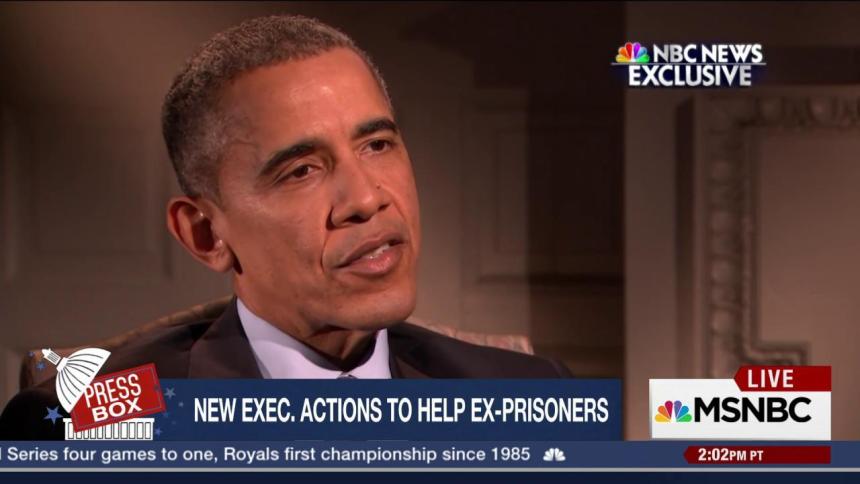
Moved to action by the horror stories of trauma and abuse suffered by juveniles locked up in isolation, Obama sought to continue laying the groundwork for broad criminal justice reform, but also, perhaps, to solidify his legacy as a president that firmly pressed his thumb to the scale of social inequity.
In a series of executive actions, Obama this week sought to taper a long and controversial era of crude law enforcement tools employed en masse during the so-called War on Drugs, which ushered in an era in mass incarceration.
His move on Monday to end solitary confinement of young inmates in federal prison is limited given the relatively low number of juveniles in federal custody, but many who’ve been advocating on behalf of youthful offenders hope the ban will push states to enact similar bans in their prisons, which house the vast majority of juvenile inmates.
The White House estimates that 10,000 inmates would be covered under the new executive actions, representing just a small fraction of the 100,000 prisoners held in solitary confinement on any given day.
As recently as 2012 there were more than 57,000 juvenile offenders locked away in jails and prisons across the country, according to the Justice Department. Many of these juveniles — under the age of 18 — are held in solitary confinement, alone and often in small cells with limited natural light and limited human contact for up to 22 hours a day.
RELATED: Juveniles sentenced to life in prison given a second chance
The long-term emotional and psychological effects can be damning on a hardened adult prisoner, let alone a teenager whose psyche is still being shaped.
“Research suggests that solitary confinement has the potential to lead to devastating, lasting psychological consequences,” Obama said. “It has been linked to depression, alienation, withdrawal, a reduced ability to interact with others and the potential for violent behavior. Some studies indicate that it can worsen existing mental illnesses and even trigger new ones.”
For years the United States stood out in its acceptance of solitary confinement for juveniles, a practice that the United Nation’s has condemned as torture, and a practice that is widely prohibited around the world.
Banning isolation for the most vulnerable within prison populations— including juveniles and the mentally ill— has been years in the making, buoyed by bipartisan support of reform in Congress and a new willingness to rethink how even the most hardened of juveniles should be punished.
“President Obama’s decision to ban solitary confinement for youth of 16 and 17 puts a spotlight on what we know to be true: juveniles are not adults and should not be treated like adults in the criminal justice system,” said Jennifer March, executive director of the Citizens’ Committee for Children of New York.
For some, reform is seen as a moral obligation, while for others it’s a fiscal one. As states in recent years have faced steep budget shortfalls, housing and feeding low-level offenders for long sentences simply became too costly.
Some states have already taken up the cause, though, while at times pushed in a corner. A pair of lawsuits in Oregon and Illinois have prompted prison officials to exclude mentally ill inmates from facing isolation. New York last month reached a $62 million settlement with the ACLU and agreed to dramatically reduce its solitary confinement population and cut the maximum amount of time inmates can spend in isolation. Ohio reached an agreement with the DOJ in 2014 after federal investigators found that at least 229 boys with mental-health problems were kept in solitary confinement for almost 60,000 hours over a six-month period.
“The president is leading the way for other states to follow suit,” said Alida Merlo, an expert in juvenile justice policy and professor at the Indiana University of Pennsylvania. “It’s very odd to think that in 2016, we’re debating if we should be banning solitary confinement for children. It shouldn’t have to be on the agenda.”
%22Juveniles%20are%20not%20adults%20and%20should%20not%20be%20treated%20like%20adults%20in%20the%20criminal%20justice%20system.%22′
Public shock and outrage over Browder’s death spanned the political spectrum, setting the stage for criminal justice reform to emerge as a central pillar to the issues shaping the 2016 presidential race. Out on the campaign trail, Republican Sen. Rand Paul of Kentucky incorporated Browder’s story into his stump speech. Other candidates have focused broadly to overhaul a system that disproportionately impact communities of color.
The timing of Obama’s push for criminal justice reform also pairs with historic efforts in Congress to adopt bi-partisan legislation before the end of the year. A bill to reduce prison sentences for nonviolent offenders has the crucial backing of key players from both parties, making hopes of achieving significant reform more than just a pipe dream.
There’s still a minefield of obstacles ahead that Congress will have to navigate with deft footing in order to pass meaningful reform. Rather than wait for Congress, Obama’s measures this week go even further than legislative proposals on solitary confinement for juveniles.
The drive to treat juveniles differently in the system now extends to all branches of the federal government. Obama’s announcement comes on the same day that the Supreme Court decided that convicted killers sentenced to life in prison as juveniles must have the chance to argue for parole.
RELATED: Recent prisoners navigate an unfamiliar world
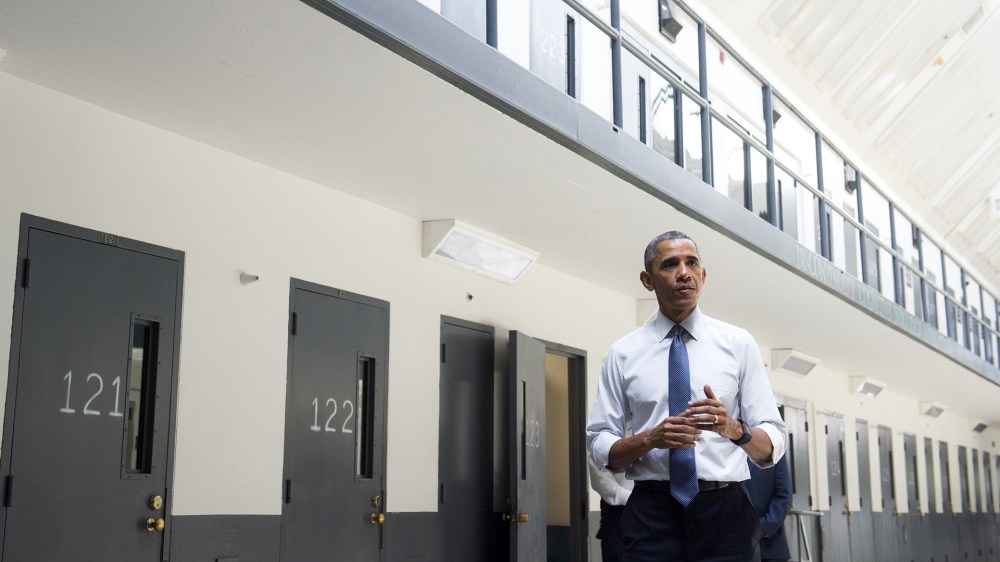
The Justice Department’s report and recommendations to the Federal Bureau of Prisons include ending juveniles placed in restrictive housing, the diversion of inmates with mental illness to mental treatment programs, diverting more inmates from “protective custody” to less restrictive forms of housing, and significantly limiting the use of restrictive housing (solitary confinement) as a form of punishment. “In some systems, the conditions can be severe; the social isolation, extreme,” the Justice Department said in its report on limiting the use of solitary confinement. “At its worst, and when applied without regard to basic standards of decency, restrictive housing can cause serious, long-lasting harm.” The report went on to say that the safety of correctional officers and prison staff also needs to be maintained, but “We do not believe that the humane treatment of inmates and the safety of correctional staff are mutually exclusive; indeed, neither is possible without the other.” %E2%80%9CThese%20are%20young%20people%20who%20made%20mistakes%20that%20aren%E2%80%99t%20that%20different%20than%20the%20mistakes%20that%20I%20made%2C%20and%20the%20mistakes%20that%20a%20lot%20of%20you%20guys%20made.%22′ In the fourth quarter of his presidency Obama has taken aggressive steps toward criminal justice reform, particularly in addressing the wide racial disparities in the system. Over the summer, Obama became the first sitting president to visit a federal prison. During his visit and tour of El Reno Federal Correctional Institution in Oklahoma he sat with a group of inmates and talked with them about their experiences behind bars, their struggles and hopes for redemption. The visit seemed to bolster, if not solidify, Obama’s vocal support for undoing the tangle of systems that have disproportionately ensnared millions of poor black and brown people across the country. “These are young people who made mistakes that aren’t that different than the mistakes that I made, and the mistakes that a lot of you guys made,” Obama told reporters after his visit. “The difference is they did not have the kinds of support structures, the second chances, the resources that would allow them to survive those mistakes.” Andra Gillespie, an associate professor of political science at Emory University, described the president’s executive actions, “another building block, an incremental step.” “But I do think he is sensitive to some of the stories that have come out about criminal justice disparities, in particular how those disparities affect African-Americans,” she said. The seeds of such wide-ranging reform began when in 2010 Obama signed a law narrowing the cocaine sentencing disparities. Under the old law, a person caught with five grams of crack cocaine received a mandatory sentence of five years in prison. But a person caught with powder cocaine needed 500 grams to receive the same sentence. Crack is a cooked version of powder cocaine which sells for much cheaper than its uncooked counterpart. While crack appealed to poorer users, powder remained a favorite of the wealthy. The new law reduced the 100-to-1 disparity to 18-to-1. RELATED: 6,000 Federal prisoners to be granted early release In 2014, then-Attorney General Eric Holder announced his support for a Justice Department plan to retroactively recuse the sentences of some federal prisoners locked up under the old crack-era guidelines. The administration said the plan could shorten the prison time for as many as 20,000 inmates. At the time 50 percent of the 216,896 inmates held in federal detention were incarcerated on drug offenses, compared to about 16 percent who were incarcerated for weapons offenses. Just 2.8 percent are locked-up for homicide, aggravated assault and kidnapping convictions. Many of the Obama administration’s reforms grew from the president’s My Brother’s Keeper initiative, his hallmark program aimed improving the prospects and outcomes of young men and boys of color. The program pooled hundreds of millions of dollars in private foundation money and tied in technical and logistical administration resources. The efforts have included funding for supportive housing for the reentry population returning from prison, including juveniles, and second-chance programs directed at giving rehabilitated youth offenders an opportunity to enter the workforce. Last year he commuted the sentences of dozens of non-violent offenders who he believed were unfairly sentenced under harsh crack-era mandatory minimum sentences. The Justice Department in October cut the sentences of about 6,000 federal inmates in the largest one-time release from the federal prison system. The move was aimed at reducing overcrowding, but was also another nod at the harsh treatment many low-level and non-violent offenders have faced since the so-called War on Drugs began in the 1980s. The president’s visit to the federal prison, his dismantling of antiquated and unfair sentencing laws, his efforts to boost the lives of young men of color and even his stirring eulogy for the churchgoers who were gunned down by a white supremacist at Mother Emanuel Church in Charleston, South Carolina, over the summer, all seem to speak to a focus on race relations and criminal justice that could carry on for Obama well after he leaves office. “I think of this in the context of some of the comments President Obama made in his State of the Union Address, when he talked about how we were not going to realize some of these policy changes during the course of his presidency. That it was going to take a long time,” Gillespie said. “But he also said he was going to lay the groundwork for a policy agenda that future administrations could take on.”
Trymaine Lee
Trymaine Lee is an NBC News correspondent.
Amanda Sakuma Recommended


