








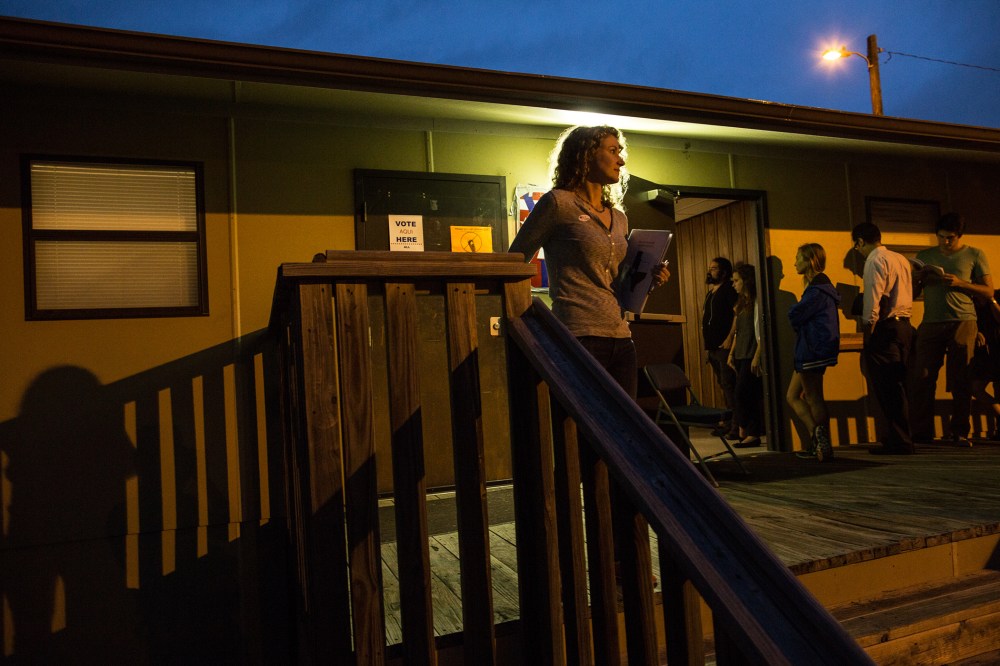
Both sides are already making claims and counterclaims about the impact of Texas’ strict voter ID law in last week’s election.
There’s no question that some legitimate voters were disenfranchised by the law. But how many? Perhaps a large number — but the truth is, nobody knows.
The difficulty of gauging the law’s effect, at least in the election’s immediate aftermath, points to an irony that has characterized the voter ID controversy nationally: Though lawyers challenging ID measures have marshaled reams of compelling evidence to show how they could keep voters from the polls, individual elections are not well-suited to demonstrating the impact.
RELATED: Texas sees surge in disenfranchised voters
That’s not stopping partisans from jumping into the debate. At a post-election event last week, Gilberto Hinojosa, the chair of the Texas Democratic Party, said the ID law was “a large part of the reason” for the decline in turnout compared to 2010 (though he also said that Texans who didn’t turn out “need to look at yourself in the mirror”). His Republican counterpart, Steve Munisteri, just as confidently dismissed the idea.
Around 600,000 registered Texas voters don’t have one of the limited forms of ID that the law allows, according to evidence presented in the legal challenge to the law, which was brought by civil rights groups and the Justice Department. The state did almost nothing to challenge that assessment. That means there’s no doubt whatsoever that the law disenfranchised legitimate voters. MSNBC met with several of them last week.
There is also no serious doubt that the number of disenfranchised voters exceeds the amount of fraudulent votes the law stopped. Texas has been able to point to just two fraudulent votes since 2000 that would have been prevented by the ID law.
Still, it’s also important to know how many people we’re talking about — and whether any major races were affected. That, however, is hard to determine with much certainty.
Few claim that the ID law affected Texas’ governor’s race, in which Republican Greg Abbott beat Democrat Wendy Davis by about 958,000 votes. But Republican Will Hurd won Texas’ only competitive House race by just 2,500 votes, ousting Democratic Rep. Pete Gallego. If Texans without acceptable IDs were spread evenly throughout the state’s congressional districts, approximately 17,000 registered voters in that district lacked IDs.
It’s impossible to say how many of them would have voted, and by what margin, if any, they’d have voted Democratic. But it’s plausible that the number would have exceeded the margin of Hurd’s victory.
To say anything more conclusive requires gauging the law’s impact on turnout. But even careful efforts to do that with regard to other ID laws have produced a murky picture.
A recent Government Accountability Office study found that voter ID laws in Tennessee in Kansas depressed turnout by around 2 percentage points each in 2012. But other analyses have found no significant impact. Perhaps the most authoritative report — a 2009 project that aimed to summarize the results of several existing studies — concluded that the available data just doesn’t allow for firm conclusions to be drawn in either direction.
RELATED: The real stories behind voter ID laws
Texas’ election last week offers a similarly confusing takeaway.
There’s a plenty of evidence to suggest that the voter ID law — which was struck down by a federal judge, then approved by the Supreme Court just days before early voting began — had a significant impact. For starters, turnout dropped to 33.6%, down from 37.5% in 2010 — a decline of 271,000 voters. That happened despite a high-profile governor’s race, and an increase of 700,000 in the number of registered voters.
And even though turnout was lower, the number of provisional ballots doubled. That might be attributable to voters who lacked acceptable ID, since the law allows such voters to cast a provisional ballot. (In order to make those ballots count, the voter needs to return soon with valid ID, something few would be likely to do.) But before concluding with certainty that the law kept hundreds of thousands of would-be voters from the polls, it’s worth keeping a few things in mind. First, turnout declined everywhere. The national drop — from 40.9% in 2010 to 36.4% this year — wasn’t much different from Texas’ decline. In fact, at least 10 other states, and probably far more, saw bigger voter drop-offs from 2010 than Texas did. According to numbers compiled by PBS, nine states saw declines of more than 20% in their top-of-the-ticket races. Mississippi’s drop of 19.7% was the 10th biggest — at 11.2%, Texas’ was significantly smaller. RELATED: Voter turnout drops to historic lows At the root of the problem is the reality that it’s difficult to compare one election to another, because the other relevant conditions aren’t the same. What portion of the decline in Texas’ turnout from 2010 was caused by the ID law, compared to the portion caused by, say, a mood of frustration about politics? It’s difficult to say. “The relevant question is: how many people who WANTED to vote this year DID NOT DO SO (and reasonably could not have done so) BECAUSE of the changes in the voting rules?” wrote Rick Hasen, a leading election law scholar at the University of California, Irvine, last week. Hasen added that any analysis of the question would need to control for a decline in turnout “for reasons unrelated to these laws (e.g., less enthusiasm in a midterm election year without an African-American candidate on the ballot).” Hasen was responding to claims made by voting rights advocates about the impact of North Carolina’s restrictive voting law, but his point applies equally to the Texas ID law. Detailed studies that look closely at county- or precinct-level data and attempt to control for those outside factors might begin to shed light on the law’s impact. But those studies are yet to be done. What’s clear now, though, is that the law deprived some voters — very plausibly a number in the tens of thousands, if not more — of their most basic democratic right. That’s a reason for enormous concern, no matter how many people, or election results, were affected.
Zachary Roth Recommended


