








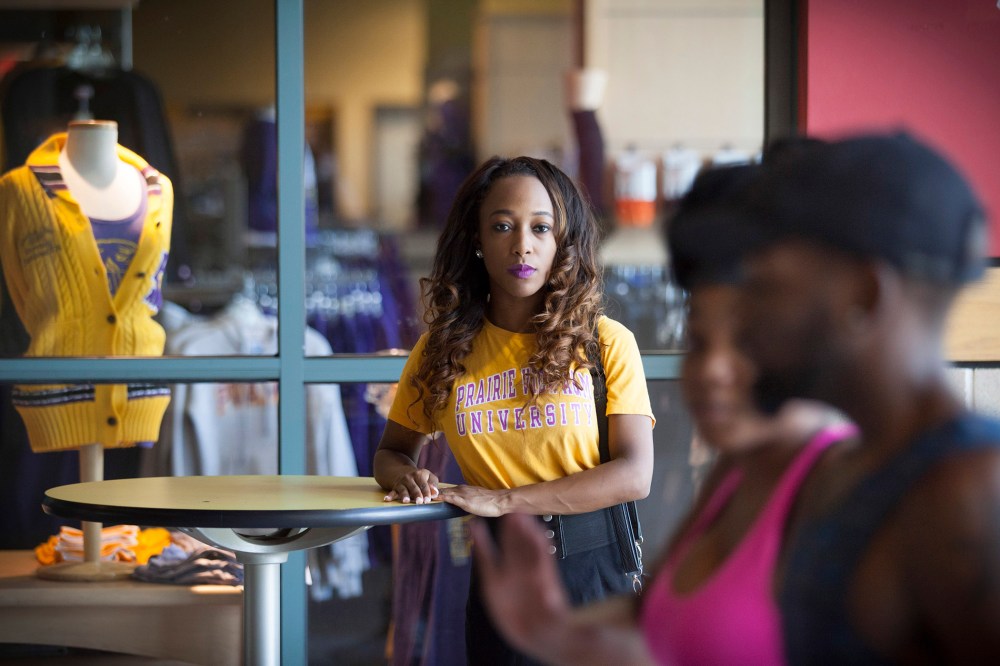
HOUSTON – A day before Texans go to the polls, an unusual group gathered for lunch at a Mexican restaurant not far from downtown: an unemployed African-American grandmother; a University of Houston student originally from Pennsylvania; a pregnant mother who had recently moved back to the area with her family; and a low-income white woman who struggled to make eye contact and kept her money in a pack strapped around her waist.
RELATED: Can Democrats turn reliably red Texas a little bit bluer?
They had not met each other before, but they had one thing in common: Thanks to Texas’s strict voter ID law, they all faced massive hurdles in casting a vote. Over fish tacos and guacamole, they shared their stories—hesitantly at first, then with growing eagerness as they realized they weren’t alone in being victimized by their state.

Lindsay Gonzales, 36, has an out-of-state driver’s license, which isn’t accepted under the ID law. Despite trying for months, she has been unable to navigate an astonishing bureaucratic thicket in time to get a Texas license she can use to vote. “I’m still a little bit in shock,” said Gonzales, who is white, well-educated, and politically engaged. “Because of all those barriers, the side effect is that I don’t get to participate in the democratic process. That’s something I care deeply about and I’m not going to be able to do it.”
As Texas prepares for its first high-turnout election with the voter ID law in place, the state has scrambled to reassure residents that it’s being proactive in getting IDs to those who need them, and that few voters will ultimately be disenfranchised. But those claims are belied by continued reports of legitimate Texans who, despite often Herculean efforts, still lack the identification required to exercise their most fundamental democratic right.
The U.S. Justice Department announced Monday that it will send election monitors to the Houston area, as well as Waller County, Texas and 26 other counties across the country, to protect access to the ballot.
RELATED: Texas woman threatened with jail after applying for voter ID
Next to Gonzales sat Adam Alkhafaji, a student at the University of Houston, who turned 18 in September and was excited to vote for the first time. But to prove his residency and get a Texas ID, he needed a residential housing agreement, a birth certificate, and a Social Security card, none of which he had. Overwhelmed with school, he ran out of time. “It’s almost like a milestone in your life: You take your first steps, then you get your driver’s license, and then you exercise your right to vote,” Alkhafaji said. “I’m more than disappointed.”
A Houston woman who asked to be identified as Sister J said she put her valuables in storage after a robbery. When she went back later to retrieve her ID and birth certificate, they were missing. And another local woman—an African-American who asked to remain anonymous because she’s looking for a job—said she lost her driver’s license recently, then was given conflicting information by staffers at the Department of Public Safety (DPS) as she tried to get an ID.
Eventually, that woman was able to obtain identification and vote last week after getting help from VoteRiders, a grassroots group that works to get voter IDs for those who need them, and which organized Monday’s lunch. Kathleen Unger, a veteran California lawyer and philanthropy professional, founded the group last year in response to the recent wave of Republican voting restrictions. But despite VoteRiders’ efforts, the voters they can help on a shoestring budget likely amount to a drop in the bucket of Texans without ID (See list below).
RELATED: Minorities more likely to cast provisional ballots
Of course, a comprehensive drive to get IDs to the estimated 600,000 registered Texas voters who lack them should have come from the state. But as a U.S. District Court Judge Nelva Gonzales Ramos found last month in a scathing ruling, Texas’s outreach was utterly ineffective: By the end of August, it had given out just 279 IDs.
Texas’s ID law, passed by Republicans in 2011, is the nation’s strictest. As Alkhafaji found out, it doesn’t allow student IDs, though it does allow concealed handgun permits. Texas has been able to point to just two cases since 2000 of in-person voter impersonation fraud of the kind that the ID requirement would prevent.
The law’s road to being in place for this election has been windy: It was blocked by a federal court in 2012 under the Voting Rights Act, but last year reinstated after the Supreme Court weakened the landmark civil rights law. Then it was struck down by Gonzales Ramos, who labeled it a “poll tax” because of the costs involved in obtaining ID for many would-be voters. But that ruling was blocked by an appeals court, and ultimately by the Supreme Court just two days before early voting was set to start.
Texas Attorney General Greg Abbott’s office aggressively defended the law in court, and Abbott, a Republican, has talked it up during his campaign for governor this year. He’s expected to comfortably defeat state Sen. Wendy Davis, a Democrat and opponent of the law, in Tuesday’s elections. And Abbott’s margin could be even greater if the law keeps large numbers of blacks and Hispanics, who lean Democratic, from the polls.
RELATED: Why 600,000 people in Texas may be unable to vote
Other states have passed ID laws in recent years, but the two highest-profile ID measures, aside from Texas’s, won’t be in effect this year. Wisconsin’s was blocked by the Supreme Court, which decided that it was put into effect too close to the election. And North Carolina’s won’t go into effect until 2016.
It’s not hard to see why Texas’s has generated national attention. Gonzales’s experience shows how the law can send even hyper-competent people into a maze of bureaucratic tie-ups that amount to an extraordinary burden on the right to vote.
Gonzales moved back to Houston from Washington D.C. in July. To get a Texas driver’s license or voter ID, she needed to show proof of identity, of residence, and of citizenship. Her family has been living with her parents, so residency was tough: Her auto registration might work, she was told, but the car was in her husband’s name, meaning she’d need to show up at a DPS office with him—which is hard, since he frequently travels for work. And the car still needed to pass inspection to be registered in Texas. Meanwhile, her birth certificate, which she needed for proof of identity, shows her maiden name, meaning she needed a copy of her marriage certificate. And she said she and her husband were given conflicting information by DPS workers throughout. She said she’ll cast a provisional ballot Tuesday, which won’t count unless she returns with acceptable ID by Nov. 10.
QUIZ: How much do you know about voting restrictions?
Of course, the Texans who are typically affected are minorities. Catherine Overton, who is 70 and black, moved to Dallas from Las Vegas earlier this year. In a phone interview, she said she wasn’t told about the ID law when she registered to vote. When she went to the polls last week, Overton said she was turned away by a poll worker who told her, “If you’ve been here long enough to get a voter registration card, you’ve been here long enough to get ID.” She said she hoped to go with her sister Monday or Tuesday to get a state ID, then take it to the polls. But because they both have doctors’ appointments, it may not work out.
Overton said the whole experience reminded her of voting in her native Mississippi under Jim Crow, when she was forced to recite parts of the Constitution. “It brought it all back,” Overton said. “I’m 70 years old. I’ve been discriminated against all my life.”
—
Below is a list, not comprehensive, of Texans who, according to reliable reports, have been prevented from voting, or have faced unreasonable obstacles to the ballot box, thanks to the ID law. In addition to msnbc, the reports come from the Brennan Center for Justice—which was among the groups that challenged the law—The Guardian, Think Progress, and the Huffington Post.
Lynne Messinger, Austin: Messinger, who is 62 and white, has a California driver’s license, which isn’t allowed under the law. After a year of trying, she got a copy of her birth certificate and took it to a state office that issues IDs. There, she told msnbc, she was interrogated by a state trooper about why she had an out-of-state license. She left without an ID. Eric Kennie, Austin: Kennie, who is 45 and African-American, has never left Austin. He doesn’t have a driver’s license and couldn’t get an ID despite several trips to the state office that issues them, because his birth certificate lists his mother’s maiden name as his last name. Mr. P, Edinburg: Mr. P said his son was not allowed to vote because his driver’s license had expired a little past the 60-day cutoff. His son had his voter registration card, and even his birth certificate. Krystal Watson, Marshall: Watson, who is black, is a student at Wiley College in Texas, a historically black college. Though she signed up as a deputy registrar and registered around 100 people to vote, Watson wasn’t told about the ID requirement. She was turned away from the polls when she tried to use her Louisiana driver’s license. Watson said she has seen many other students having trouble. Imani Clark, Prairie View: Clark, who is black, is a student at historically black Prairie View A&M University, and a plaintiff in the challenge to the ID law. She has an out-of-state driver’s license and has been unable to get a voter ID. Mr. R, Edcouch: Mr. R, who is in his 30s, was turned away from the polls, along with his wife. His driver’s license was taken away because of a DUI. He wasn’t told about how to get an ID or offered the chance to cast a provisional ballot. Lee Calvin Molina, Mercedes: Molina has a state ID card that expired in 2010. A poll worker incorrectly told him he couldn’t vote with it, even though the law allows cards that have expired within 60 days. Later, he happened to learn that he should have been able to vote, so he returned to the polling place and voted. Esmerelda Torres, Elsa: Torres, who is disabled, was turned away from the polls because she didn’t have acceptable ID. She had previously tried to get an ID, but she lives with her sister and has few documents with her name and address. She wasn’t told about the exemption to the law for people with disabilities. After her sister took time off work and loaned her money for an ID card, Torres was ultimately able to vote. Olester McGriff, Dallas: McGriff, who is black and disabled, has an expired driver’s license and was turned away from the polls. When he’d gone to get an ID, he was told the office had run out and he’d have to come back. He was ultimately able to vote by absentee ballot, but only because an experienced volunteer, not the poll workers, suggested it. Jesus Garcia, Mercedes: Garcia, who is Hispanic, has an expired driver’s license. He tried twice to get an ID card, but has been unable to because his birth certificate was stolen. Getting a new birth certificate and ID would cost around $30—more than he can comfortably afford. 93-year-old man, Houston: William Parsley, an election judge, said he was forced to turn away a 93-year-old veteran with an expired license, even though the man had “all sorts” of other ID. Madeleine, Austin: Dana DeBeauvoir, the Travis County elections clerk, said she spoke to a 61-year-old woman, Madeleine, who was “in tears” after being turned away from voting. The woman’s license has been suspended while she pays off parking tickets. Lindsay Gonzales, Houston: See full story above. Adam Alkhafaji, Houston: See full story above. Catherine Overton, Dallas: See full story above. Sister J, Houston: See full story above.
Zachary Roth Recommended


