








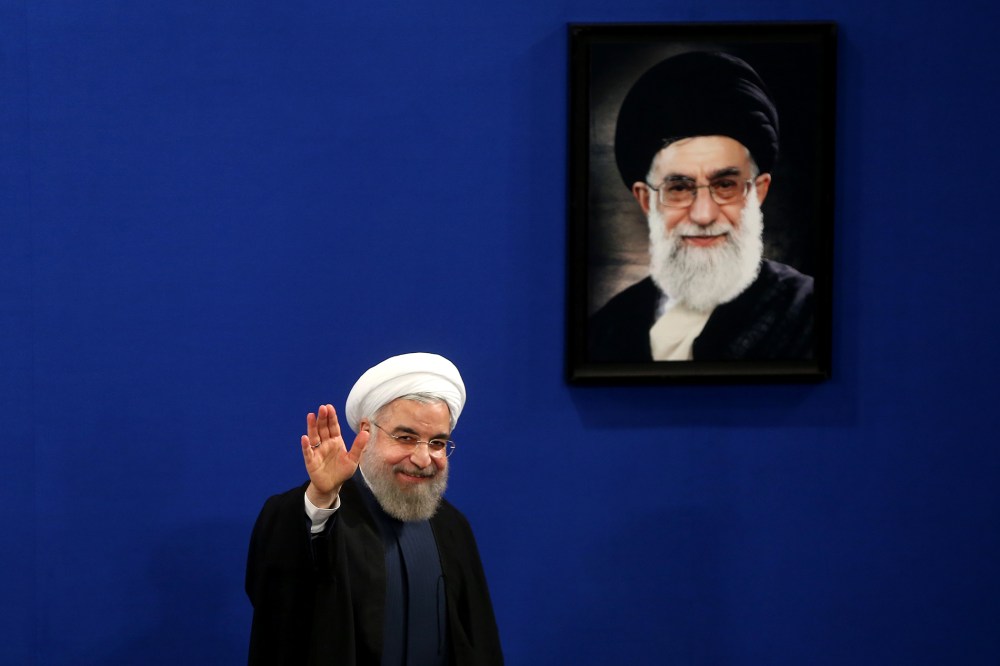
The debate and criticism of the comprehensive nuclear deal was expected to be fiercer in Tehran than Washington. Hardliners in Iran made it no secret that they did not support the talks. But today, in Iran, opposition to the deal is relatively muted. Opponents of the agreement are not attacking it based on its content, but as a way to target the Rouhani administration and the moderates in the run-up to the Iranian parliamentary elections in February 2016. The deal is a tool in Iranian internal politicking and campaigning.
The%20deal%20is%20being%20used%20as%20the%20latest%20tool%20to%20fight%20the%20moderates%20and%20prevent%20them%20from%20building%20on%20the%20success%20to%20gain%20ground%20politically.’
Contrary to popular perception, politics is vibrant in Iran. The Supreme Leader is the final decision maker, but not the only decision maker. Instead, he lets factions debate — as long as they don’t threaten the regime — and only steps in to make the final call. Parliamentary elections are therefore vital in Iran.
The 2016 elections present the moderates with a chance to retake control of parliament (Majles) and politics. This would give them a greater mandate for change and help strengthen a reformed Islamic Republic. Since 2004, Iranian hardliners have held a majority in the 310-seat Majles. Historically, parliamentary elections in Iran have been fiercely contested: Entire factions have boycotted the elections at times.
Following the conclusion of the interim deal in 2013, opponents virulently criticized the talks and negotiators. Comments largely focused on the technical content of the agreement. Opponents insisted that sanctions relief would not be enough, that facilities could not be shut down, or that centrifuge numbers would not be limited. Throughout the talks, Khamenei intervened to undermine the critics and allow the negotiators to negotiate. But the lack of overt support or opposition ensured he stood above the politics — he would be a winner regardless of the outcome of the talks.
But today, the tone of that criticism has changed.
Not only is it more muted than expected, but most of the criticism does not target the content of the deal. This is because the negotiators can sell their concessions as respecting the Supreme Leader’s loose redlines.

Rather, the criticism targets the Rouhani administration in order to discredit it in the run up to the parliamentary elections. The deal is being used as the latest tool to fight the moderates and prevent them from building on the success of the nuclear accord to gain ground politically. Opponents changed the focus of their attacks to target the wisdom of Rouhani’s decision-making and whether his policies are in the Islamic Republic’s interests, thereby questioning his ability to govern.
Officials like Saeed Jalili, former nuclear negotiator and 2013 presidential hopeful, and Fereydoon Abbasi, who directed Iran’s nuclear program under Iran’s former president, Mahmoud Ahmadinejad, publicly attacked the Rouhani administration for selling Iran out. Abbassi claimed that the negotiators, “especially Mr. Rouhani … have accepted the premise that [Iran] is guilty.”
In particular, criticism of Rouhani’s efforts to reposition Iran on the international stage intensified. Animosity toward the U.S., the “Great Satan,” is a fundamental feature of the Islamic Republic. Days before the deal, Kayhan, the most hardline newspapers in Iran, ran an editorial criticizing the administration for negotiating with the US. In recent weeks, Rouhani’s willingness to engage not only with the U.S., but also British officials and the recent re-opening the British embassy in Tehran and the Iranian embassy in London, caused quite the stir in Tehran. Such efforts even sparked remarks from the Supreme Leader. On Aug. 26, after re-affirming his cautious support for the agreement, Khamenei highlighted the dangers of talking to the U.S. His post-deal rhetoric, much like his statements during the talks, aim to ensure he is free of reproach regardless of the outcome. After all, he could not be seen as supportive of an agreement if the U.S. Congress had subsequently rejected it. RELATED: Senate fails to derail Iran deal The first and most crucial phase of the implementation of the comprehensive agreement coincides with the run-up to the Iranian parliamentary elections. The nuclear deal is Rouhani’s greatest achievement and the key to the rest of his political agenda. Because of this, critics in Iran have and will use it to attack the Rouhani government, and by extension the moderate camp. But this opposition will likely not affect the deal’s implementation. The fate of the deal’s implementation rests in the hands of the U.S. Dina Esfandiary is a Visiting Scholar at the Salzman Institute of War and Peace Studies at Columbia University, and a MacArthur Fellow at the Centre for Science and Security Studies at King’s College London. Ariane Tabatabai is a Visiting Assistant Professor of Security Studies at the Georgetown University Edmund A. Walsh School of Foreign Service.
Dina Esfandiary
Ariane Tabatabai Recommended


