








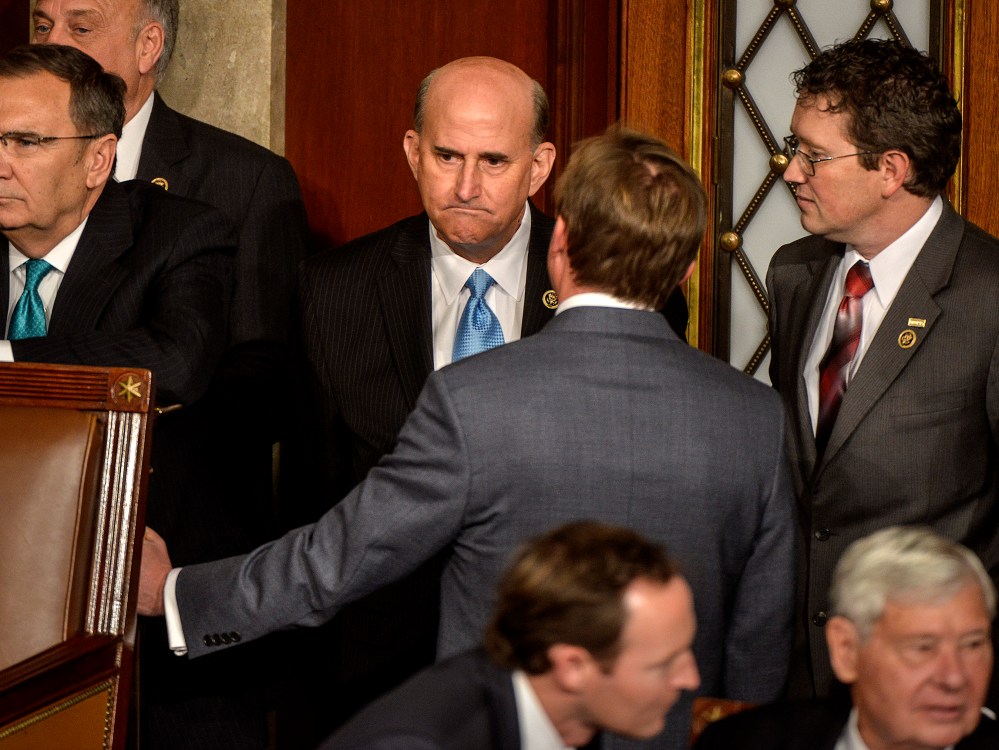
Listening to Rep. Louis Gohmert’s (R-TX) revanchist logic for his failed bid to oust John Boehner as speaker of the House earlier this month, you’d think the tea party wing of the Republican Party had been working with President Obama. “[We’ll] fight amnesty tooth and nail. We’ll use the powers of the purse,” Gohmert vowed in an interview with Fox News during which he repeatedly associated Boehner with Obama and House Minority Leader Nancy Pelosi. “We’ll have better oversight. We’ll fight to defund ObamaCare.”
Unfortunately for any Republican who sincerely wants to curb the power of the presidency, Gohmert’s strategy is as ineffective as the only slightly less obstructionist methods employed by Boehner. Indeed, Obama already has emerged as a particularly ambitious and effective lame duck president precisely because he has been faced with one of the most uncompromising and hyper-partisan Congresses in American history. By forcing him to work outside the legislative branch to pursue his policy goals, tea party Republicans like Gohmert have actually empowered Obama — and with him the office of the presidency — to an unexpected degree.
%22Tea%20party%20Republicans%20like%20Gohmert%20have%20actually%20empowered%20Obama%22′
First there was immigration reform. After Republicans in Congress held up Obama’s immigration reform bill until it failed, the president issued an executive order on Nov. 20 that accomplished much of what his original bill had hoped to do. For about 5 million of America’s roughly 11 million undocumented immigrants, it will extend work permits and protect them from deportation; in addition, it ordered law enforcement to prioritize undocumented residents with criminal records or other histories of violent activity, expanded the number of high-tech visas, and loosened restrictions on highly-educated and skilled foreign residents. It was a move that led historian Douglas Brinkley to predict Obama would be remembered as a “folk hero to Latino Americans” — and instead of being able to share credit with the president, Republicans will be remembered as his rigid opponents.
Next there was climate change. “The Republican Party had grown increasingly hostile to the science of global warming and to cap-and-trade,” wrote Ryan Lizza of The New Yorker in a piece on the failure of Obama’s 2010 climate change bill to pass the Senate. “By not automatically resisting everything connected to Obama,” Lizza added, “these senators [Republicans who might support the bill] risked angering Mitch McConnell, the Republican leader and architect of the strategy to oppose every part of Obama’s agenda, and the Tea Party movement, which seemed to be gaining power every day.” Consequently, Obama is currently in the process of finalizing a historic agreement with China (which along with the United States is responsible for one-third of all greenhouse emissions) that his administration negotiated in secret and will commit America to reduce its emissions to at least 26% of its 2005 levels by 2025 and hold China to aggressively seek alternate energy sources and make its greenhouse output peaks before 2030. As Jonathan R. Nash of The Hill opined,“the existence of a ratified treaty might empower the executive branch to take broader steps toward national reductions than it could in the absence of a treaty.”
Related: Obama unveils free community college ‘game changer’
Finally there is Cuba. After more than half a century of diplomatic hostility, Obama announced that the United States would move to restore full diplomatic relations with its southern neighbor, as well as expand trade and travel. Although Republicans have discussed using funding for the Department of Homeland Security as a weapon to thwart Obama’s agenda on Cuba, the reality is that their best weapon on this issue — as with any foreign policy matter involving matters of statecraft, which is constitutionally assigned to the president — was the potential ability to leverage future support for other measures important to him in return for ceding to their wishes (or at least compromising with them) on this one. But by making it clear that there is little chance they will ever work with him, Republicans have left the president with no incentive to consult them on matters that lie strictly within the realm of his prerogatives. When historians look back at the Obama era, they will be struck by the contrast between the first two years of his presidency — during which, with the 111th Congress, Obama passed more landmark progressive legislation than any president since Lyndon Johnson — and the final six years of his administration, in which the most recent congress reached such heights of obstructionism that they will go down as the single least productive legislative body in American history. Despite this obstacle, Obama is likely to be remembered as a very successful president (as I’ve discussed before), if for no other reason than he managed to meet so many legitimate national needs (ending the Great Recession he inherited from Bush, addressing the crisis in America’s health care system) with so few tools at his disposal. Yet even that isn’t the most salient takeaway of the continuing battle between the Republican establishment figures like Boehner and more conservative members like Gohmert. Far more important than the leadership of the Republican Party in the House of Representatives, or even of Obama’s legacy, is the precedent they have established for executive leadership. By making it impossible for this president to govern with Congress, Republicans has taught future presidents how to do what they want without legislative sanction. The Grand Old Party, which has so long claimed to fight against the expansion of central power, has created the conditions that essentially guaranteed its growth. Matthew Rozsa is getting his PhD in American history from Lehigh University and is a regular contributor to The Daily Dot, Salon, and The Good Men Project. In the past he has written for Mic, appeared on Huff Post Live, and has had articles published in roughly a dozen other venues.
Matthew Rozsa Recommended


