








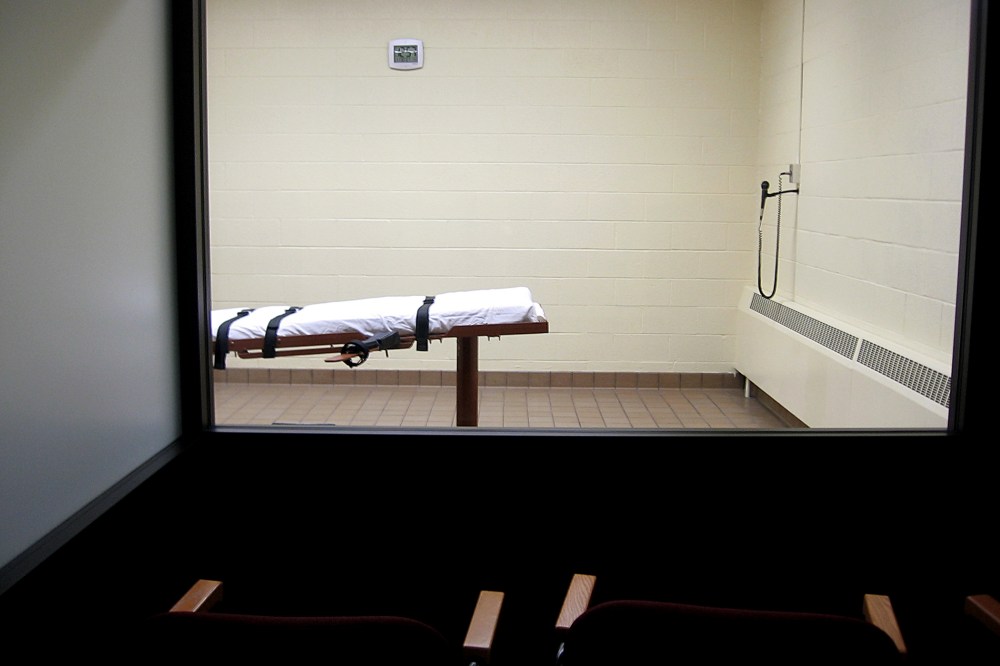
When Nebraska Gov. Pete Ricketts on Tuesday vetoed a bill that would have repealed the death penalty, he set in motion a series of actions that just a few short years ago would have been unthinkable: testing whether lawmakers will override the governor, making one of the deepest red states in the country, the first of its kind in decades to abolish capital punishment.
The Nebraska legislature is expected to take up the issue as early as Wednesday, setting the stage for the “uni-cam” to vote on overriding Ricketts’ veto. Lawmakers need to muster 30 votes to strike the death penalty from the books in Nebraska. And judging by the legislature’s 32-15 vote last week on the repeal bill, supporters have the numbers on their side — with a few to spare.
RELATED: Nebraska legislature repeals death penalty
The strong push to repeal the death penalty in a historically far right region marks a growing change in the debate, as policy makers, advocates and religious leaders have sought to recast concerns with capital punishment as violating core tenets of conservatism. While the majority of Americans say that they favor the death penalty, Republicans’ support has dropped 9% in the last decade. For many, the death penalty symbolizes the antithesis of a conservative emphasis on small-government, religious values and minimal spending.
In an era marred by botched executions and limited means for a state to carry out capital punishment, Nebraska is just the latest in a growing national movement to cast abolition as a squarely conservative argument. Prominent conservatives teamed up with death penalty reformers in a letter to Texas Gov. Rick Perry last December, urging him to halt the execution of a man they said was the “most seriously mentally ill prisoners on death row in the United States.”
“Conservatives believe that policies should be pro-life, fiscally responsible and about limited government — the death penalty is inconsistent with all of those,” said Marc Hyden, advocacy coordinator for the national group Conservatives Concerned about the Death Penalty.
The last time that Nebraska executed a condemned prisoner was in 1997, when Robert Williams was electrocuted for killing three women. More than a decade later, the Nebraska state Supreme Court found that the electric chair amounted to cruel and unusual punishment. Lethal injection was formally made the state’s official method of carrying out capital punishment, but it has never used the deadly drug cocktail. Instead, the 10 prisoners facing execution have languished on death row — a condemned man died in prison on Sunday after spending three decades there.
Nebraska state Sen. Colby Coash said there was a push from conservatives in the legislature to change the narrative around the death penalty as a cost-benefit analysis.
RELATED: Death penalty repeal momentum surprises red state Nebraska
“We’re lying to our constituency when we say that it’s an effective tool when it’s one that hasn’t been used in 20 years,” Coash said. “It’s been expensive, hasn’t been used, it won’t be used and doesn’t need to be in the statute.” The governor has been very vocal in his opposition to the repeal, lobbying senators to change their vote and urging residents to see the bill as damaging public safety. “Under this bill, there is no guarantee that convicted murderers will stay behind bars for life or not harm other innocent victims,” he said in a statement following his veto. Ricketts has gone out of his way to prove the state is equipped to carry out executions should inmates ever make it to the death chamber. The last of the state’s lethal supplies expired in 2013. And amid nationwide shortages of the drug needed in executions, the governor announced that last month that Nebraska had purchased two drugs needed in the lethal cocktail from a distributor in India. Stacy Anderson, executive director of Nebraskans for Alternatives to the Death Penalty, said a grassroots movement against the death penalty had been simmering and slowly gaining momentum. ‘Nebraskans by and large feel like we’re wasting a lot of tax-payer money on something that doesn’t really work,” she said. “They feel like they can live without it.
Amanda Sakuma Recommended


