








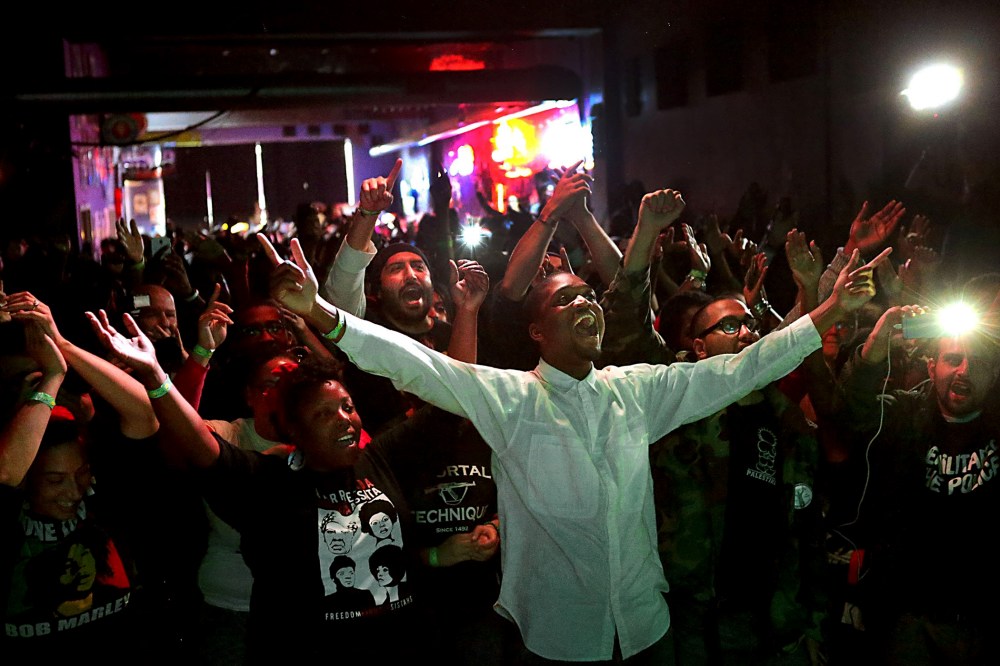
ST. LOUIS, Missouri — If the protests in Ferguson and St. Louis in recent months have an anthem, it isn’t “We Shall Overcome,” or “Wade in the Water,” or any other civil rights-era song. It’s a darker, more confrontational song — Lil Boosie’s “F*** the Police.”
When the chorus of Lil Boosie’s song wasn’t blaring on a giant sound system carted through the crowd at night, it showed up in chants or printed on posters. As night fell, the protests morphed into a party, with demonstrators dancing out on the street and on top of cars.
%22I%20was%20just%20rapping%20about%20my%20life%20in%20the%20circumstances%20of%20the%20culture%20in%20my%20city.%20It%20just%20so%20happens%20that%20it%E2%80%99s%20true.%22′
With few ways for protesters to channel vivid anger and pent up frustration over a system they feel works against them at every level, hip-hop has become an outlet for the young people who reject the old ways of the civil rights movement that they say does not speak to them. Instead, the artists and rappers on the ground every night used their networks to connect with the countless other Fergusons around the country that are struggling to overcome racial and economic tensions.
Young protesters weren’t looking to their elders for help coping with their pain after unarmed black teen Michael Brown was shot and killed by a police officer on Aug. 9. Instead, a generational gap emerged almost immediately after police stormed in to disperse protests and the first canisters of tear gas dropped.
In August, a group of young protesters stood outside a church rally held in Brown’s honor and watched as civil rights icon Rev. Jesse Jackson stepped out of his car, surrounded by men wearing crisp back suits. The young men turned to each other looking confused, until finally one spoke up, “Who’s that guy again?”
Photo Essay: Ferguson’s ‘Weekend of Resistance’
Their heroes instead were the artists from their hometown, who saw Brown’s blood stain the street in front of the Canfield Green Apartments. They learned together how to wrap bandanas around their faces to shield themselves from the clouds of tear gas. They were on the front lines, together, watching in disbelief as police trained assault rifles on young men who held their hands in the air.
“A lot of music artists are positive role models in our community. A lot of rappers from our community have already felt our struggle,” said 15-year-old Devante Jackson, who goes by the name Low-Key when he raps. “So seeing them and seeing their faces are bringing more people out for the struggle. We feel their pain when they rap.”
%22This%20is%20where%20we%20live%2C%20this%20is%20what%20we%20rap%20about.%20We%20felt%20obligated%20to%20be%20there%20to%20see%20what%E2%80%99s%20going%20on%20and%20to%20say%20we%E2%80%99re%20going%20to%20stand%20up%2C%20we%E2%80%99re%20not%20going%20to%20take%20this%20anymore.%22′
Some say local rapper Tef Poe even predicted Brown’s killing. For years, the St. Louis-based artist has been rapping about the dismal economic options for young people, and the racial divide here.
Poe, whose real name is Kareem Jackson, has a tattoo of Martin Luther King Jr.’s face on his left arm. Though he had always been socially conscious, he never expected to be a leader in the fight for racial justice.
“I was just rapping about my life in the circumstances of the culture in my city,” Poe said. “It just so happens that it’s true.”
While local media were shut out of covering the scene that unfolded on Canfield that Saturday afternoon in August, when Brown’s body lay on the street for more than four hours after a police officer fatally shot him, local artists and rappers said they were the first ones there to understand the gravity of Brown’s killing, and to be able to do something about it.
“This is where we live, this is what we rap about,” said rapper T-Dubb-O. “We felt obligated to be there to see what’s going on and to say we’re going to stand up, we’re not going to take this anymore.” Tapping contacts from battle-rap networks in New York, Atlanta and Chicago, the local St. Louis hip-hop community amplified the local outrage over Brown’s death into a national outcry within hours. “It turned into a nationwide thing because we were the ones putting out the message there letting them know, ‘Hey this is what’s going on,’” he said. Within days, nationally renowned artists came streaming into town. Nelly, who has a music school in downtown St. Louis, walked alongside protesters in the days after Brown’s death. Common invited Brown’s family onstage at the BET Hip Hop Awards, and the audience put their hands in the air in honor of the slain teen. Snoop Dog attended Brown’s funeral and led a series of panel discussions on police violence in the black community. Artists here said none of them sought to become organizers for an entire movement — they just knew how to get the word out. Having spent years promoting their own profiles, expanding their social media reach and building a network of contacts and fans throughout the country, the rappers on the ground since day one knew how to assemble entire crowds of hundreds almost spontaneously, and keep them hooked to come back day after day. “These are not only some of the most conscious, underground artists in St. Louis, but they came out and they put their feet on the ground,” said Taurean Russell, an activist who mobilized protests in Ferguson. “They were out there, they got some tear gas, they got shot down with those rubber bullets, and they didn’t think about their rap career, they didn’t think about PR and how their tour is going to look later.” “They said there are people out there who need some justice,” he said.
Amanda Sakuma Recommended


