








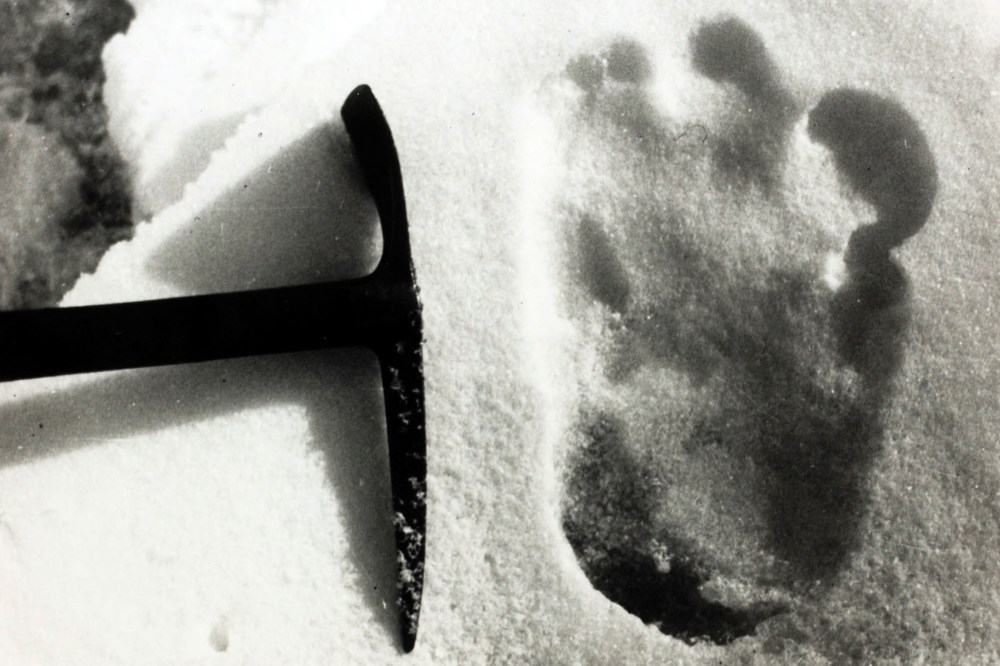
Mystery solved? Not Yeti, but close.
A year ago, geneticists reported that RNA extracted from hair samples attributed to the Himalayan Yeti monster, a.k.a. “the Abominable Snowman,” were actually most similar to the 40,000-year-old genetic signature of a now-extinct breed of polar bear. They suggested there might be a yet-to-be-discovered bear species lurking in the remote Himalayan snows.
Now a different research team says the hairs were just as likely to come from a type of brown bear that’s common in the Himalayas.
The scientists behind the original study, led by Oxford University’s Bryan Sykes, are holding to their claims about the polar-bearish RNA. But Eliecer Gutierrez of the Smithsonian Institution and Ronald Pine, who’s associated with the University of Kansas’ Natural History Museum and Biodiversity Research Center, say there’s too much genetic overlap in the RNA results to rule out the Himalayan brown bear.
The analysis from Gutierrez and Pine was published online Monday by the open-access journal ZooKeys.
Is an exotic bear out there?
Sykes’ results made a splash when they came out last year in the Proceedings of the Royal Society B. The project involved gathering up dozens of samples of hair that had been collected over the years by monster-hunters and fringe researchers known as cryptozoologists. Sykes and his team looked specifically at mitochondrial RNA extracted from the samples.
Most of the hairs matched run-of-the-mill species, ranging from cows and canines to humans. But two of the samples, from northern India and Bhutan, matched up with genetic markers from a 40,000-year-old polar bear fossil from Norway. That led Sykes to call for an expedition to seek evidence of such a species in the Himalayas.
Since then, other researchers have suggested that the results may have been affected by contamination, and that it’s too great a leap to assume there’s an exotic bear species waiting to be found. The newly published results echo those conclusions.
In an email to NBC News, Sykes said he stood by last year’s findings. He noted that the findings published in ZooKeys were “entirely statistical” in nature. ‘Getting off your butt’ “The explanation by Gutierrez and Pine might be right, or it might not be,” Sykes wrote. “The only way forward, as I have repeatedly said, is to find a living bear that matches the 12S RNA and and study fresh material from it. Which involves getting off your butt, not an activity I usually associate with desk-bound molecular taxonomists.” Sykes said “the real heroes of the piece are the people who actually went to the Himalayas, spoke to the local people, found these hairs, had the wit to keep a few, and then contributed them to the study.” Read more at NBCNews.com.
Alan Boyle Recommended


