








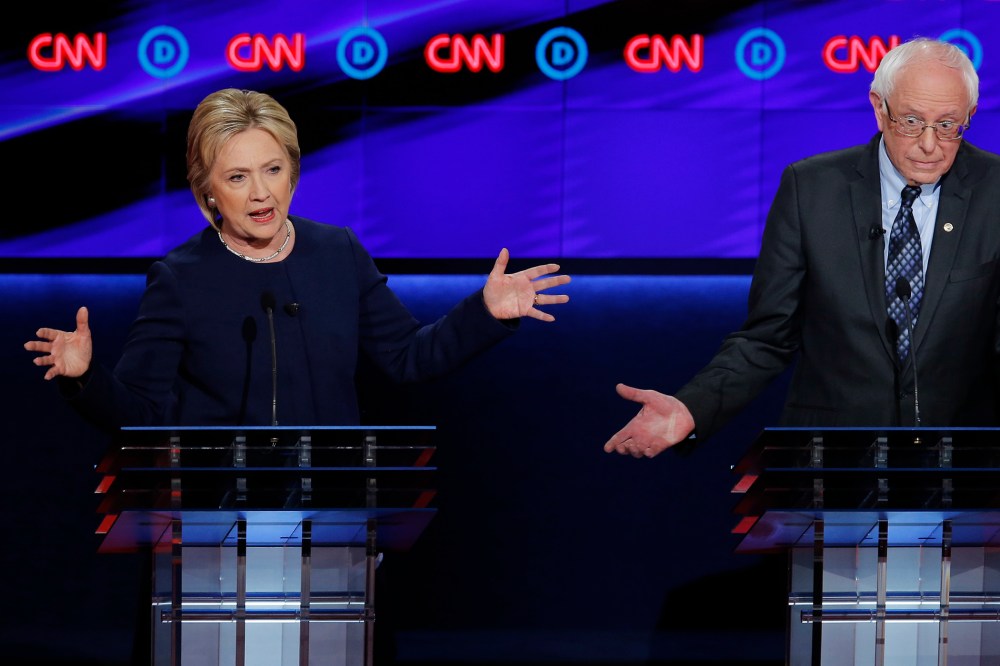
FLINT, Mich. — Sunday night’s Democratic presidential debate in Flint, a city where manufacturing jobs have been replaced by poisoned water, should have been on Bernie Sanders’ turf: a discussion of trade policies, corporate greed and government spending cuts that have led to horrible consequences.
Sanders fought as if his life depended on it — and it just might be, as he has fallen dangerously behind Hillary Clinton in the delegate count.
But Clinton came prepared to the CNN debate and more than held her own, preventing Sanders from the clear victory he needs to change the trajectory of the race ahead of Michigan’s primary on Tuesday.
While the debate is unlikely to dramatically alter the outcome of the Michigan primary or the even more important set of contests on March 15, it nonetheless revealed new details about the candidates and the differences between them.
Here are four key moments:
Flint’s water crisis gets its moment

Clinton made news out of the gate by saying that Michigan Gov. Rick Snyder should resign or be recalled for his “dereliction of duty” in switching Flint’s water source. And, she noted, the debate was only happening here in Flint because she requested it.
Sanders has called for Snyder’s job for months and said more heads might roll at the U.S. Environmental Protection Agency under a Sanders administration. He also called for the Centers for Disease Control to test all Flint residents for lead poisoning and residents to be retroactively reimbursed for their water bills, in addition to fixing the city’s lead pipes.
Both candidates pledged to stay on top of the crisis even after it fades from the headlines. “I will be with Flint all the way through this crisis,” said Clinton, who this weekend proposed a program to employ residents as the city replaces its ruined piping.
“At a certain point, the TV cameras and CNN is going to disappear, and then people are going to be left struggling in order to live in a safe and healthy community,” Sanders said, pledging not to forget the city.
Trade and the auto industry
This was the fight Sanders has been hoping to have.
The Vermont senator, who noted he was on picket lines in the 1990s protesting NAFTA, has put what he calls “disastrous trade policy” at the center of his campaign in Michigan, with an eye on Ohio and Illinois’ contests on March 15.
“I’m very glad … Secretary Clinton has discovered religion on this issue – but it’s too late, ” Sanders said on Clinton’s opposition to the Trans-Pacific Partnership trade deal.
But Clinton was ready for the attack and parried by noting that Sanders had voted against the auto bailout that President Obama and others have credited with saving the industry, a key employer in Michigan. Clinton has been campaigning in the state for days and gave a major speech on jobs on Friday, but neither she nor anyone on her campaign had previously mentioned Sanders’ vote, so it seemed to catch him off guard.
“If everybody voted the way he did, I believe the auto industry would have collapsed, taking 4 million jobs with it,” Clinton said.

Sanders supporters will call this a cheap and misleading shot. The auto bailout was actually part of the larger Wall Street assistance package, and Sanders responded by touting his opposition to the larger bill. “If you’re talking about the Wall Street bailout, where some of your friends ruined the economy,” he said.
Clinton interrupted him, but Sanders would not allow her to speak. “Excuse me, I’m talking,” he said curtly. It was a tense moment that would be repeated later in the night on guns, when Sanders injected with another “excuse me, I’m talking.” Sanders has said he would likely have supported the auto package if it had been stripped from the Wall Street bailout. But in his argument with Clinton, he seemed to paint the carmakers with the same broad brush he uses for Wall Street and corporate America — something that may not play well in Michigan. Meanwhile, Clinton hit Sanders with his vote against the Export-Import Bank, a federal agency that helps American companies like Boeing sell goods abroad. Clinton defended that practice, saying the airplane maker would otherwise lose business to Europe’s Airbus. But Sanders called the bank “corporate welfare,” mocking the idea that large multinational corporations need taxpayer help. Race, guns and crime The candidates had a by now familiar exchange on guns, but Clinton added to it a new line challenging Sanders’ presumed monopoly on opposition to corporate malfeasance. “Gun makers epitomize corporate greed,” Clinton said, flopping the usual script as Sanders defended gun manufacturing in America. But she stumbled when asked why she campaigned for the 1994 Crime Bill, which many — including her husband, who signed it — blame for exacerbating racial discrimination in the criminal justice system and mass incarceration. “Sen. Sanders voted for this bill as well — are you going to ask him the same question?” was Clinton’s response, seemingly trying to dodge the question. Both candidates had thoughtful answers when asked what racial blind spots they have, both saying there are experiences they will never understand as white people. But Sanders made an unforced error when he used the antiquated word “ghetto”: “When you’re white, you don’t know what it’s like to be living in a ghetto.” Leftovers The candidates also had a to-type exchange on fracking. Clinton give a nuanced answer on when she would oppose and allow fracking, while Sanders replied, “My answer is a lot shorter: No, I do not support fracking.” Asked about their relationships with God, Sanders, who rarely discusses his personal life, said he is “very proud to be Jewish.” Clinton, a practicing Methodist, spoke about how religion helped teach her humility and grit during her trying life in the public eye.
Alex Seitz-Wald Recommended


