








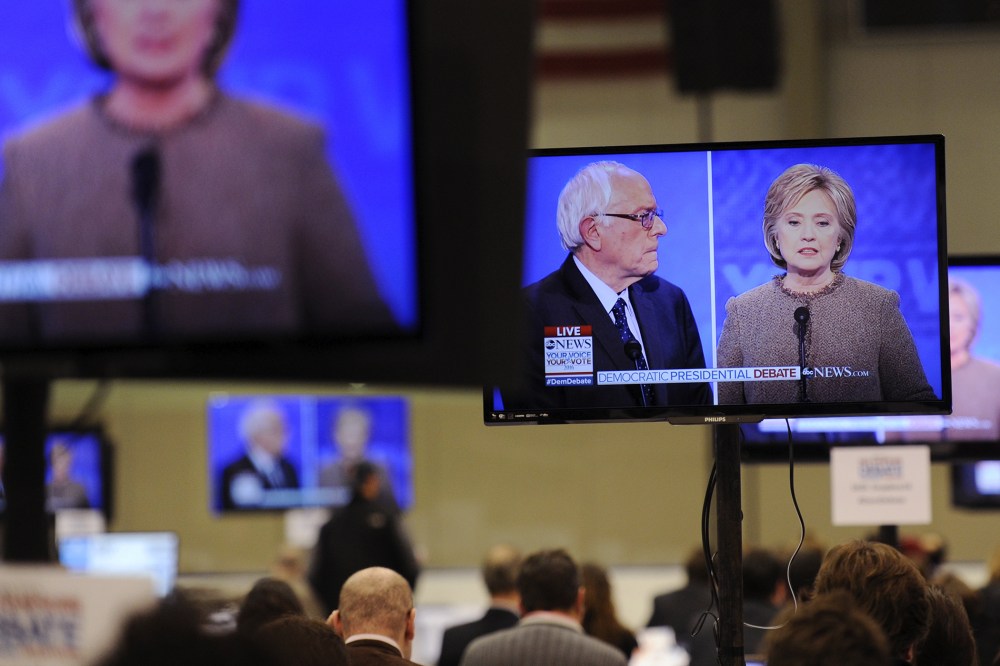
By this point in the 2008 presidential campaign, the last time Democrats had a competitive primary race, there had already been a total of 19 debates. By contrast, Sunday night’s showdown between Hillary Clinton, Bernie Sanders, and Martin O’Malley will be only their fourth such encounter. It could also be their last one – at least their last meaningful one.
That will be the case if Clinton manages to win the two lead-off contests, in Iowa and New Hampshire. Demographically, these are two of Sanders’ best targets in the country. If Clinton can hold him off in both places, there’ll be no stopping her in South Carolina and the next wave of contests, where she already enjoys huge built-in advantages. And that would turn the next scheduled debate – on February 11, after both Iowa and New Hampshire have voted – into the political equivalent of an exhibition game.
RELATED: How to watch Sunday’s Democratic debate
So tonight is a big moment for Sanders, his last chance to go toe-to-toe with Clinton before the voting begins. At an absolute minimum, he’ll need to put up a win in either Iowa or New Hampshire. That, at least, would extend some suspense through the South Carolina primary. More realistically, though, Sanders will need a clean sweep of Iowa and New Hampshire if he’s to have any chance of actually stealing the nomination from Clinton – that’s how strong her grip is on South Carolina and the other states that follow.
The good news for Sanders is that as of this moment he is leading in New Hampshire. His margin varies, but four of the last five polls taken in the state have put him ahead of Clinton. Some chalk this up to his next-door neighbor status. Campaigning in the state earlier this month, Bill Clinton argued that “no candidate who borders New Hampshire has ever lost a primary here, except when Howard Dean lost to John Kerry because they both did.” (This isn’t quite true. Massachusetts Senator Ted Kennedy lost the 1980 New Hampshire primary to Jimmy Carter by ten points.)
But this sells Sanders short. After all, when he entered the race, no one – least of all the Clinton campaign – expected that he’d be running in first place in the state three weeks before the primary. His Vermont background surely doesn’t hurt, but he has to date vastly exceeded expectations in New Hampshire.
The same is true in Iowa, where Clinton seems to be ahead – but barely. The state is naturally suited to Sanders. Like Vermont, it is rural and largely white, with a heavy agricultural presence. But again, there is almost no one in politics who would have thought at the start of this campaign that Sanders would be so well positioned in Iowa so close to caucus day. Polls show that Sanders is essentially following the Obama model in Iowa, appealing to younger voters, political independents, and those who have never participated in the caucuses before. Only once before – with Obama in 2008 – have these voters shown up in droves on caucus day.
So the opportunity for Sanders is clear: If he can generate Obama-like turnout in Iowa, then he’ll have a chance to pull off a win there on February 1. And if he can win there, then the media and political worlds will immediately look at the Democratic race very differently, giving Sanders a chance to pull away in New Hampshire and score a follow-up victory there on February 9. And if he can pull that off, then maybe – just maybe – it would be enough to convince Democrats in South Carolina, where Clinton now leads by around 40 points, to reconsider their loyalties.
RELATED: Sanders: Clinton ‘getting defensive’ as polls tighten A particular concern for Sanders in South Carolina is African American voters, who will make up more than half of the Democratic primary electorate there and who are siding with Clinton by more than 60 points in most polls. Sanders has been trying hard to make inroads with blacks, but so far he has little to show for it. And it’s more than just a South Carolina problem for him. Blacks will also hold considerable sway in the “SEC” states that will vote on March 1, and in other large states that follow. Without significantly increasing his share of the black vote, Sanders cannot win the nomination. The bad news for Sanders is this: Clinton is good in these spots. The headlines for her have not been great in the past week: bad polling news in Iowa and New Hampshire, anger by liberals over her new attacks on Sanders, questions about how strong her position actually is. But we’ve been here before, and not that long ago. Back in October, Clinton’s grip on her party also seemed to be loosening. Just like now, Sanders was on the rise in the early states. Joe Biden was flirting with a last-minute entry into the race. And Clinton’s testimony before the House Benghazi Committee loomed. If there was any panic around the Clinton campaign, though, it didn’t last long. She aced the Benghazi hearing. She dominated the first Democratic debate. And Biden decided there was no room for him in the race. Tonight, then, is also an opportunity for Clinton. She is very good in debates. If she can turn in another strong performance tonight, maybe knock Sanders off his game too, then those early state polls could swing right back in her direction – just as voters start to make up their minds for good. Not for the first time, we could all end up wondering: Why did we ever think she was in any trouble?
Steve Kornacki
Steve Kornacki, author of "The Red and the Blue: 1990s and the Birth of Political Tribalism," is a national political correspondent for NBC News and MSNBC. Recommended


