








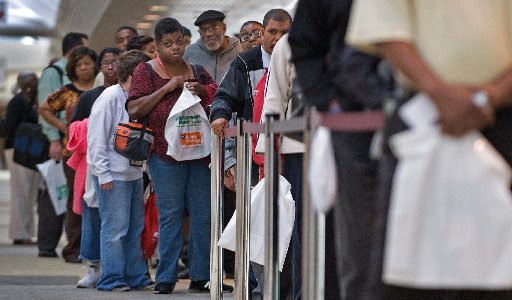
Officials in Erie County, N.Y., were forced to cut the days it runs a free transportation program in poor and rural communities, leaving countless elderly and disabled residents stranded.
In Denver and Jacksonville, Fla., road and water projects have fallen into limbo, while city administrators in Salt Lake City, Utah, say the waiting list for families seeking housing assistance has grown from a two-year wait to five years.
And in Baltimore a heralded adult literacy program that helps nearly a thousand low-income city residents learn to read each year and get their GEDs has had to lay off staff and eliminate some of its most successful programs.
“When people line up at your door to try to register for a class, all you can do is say sorry,” Shirley Bigley-LaMotte, the CEO of Baltimore Reads, told msnbc.com.
For cities and rural towns across the country, as well as nonprofits like Baltimore Reads, officials are struggling to maintain programs offered to low- and moderate-income residents that for decades were funded through one of the most popular bipartisan federal grant programs. Roughly 1,200 communities each year receive Community Development Block Grants (CDBG), in which the federal government funnels billions of dollars directly to cities, bypassing state government bureaucracy and allowing vast leeway in the way the dollars are spent.
BUDGET CUTS STACK UP YEAR BY YEAR
Year-by-year congressional funding for the program has shrunk. CDBG funding last year shriveled to $2.9 billion, its lowest in the programs nearly four-decade history, down a full billion from where it was just two years ago.
Now many local officials across the country fear further cuts could be likely as President Obama and congressional Republicans haggle over a budget deal to avoid the so-called “fiscal cliff,” at which time more than a trillion dollars of automatic cuts in federal spending would be enacted on Jan. 1.
If a deal isn’t hammered out, cities expect to lose about 8.2% of their CDBG funding, compounding the programs already shriveling funding. The U.S. Conference of Mayors estimates that further reductions to the program could siphon $242 million from city budgets.
But even if a deal is reached and the cliff is avoided, further deficit reduction measures could mean deeper cuts to CDBG funding, analysts say, and communities nationwide could find funding for many of their prized housing and social programs gutted.
“There’s real fear and uncertainty,” said Baltimore Mayor Stephanie Rawlings-Blake, who said the city has used CDBG funding to raze and rehab some of the city’s more than 16,000 abandoned houses and for job training programs. “More cuts would mean that there’s going to be a reduction in the number of people that we are able to provide job training to. We are trying to grow out of the great recession. We should be trying to do more not less.”
Last year, the city received about 30% less in CDBG funding than it did two years ago.
While CDBG funding is typically a small slice of any city’s budget, the funding covers vital services that include housing assistance and foreclosure prevention programs, after-school enrichment programs, crime prevention, and public works projects. Among the two dozen or so stipulations of the program are that the funds be used to address housing, infrastructure, and social needs in low and moderate income communities.
If any city has cause for alarm it’s Baltimore. The city has a glut of abandoned houses, a perpetually dwindling tax base, a stubbornly high unemployment rate of more than 10%, and has consistently ranked among the most dangerous American cities. The city’s population has also been cursed by a laundry list of health and social ills, including a staggering HIV/AIDS rate.
The city has used some CDBG money for one of Rawlings-Blake’s hallmark initiatives, Vacants to Values, a two-year-old program that targets blighted neighborhoods for reinvestment through stronger code enforcement, the streamlined sale of vacant city-owned property, and incentives for homebuyers and developers.
Analysts say vacancies seed blight and crime, further destabilizing already fragile communities found in many post-industrial cities such as Baltimore.
According to city officials, property sales have increased 500% since 2010, from 100 to 524 in the 2012 fiscal year. About $23 million has been raised through citations issued to vacant building owners, and the city has sold 90% of city-owned property in so-called “development clusters.”
“What [CDBG] money allows us to do is ensure that the least of us, the most vulnerable of us, have resources to retool themselves,” Mayor Rawlings-Blake said.
A recent report by the nonpartisan Government Accountability Office noted a dramatic spike in the number of American vacant properties, from about 7 million in 2000 to 10 million today.
“With sustained high foreclosure and unemployment rates and further declining home values, local officials said that continued, flexible CDBG funding would help them maintain efforts to address vacant properties in their areas,” the report noted.
Baltimore received about $18 million in CDBG funding last fiscal year, much of it going to nonprofits, the city’s housing assistance programs, and to organizations involved in neighborhood revitalization.
“People will feel the difference,” said Steve Janes, the city’s assistant commissioner for research.
Janes said about 20 years ago the city would receive an average of about $30 million. Much of the funding back then was used for capital development projects. During the 1970s and 80s, as Baltimore began to decay both socially and structurally, there was a shift to funding more of the city’s emerging large nonprofits. By 2000, federal funding started to creep downward, Janes said.
“We don’t know that sequestration is going to take place,” said Janes of the automatic cuts that will take place if a budget deal isn’t reached. “But I think what it means, if it happens, is there will be a diminished number of people receiving job training, fewer low-income kids taking part in educational and recreational programs, more reductions in the workforce. City governments and the nonprofits are going to be laying people off.”
Critics of the CDBG program say the element of the program that has made it a favorite among mayors and other local officials–the program’s flexibility–allows for misuse, fraud, and waste. There have been a number of indictments related to the grants, and over the years, federal investigators have uncovered streams of squandered funds on foolish projects and gifts.
But city leaders in Baltimore and elsewhere say CDBG funding is critical in communities hard-hit by the recession, by the loss of jobs, and other infrastructure funding.
Last month, more than a dozen members of the U.S. Conference of Mayors met with members of Congress and Vice President Joe Biden to lobby for a budget deal to avoid the cliff and against further cuts to the block grant program.
“Mayors have been taking a balanced approach, including spending cuts, for years. Washington needs to do the same,” Minneapolis Mayor R.T. Rybak told National Journal after a meeting with House Minority Leader Nancy Pelosi. “But they can’t do it in a way that makes them feel that the job is done by shifting dollars back to local property tax payers.”
Rybak added: “We have been making massive cuts to those [CDBG] programs for years. We have been compromising and understand that point… We will get upset when others who have gotten off, especially those in the very top end, [don’t] have to carry their fair share.”
IMPACT FELT IN POORER, MINORITY COMMUNITIES
Across the country, local officials have had to chip away at programs they say were possible because of the CDBG funding and the wide discretion they had in using it.
“We are talking about roads, bridges; we are talking about people actually going to work” to build them, Mayor Alvin Brown of Jacksonville, Fla., told Bloomberg Businessweek.
“This is a meat-ax approach,” Kerry Bate, director of housing opportunities for the Salt Lake County Housing Authority, in Utah, told a local newspaper. “My biggest concern is that we have a lot of people in very fragile housing situations.”
Maya Wiley, president of the Center for Social Inclusion, said the impact felt locally would be even more acute on minorities and the aging, among the country’s fastest growing populations. “We can’t quantify this by race, but because over 70% of people of color live in cities we are obviously looking at a very heavy impact on blacks, Latinos, Asians, and urban Native Americans,” Wiley said. “This really is a disinvestment in our future,” Wiley added. “When you combine the cuts outside of the CDBG program with the cuts to CDBG, it’s a much bigger problem.” Wiley said decreases in funding to Title 1 “head start” programs that help improve academic achievement among disadvantaged children, and food stamps combined with cuts to block grant funding, amount to a monumental fiasco. “This is a fiscal fiasco of political making that’s going to be ruinous to the lives of millions of Americans,” Wiley said.“Housing is a very serious kind of personal life crisis for many people. That’s real pain.” Officials in Erie County, N.Y., say they have had to cut the days it runs a free transportation program in poor and rural communities, leaving countless elderly and disabled residents stranded. Tom Dearing, the Deputy Commissioner of Erie County, which includes the city of Buffalo, said its CDBG funding to the county has been cut by 30% since 2010. The county is responsible for allocating the funds to 25 towns, 16 villages, and three cities, a few of which receive their own CDBG funding. In 2010, the county received $3.6 million, but it’s down to $2.5 million for this past year. Dearing said the decrease is felt hardest in the rural communities where CDBG-funded programs had helped people make roof and mobile home repairs, and installed wheelchair ramps and special handicap fixtures in bathrooms. “We hear very distressing stories every day, and we feel very helpless in our ability to help them,” Dearing said. “We have to deal with those conversations every day. We had someone just call this morning to try to get their furnace fixed that had collapsed in a mobile home. But we have no money to help them.” Back in Baltimore, Shirley Bigley-LaMotte, of Baltimore Reads, said she and her group aim to push forward despite the uncertain future of its funding, which comes primarily from CDBG, the Department of Labor, and private donations. Four years ago Baltimore Reads collected $70,000 in CDBG funds. Funding is down to $39,000 this year. “We’re committed to our mission, but if funding is cut even further, it’s my opinion that it puts us at serious risk of closure,” she said. “In order to pay rent and utilities we rely on CDBG or private funds, which over the last couple of years has decreased dramatically.” This past summer she had to lay off about half of her teachers. The organization has rehired many of them, but she can only afford to pay 16 teachers, down from 30 just a few years ago. The staff that remains has had their weekly hours shortened. Some classes had to be eliminated. Funding the program has gotten so tough that Bigley-LaMotte has given herself a 60% decrease in salary. About 16% of Baltimore residents are “fundamentally illiterate,” she said, estimating that about half of the adults in the city don’t have a high school diploma. “There is no safety net for many of them,” Bigley-LaMotte said. “People don’t understand that many of the people that come through these doors have 5th or 6th grade educations, are holding down marginal employment or aren’t able to get a job at all.” Wayne Stokes was one of them. He dropped out of high school at 15. Soon after, he said he started experimenting with drugs. Stokes said that much of his adult life was spent spiraling in addiction, on a loop between the streets and jail, and on a fast track to early death. “I never had anybody be proud of me,” Stokes said. “And I never gave anybody a reason to be proud of me.” Until recently, he said. Three months ago, after nearly a year of taking courses at Baltimore Reads, Stokes earned his GED. Next month he’ll be enrolling at Baltimore City Community College to become a youth and drug treatment counselor. “They just cared,” Stokes said of Baltimore Reads. “To have someone to care for once in your life is special. Coming from an abusive childhood, where nobody cared, I really felt these people cared about my future and me.” Today, Stokes said he works at a drug treatment center helping people whose lives have largely been as tattered as his had been. Getting the job was contingent on his getting his GED. “A year ago I was dusty, homeless, strung out on drugs. A year a later I’m a staff member, ready to go to college,” Stokes said. If not for Baltimore Reads, Stokes added, “I don’t even know, I think I’d be messed up somewhere, maybe locked up. Maybe I’d be homeless or dead.”
Trymaine Lee
Trymaine Lee is an NBC News correspondent. Recommended


