








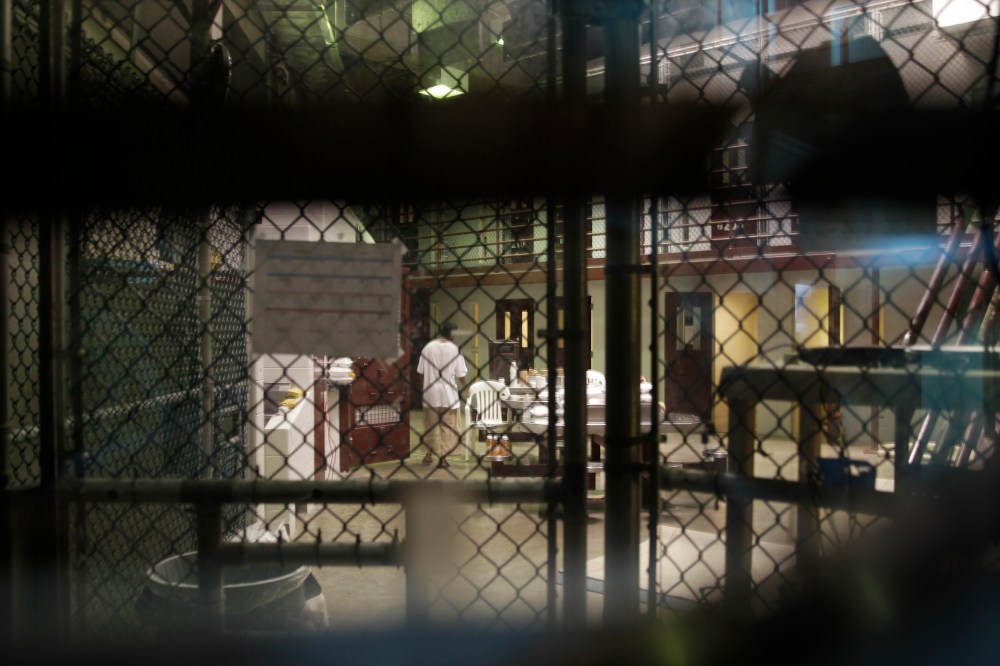
When we filed the first case challenging detentions at Guantánamo Bay shortly after the first men arrived there in 2002, we didn’t know what to expect. Family members of a few of the detained men had contacted lawyers seeking help, but we truly had no idea who was inside the prison as they were held incommunicado. We could not communicate with our clients but filed suit at the behest of their families. The Bush administration had been telling the public that these men were extremely dangerous, committed to killing Americans — the worst of the worst. And for all we knew at the time, that was the truth.
%22Even%20if%20the%20men%20at%20Guant%C3%A1namo%20were%20the%20worst%20of%20the%20worst%2C%20they%20must%20have%20the%20opportunity%20to%20challenge%20their%20detention…%22′
But we also knew the government was trying to create a legal black hole. It had happened before. In the early 1990s, the U.S. government detained at Guantánamo thousands of Haitian refugees fleeing the military coup that ousted President Aristide. As human rights advocates challenged these detentions, including the segregation of HIV-positive people who were prohibited by law from immigrating to the U.S., the government argued that Guantánamo was outside the reach of U.S. law, including basic access to legal representation. These refugees were trapped in legal limbo: unable to return to Haiti but prevented from seeking asylum in the U.S. Although one of the appellate courts gave limited due process rights to the HIV positive refugees at Guantanamo and they were eventually admitted to the U.S., another court ruled that thousands of others had no constitutional rights at Guantanamo.
A decade later, as we watched the Bush administration populate a prison that held the dubious distinction of having been declared a lawless space, we knew it did not matter who was in Guantánamo. Since the Magna Carta, the cornerstone of Western law has rested on the principle that the Executive cannot lock up anyone arbitrarily and throw away the key. Even if the men at Guantánamo were the worst of the worst, they must have the opportunity to challenge their detention — through a legal mechanism called habeas corpus.
That first habeas corpus case to address the rights of detainees at Guantánamo, Rasul v. Bush, was decided by the Supreme Court 10 years ago yesterday in what The New York Times said was arguably “the most important civil liberties case in half a century.” Establishing the right of prisoners at Guantánamo to challenge their detention, Rasul pierced the shroud of secrecy surrounding the prison. It had taken over two years for attorneys to fight their way in, and now they began to collect the names of the men being detained and their stories of torture and abuse.
The world learned that these men were not the worst of the worst, but that almost all of them had no involvement with terrorism. According to the government’s own documentation, the majority of the men at Guantánamo had never committed any hostile act against the U.S. or its allies, and only 8% of the prisoners were alleged al-Qaeda fighters. Most startling, the overwhelming proportion of the prison population, a full 86% of the men imprisoned at Guantánamo, had been sold to the United States for bounties.
Yet even these facts were not the most startling revelations. After Rasul, we learned what our government was capable of: not only imprisoning innocent men and denying them due process, but torture. We learned of beatings, stress positions, and exposure to extreme temperatures; solitary confinement, sleep deprivation, religious and sexual humiliation.
These stories forever changed the public narrative surrounding detentions at Guantánamo — so much so that a rising star in the Democratic party made his name and secured the presidency in part on his calls for and commitment to closing the island internment camp.
But a decade after Rasul, 149 of those stories, 149 men, remain imprisoned at Guantánamo, despite the majority having been cleared for release, embroiled in another cycle of political mudslinging. The Supreme Court, abdicating its responsibility to enforce its own rulings, has refused to hear every Guantánamo case on the merits since 2008. Congress is considering legislation to strip Guantánamo prisoners of their hard-won rights. And that committed senator, now president, has repeatedly failed to exercise the political will to close the prison. Meanwhile, the old narrative is rearing its head. Just a few weeks ago, media sources described the five Guantánamo prisoners exchanged for U.S. Army Sgt. Bowe Bergdahl as the “worst of the worst,” despite evidence that they had been — 12 years ago — primarily mid- and low-level Taliban bureaucrats. Once again, fear-mongering and fable threaten to distract from the ugly realities of fact and injustice: twelve years of detention without charge or trial; the winnowing of Guantánamo’s population to mostly Yemenis, trapped by their citizenship; and more than half a prisoner population languishing years after having been cleared for release. If Guantánamo is ever to end, we must remember the legacy of Rasul: no human being is outside the law; executive detention is anathema in a democratic society; and fundamental rights are not just words in law books, but must be enforced. We must remember how false a narrative can be, and that, as a lawyer for one of the men traded for Sgt. Bowe Bergdahl pointed out, if people actually look at the evidence, it “will puncture the exaggerated and hysterical claims of politicians and pundits.” Because of Rasul, those facts are public. Congress, the courts, and above all President Obama should take a cold hard look at them, and save these men from their decade-plus in limbo. Michael Ratner is president emeritus of the Center for Constitutional Rights.
Michael Ratner Recommended


