








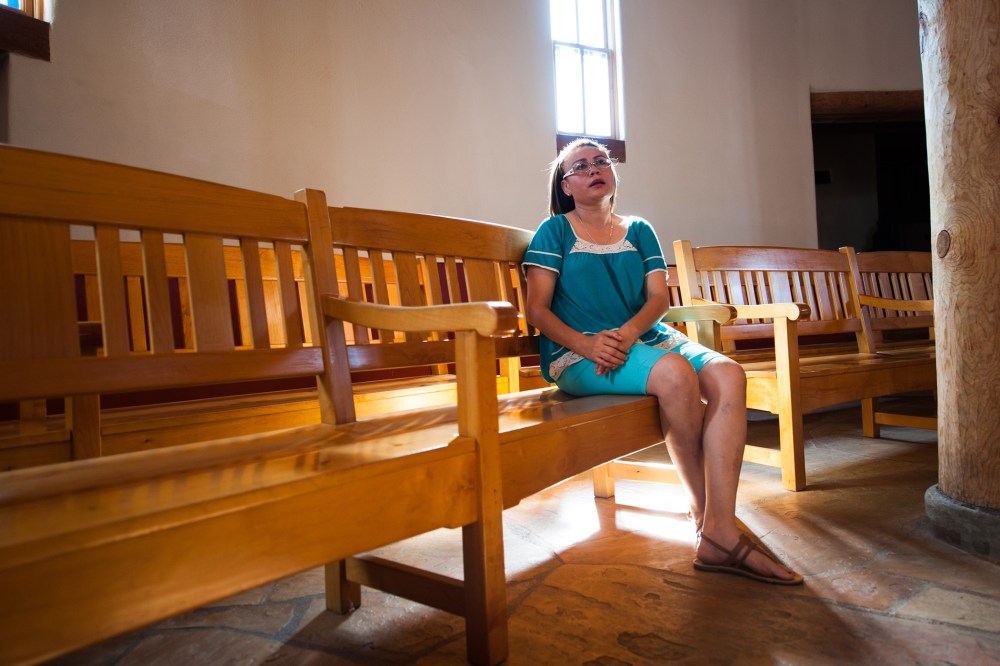
President Obama had said repeatedly that Congress has left him no choice but to act on his own to repair U.S. immigration policies by keeping more families united. Because he has yet to live up to his pledge, church leaders say Obama is now leaving them with a familiar dilemma — if the president wasn’t going to shield immigrants from threats of deportation, then it was up to them.
In light of President Obama’s delay on immigration action, religious leaders from across the country are reinforcing calls to revive the Sanctuary Movement, a network of faith-based institutions willing to open their doors to undocumented immigrants for as long as it takes for federal officials to close their deportation cases.
Since the start of the summer, church leaders said more than two dozen congregations have come forward to offer sanctuary to undocumented immigrants in Phoenix, Tucson, Chicago and Portland, with another 60 communities of faith pledging their support.
“The growth and momentum of sanctuary across the country is a result of congregations and immigrant communities working together to confront these broken human-made laws. We have a higher calling,” Rev. Noel Andersen, a coordinator with the Church World Service, said in a press call with reporters Wednesday.
Taking advantage of federal policies that bar immigration agents from entering places of worship to carry out final deportation orders on undocumented immigrants, church leaders from across the country have stepped up to protect their communities and allow sometimes whole families to seek refuge behind their doors.
“Opening the doors of a church or a synagogue or a mosque and declaring sanctuary is a very serious matter,” Andersen said. “Faith leaders and their congregants do not enter into this decision lightly.”
The Obama administration has said that agencies would focus arrest and deportation resources on immigrants who have criminal records and not people who do not pose a threat. But it hasn’t always worked out that way. Communities fed up with seeing families being torn apart have begun to defy federal laws and protect people who have deep roots in the U.S.
“My struggle goes further than from my immediate family, and it is a call and a national petition so that others can also have hope and establish their lives here, where we have already lived for so long,” said Rosa Robles Loreta, who has lived in Southside Presbyterian Church in Tucson, Ariz., for 48 days.
The original Sanctuary Movement was born out of Southside Presbyterian in the early 1980s when thousands of Central Americans fled violence and brutal civil wars that were flaring up in Guatemala and El Salvador.
Church leaders began what they called an underground railroad network connecting the scores of families that were streaming across the U.S. border to safe houses that offered shelter and legal aid to those formally seeking legal asylum. Within a few years, organizers said that as many as 500 churches and synagogues joined the movement, setting roots for the religious network helping indigent populations today. Southside Presbyterian rekindled the movement this summer by opening its doors to a Tucson man who faced a final threat of deportation. Under pressure from elected officials and the community, federal immigration enforcement officials ultimately allowed him to remain in the country for another year. “While Arizona has been known as the birth place of anti-immigrant legislation and sentiments, the actions of these congregations are changing that narrative and now Arizona is becoming known as the birth place of a faith-based moment of solidarity and hospitality that we call Sanctuary,” Rev. Alison Harrington of Southside Presbyterian said. Faith leaders said they were disappointed to see President Obama delay action on deportation relief, which advocates estimate could help millions of undocumented adults who have U.S.-born children or are the parents of DREAMers, young immigrants brought to the U.S. as children. However because of the delay, as many as 70,000 more undocumented immigrants will face fears of deportation before Obama addresses the issue, advocates warn. “The Sanctuary Movement across this country speaks to the moral imperative and the humanity of the issue, which is forgotten in the political discourse that happens around the issue of immigration — where people become number, where the consequences of families being divided is minimized, where children fleeing their violence are treated as invaders,” Rep. Raúl Grijalva said Wednesday.
Amanda Sakuma Recommended


