








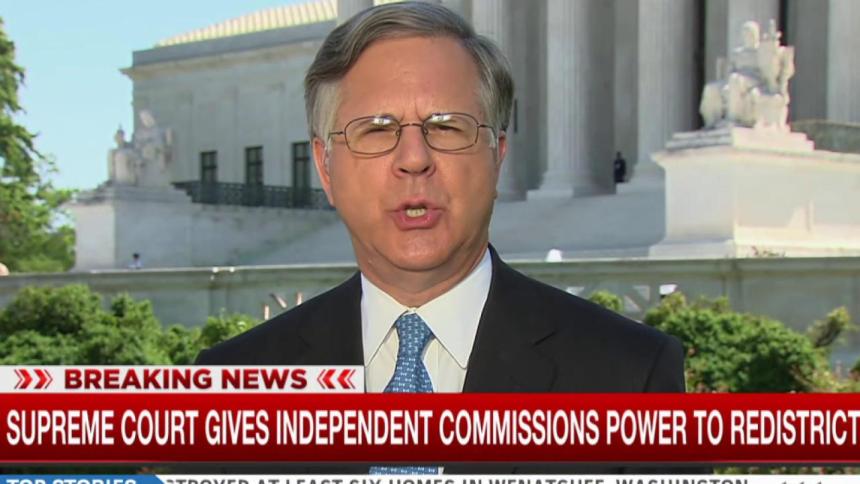
Democrats cheered and Republicans booed the Supreme Court’s decision upholding a voter-passed redistricting commission in Arizona designed to prevent gerrymandering, but it’s not entirely clear which party stands to benefit the most nationally from the case.
The case concerned Arizona’s congressional map, which, thanks to a voter-approved ballot initiative, was designed by an independent commission tasked with making races as competitive as possible. Arizona Republicans, who controlled the legislature after the 2010 census and stood to make the map more GOP-friendly if they directed the process instead, sued on the basis that the Constitution grants redistricting power only to state legislatures. In a 5-4 ruling, the court found that the voter-approved commission was a legitimate alternative.
The backdrop for the decision is the national political map, which is currently dominated by Republican gerrymanders in key states after their sweeping gains in 2010 – a redistricting year – allowed them maximize their hold on state legislatures and House seats alike with new district lines.
RELATED: SCOTUS upholds Arizona’s system for redistricting
For Democrats, the ruling prevents an otherwise Republican state in Arizona from extending that dominance even further, as GOP legislators have done in critical swing states like Pennsylvania, Ohio, Michigan, North Carolina, Florida, and Wisconsin after taking control in 2010. Republicans held onto the House in the 2012 election thanks in part to a 34-seat margin in the above six states, each of which went for President Obama that year.
Not only that, the ruling keeps alive the prospect of future gains in states that allow citizens to put policy initiatives on their state’s ballot independent of the legislature, a list that includes Michigan, Ohio, and Florida. Common Cause, a progressive advocacy group that pushed for California’s commission, is eyeing their options now that the court’s clarified the legal landscape.
“There are a number of states we’re working in to pursue commissions, whether it’s by citizen initiative or legislative action,” Dale Eisman, communications director for Common Cause, told msnbc in an interview. “We are very pleased with the ruling.”“This ruling protects the will of the voters in Arizona, California, and other states that have chosen to remove partisan gerrymandering from the congressional redistricting process,” Michael Sargeant, executive director of the Democratic Legislative Campaign Committee (DLCC), said in a statement hailing the decision.
The Republican State Leadership Committee (RSLC), a group that’s poured tens of millions of dollars into a program to elect GOP state legislators in order to direct redistricting, issued its own statement decrying the decision.
“We support the many states whose legislatures — elected by voters to make the tough decisions — determine legislative districts, and we will continue to support the work that they do,” RSLC chair Bill McCollum said.
It’s possible, however, that Republicans might have had the most to gain in the short-term from a ruling knocking out voter-passed redistricting commissions.
The only other place with a similar commission is California, the nation’s most populous state with 53 congressional seats, which implemented it for the first time in its 2010 redistricting. While the results were disappointing to some Republicans who felt Democrats still indirectly influenced the process, Democrats dominate state government and could have tried to expand their House advantages even further had Monday’s ruling gone the other way. There would have been obstacles — pushing the boundaries too far could make some of their own incumbents more vulnerable than they’d like — but the risk for the GOP was real. RELATED: Supreme Court decisions expose America’s starkest divide Additionally, one of the states where activists are working to get independent redistricting commissions passed through a referendum is Illinois – a rare state where Democrats had total control over House maps after 2010 and aggressively used the process to benefit their candidates. “It would seem to me your best opportunity to move forward reform in the future will be in Democratic leaning states like Illinois,” Michael McDonald, a professor at the University of Florida who researches election law, told msnbc. “Politically, more reform will probably work against the Democrats.” For these reasons and others, some Democratic operatives working on the issue are skeptical of commissions as the answer to their redistricting woes. The DLCC’s Sargeant hastened to add in his statement praising Monday’s ruling that winning state elections “remains the only sure means of preventing extreme GOP gerrymandering in the decade to come.” Observers on both sides of the aisle may approve or disapprove of the decision on principle even if they think the results are negative. But if raw political gain is the goal, it may be some time before we know which side won the day.
Benjy Sarlin Recommended


