As President Obama’s second term winds down and Hillary Clinton’s likely presidential campaign winds up, it feels like the 2016 election is drawing even more attention than the upcoming midterm races.
But there’s another election increasingly on the minds of Democratic lawmakers, party operatives, big money donors, and progressive activists: 2020. That’s the year voters will elect state lawmakers who will redraw congressional and state legislative districts all over the country.
Last week, the Democratic Legislative Campaign Committee announced it would commit at least $70 million to Advantage 2020, a program aimed at targeting legislative chambers in key states over the next four election cycles with the specific aim of influencing redistricting. The plan calls on Democrats to invest resources not just in state chambers the party has a shot at winning this November, but in legislatures where they might have a chance at slowly eroding a GOP majority over time thanks to demographic trends.
%22We%20are%20screwed%20in%20the%20legislature%20if%20we%20keep%20having%20these%20maps.%22′
“[Gerrymandering] has led to far right policies in states, far right policies in Congress,” Michael Sergeant, executive director of the DLCC, told reporters in announcing the new program. Republicans “don’t feel like they’re accountable to anybody because they feel like they have drawn the lines and the maps in such a way that they don’t have to actually answer to the voters,” Sargent said.
The project is part of a broader effort by Democrats to pull the party out of the rubble left behind by the 2010 election, when Republicans made massive gains at the state level that allowed them to gerrymander Congressional maps in critical states after the new census.
In addition to the DLCC’s plan, new Democratic outside groups like the General Majority PAC, which spent $9 million defending New Jersey Democrats’ control of the state senate in 2013, are gearing up to play in other state races with an eye towards 2020. Billionaire environmentalist Tom Steyer, who has pledged tens of millions of dollars toward helping Democrats win Senate and governors races this year, is looking into expanding his group NextGen’s reach into state legislatures as well.
The increasing focus on redistricting is partly a reflection of the bleak governing environment for Democrats nationally. The gridlock produced by the obstructionist Republican Congress and Democratic White House has ground policymaking to a halt, even in areas with some degree of bipartisan overlap like immigration and tax reform. While Washington has been paralyzed, Republicans’ dominance in state legislatures has triggered a renaissance of conservative policymaking across the country. Both of these trends have been exacerbated by the GOP’s tremendous success gerrymandering state and Congressional districts to help protect their majorities.
At the annual progressive conference Netroots Nation in Detroit earlier this summer, several speakers identified redrawing state and Congressional maps as a top priority. Markos Moulitsas, the Daily Kos founder who helped launch Netroots, has been urging activists to focus their attention on 2020 for months and this year’s conference included a panel by the DLCC previewing its redistricting plan.
“You can’t wait until 2020 or 2022 to start talking about it,” Tom Bonier, a Democratic consultant at Clarity Campaign Labs and redistricting veteran helping run the Advantage 2020 project, told activists. “It starts now and it’s going to be won or lost based on what we do now.”

Michigan progressives know better than anyone how big a difference the issue can make. After 2010, Republicans took complete control of the state government there and used it to redraw the state’s Congressional and state legislative districts in the party’s favor. While President Obama won Michigan by 9.5 points in 2012, voters there elected 9 Republican members of Congress to just 5 Democrats. The next month Republican Governor Rick Snyder signed “right to work” legislation into law in a state that’s historically been a bastion for organized labor.
“Who here gets up in the morning and is excited about redistricting?” Ryan Bates, the executive director of Michigan United, asked the audience at a panel of state activists. “It’s a game changer,” Bates continued. “We are screwed in the legislature if we keep having these maps.”
Melanie McElroy, the executive director of Common Cause Michigan, called redistricting “the fundamental reform that folks across the progressive spectrum need to focus on.”
The fantasy scenario for Democrats, if all goes right, might look something like this: President Hillary Clinton, capitalizing on a solid first term, a still-divided GOP, and the usual advantages of incumbency, leads her party to a decisive victory in 2020. Riding her performance, Democrats down the ticket take over a number of key state legislatures and governor’s seats. Now with far greater control over the redistricting process, they put the House back into play.
The emphasis here is on “fantasy” scenario. For Democrats to regain the ability to pass major progressive legislation anytime soon, they need a smart plan, a lot of money and a lucky streak that won’t quit.
The 2010 disaster
The 2010 election, in which Democrats lost 63 seats and their House majority, would have been a major setback by any standard. But the timing and geography of the gains made it a historic disaster from which Democrats are only beginning to recover.
While all the focus was on Democrats’ congressional losses, the damage at the state level was arguably worse. Republicans flipped 22 state legislatures and ended up with more seats nationally than any time since 1928. They also gained a net of six governorships, several of them in crucial swing states.
The GOP didn’t just gain power in states heading into post-census redistricting — they gained power in the states that matter. Republicans dominated the process in almost every large presidential swing state where, like Michigan, the right tweak can make all the difference.
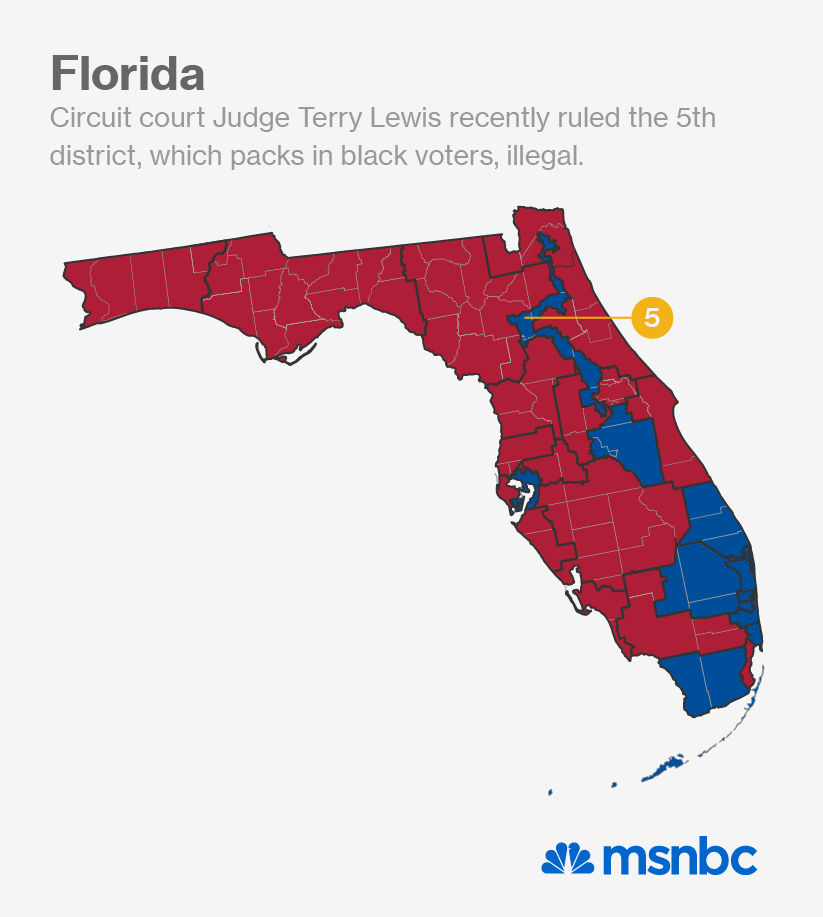
Pennsylvania, for example, has voted for a Democratic presidential candidate in every race since 1988. But by packing Democrats into districts around the Philadelphia area, Republicans today control 13 out of 18 the state’s House seats. RealClearPolitics columnist Sean Trende dubbed Pennsylvania “the gerrymander of the decade,” but it has plenty of competition from states like North Carolina, a blue-trending state that Obama won in 2008 then narrowly lost in 2012. There, Republicans jammed Democrats into 3 awkwardly shaped districts and spread GOP voters into 10 Republican-leaning seats, one of which is held by the retiring Democratic Rep. Mike McIntyre. In perennial swing state Florida, Republicans hold 17 out of 27 seats after a new map moved large numbers of Hispanic voters into safe Democratic districts.
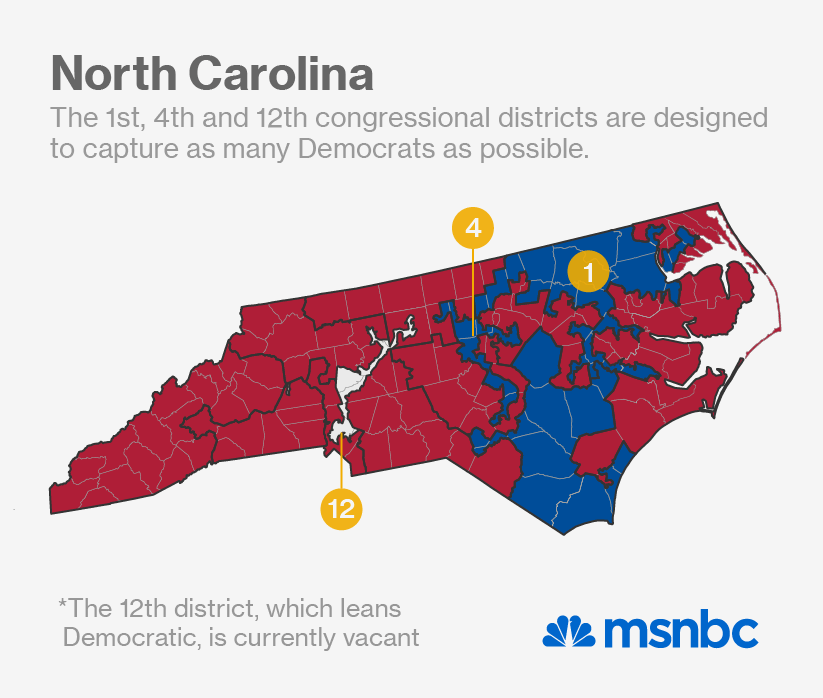
Republican state lawmakers also pulled up the ladder behind them by redrawing their own district lines. As a result, Democrats face a double obstacle: in order to undo gerrymandering after 2020, they have to win back state legislatures that have already been gerrymandered to give the GOP maximum advantage. Retaking either chamber in North Carolina, for example, is considered out of reach this year even though the legislature has grown enormously unpopular in polls. Instead, Democrats aim to chip away at seats over time and hope the state’s demographic trends eventually put them over the edge.
Across the South, the state redistricting process had a more pronounced racial component. Republican-dominated states like Alabama and Georgia used the process not just to give the GOP a solid majority but to eliminate state legislative districts represented by white Democrats en masse. Democrats say the maps are designed to limit their appeal in the racially polarized electorate by branding them exclusively as the party of black Americans.
The situation isn’t even as bad as it could get for Democrats. After Obama’s re-election, Republican leaders in Pennsylvania, Virginia, and Wisconsin flirted with bills that would allocate their electoral votes by Congressional district rather than by winner-takes-all, which would essentially sacrifice their swing state status to ensure the Republican presidential nominee gets more votes. RNC Chairman Reince Priebus praised these proposals as “something that a lot of states that have been consistently blue that are fully controlled red ought to be looking at.” Fortunately for Democrats, the idea seemed to die out quickly last year after a public backlash, but another Republican loss in the 2016 presidential contest could encourage it to resurface.
These double-gerrymandered states didn’t pop up just because 2010 was a great Republican year, though. GOP officials and donors caught Democrats off guard with a well-funded statehouse program specifically aimed at gaining control of redistricting.
The Republican State Leadership Committee, an organization helmed by veteran GOP operative (and current Virginia Senate candidate) Ed Gillespie, raised $30 million for legislative races in 2010. As detailed by The New York Times, a network of big name conservative donors, from David Koch to the late Texas homebuilding tycoon Bob Perry, routed tens of millions dollars more through state parties, candidates, and outside advertising in battleground races around the country.
By contrast, Bonier says Democrats were slower to realize the danger and devote necessary time and money into states like Ohio, where retaining even one legislative chamber would have given them far greater influence over redistricting.
“People talked about redistricting, but not a lot of people beyond the DLCC and some unions wanted to invest in it because there was always something else,” he said. “In 2008 it was the presidential election and in 2010 the focus was almost entirely on the House because it was the Obamacare fallout election.”
The Republican investments paid off big time, as the RLSC boasted in a report on how their redistricting initiative REDMAP held up in 2012:
“Democratic candidates for the U.S. House won 1.1 million more votes than their Republican opponents. But the Speaker of the U.S. House of Representatives is a Republican and presides over a 33-seat House Republican majority during the 113th Congress. How? One needs to look no farther than four states that voted Democratic on a statewide level in 2012, yet elected a strong Republican delegation to represent them in Congress: Michigan, Ohio, Pennsylvania and Wisconsin.”
In the four states the RLSC named in its memo, Republicans emerged in 2012 with 22 more seats than Democrats. Add in Florida and North Carolina and that’s a net of an additional 12 seats. While redistricting isn’t the only reason for the GOP’s superior performance in those states (more on that later), this small group alone accounts for their entire advantage in the House.
%22Anything%20is%20geographically%20possible%20if%20you%20can%20go%20crazy%20with%20the%20map%20the%20way%20Illinois%20has.%22′
“Florida, Michigan, North Carolina, Ohio, Pennsylvania: The starting lineup for your redistricting All-Stars,” one Democratic operative working on the issue said to msnbc. “Right there is your Congress.”
The current map isn’t impossible for Democrats to overcome – many of the gerrymandered districts lean only slightly Republican – but it would take an epic election year to do it. Sam Wang, a Princeton neuroscientist who has studied the latest round of redistricting, estimates that Democratic would have needed to win House races nationally by 7 points in 2012 to secure a majority. That kind of blowout is rare, but not impossible.
Take 2006, when Democrats picked up majorities in both the House and Senate. Many analysts, including some prominent Democratic strategists, believed the House was out of play at the start of the cycle thanks to similar GOP advantages of incumbency and redistricting. They were proven wrong, but it was because the party had an advantage Democrats – they hope – won’t have before 2020: An unpopular Republican president. Without the opposition in the White House, it’s hard for a party to generate levels of momentum on par with 2006 or 2010.
“If Hillary Clinton gets elected in 2016 she’s probably not going to have control of the House,” Kyle Kondik, managing editor of Larry Sabato’s Crystal Ball, told msnbc. “And if [you don’t] start with it, then generally speaking your own party’s strength erodes over your term.”
Undoing the damage
Democrats have been trying to climb out of the hole ever since with their own state level push. In 2012, with the help of a surge in outside spending from labor groups, Democrats made some gains, picking up 150 seats and eight legislative chambers, although Republicans had some successes as well. Democrats hope by hiring and training more operatives on the ground, implementing technology modeled after their presidential campaigns, and focusing donors’ attention on state level races, they can gradually reverse tougher Republican majorities heading into 2020. With state races moving to the top of the priority list and more and more money flowing through the political system, however, major swings may become harder to pull off. Republicans, for their part, are confident they can make gains in 2014 and beyond. The RSLC has set a goal of winning a “supermajority of majorities” this year, upping the number of state legislative bodies in their control from 60 to 66 out of 99 (Every state has an upper and lower chamber except Nebraska, which has a unicameral legislature.) The group has also invested in new programs to recruit more diverse candidates in order to help keep pace with the demographic changes that have buoyed Democrats at the presidential level. The Koch-backed advocacy group Americans For Prosperity, for example, is expanding its staff in states around the country and eyeing more state legislative races and local ballot initiatives. “With President Obama’s successful reelection in 2012, Democrats had their chance to make significant legislative gains but the overwhelming majority of Republican majorities withstood those challenges,” RLSC President Matt Walter told reporters in July. “That was their opportunity. They’ve missed it.” Some groups have been looking at other measures to try and level the playing field without winning elections. There’s legal action – a judge in Florida recently ruled the state’s current congressional map violates state law preventing lawmakers from drawing districts “with the intent to favor or disfavor a political party or incumbent.” But the revised version might not be too different and won’t take effect until after November. Alabama’s Legislative Black Caucus is suing to throw out its state district lines, a case that’s headed to the Supreme Court and could potentially set a new precedent that applies to other states. Another possible route is for voters to force states to practice nonpartisan redistricting, either via an independent commission or even a computer algorithm. Proponents of the nonpartisan route point to California as a model. While Democrats there enjoy complete control of government, the state’s Congressional districts roughly tracked the presidential vote thanks to an independent redistricting commission created by a voter referendum that went into effect in 2012. California is home to a number of competitive Congressional races this year, a major departure from the five elections under the previous map in which only one seat out of 265 total races changed party hands. Progressive activists in Michigan, which also allows for ballot initiatives, are looking into doing something along the same lines before 2020. But some Democrats are skeptical nonpartisan redistricting would actually make the House much more competitive. “I think it’s easy to make the argument they’d be better than status quo simply because the status quo in so many cases has been so irresponsible,” Bonier told msnbc. “But if your objective is to remove partisan bias from redistricting, then you have to use partisan data.” This runs into a broader argument over just how much gerrymandering is actually responsible for the GOP’s dominance in the House and various state legislative chambers. For Democrats, redistricting is only part of the reason they have trouble winning Congressional and state elections — Republicans also enjoy geographic advantages that give them a leg up. Democratic voters, especially minorities, tend to be densely clustered in large cities that support Democratic candidates by overwhelming margins, while Republican voters tend to be more spread out. The result is that safe Democrats end up “wasting” a lot more votes in ultra-Democratic districts compared to safe Republicans. Part of this is by design: the Voting Rights Act protects minority communities, who tend to favor Democrats by large margins, from being spread across many districts in order to dilute their electoral strength. Jowei Chen, an assistant professor of political science at the University of Michigan, ran thousands of simulations of different Congressional maps that tried to keep districts as compact and uniform as possible with no other factors considered. While his experiment found that heavily gerrymandered states like Michigan and Pennsylvania indeed produced a few more seats for Republicans against his alternate scenarios, the net gain nationally was usually around five to seven seats – significant, but still not enough for Democrats to retake the House. New York Rep. Steve Israel, the chairman of the Democratic Congressional Campaign Committee told reporters at a breakfast meeting that Democrats “have to be smarter and better going into the 2020 redistricting.” But he also estimated that only five seats were taken “irreparably” out of play by GOP gerrymandering. While Israel has some motivation to downplay gerrymandering (“The 2014 election is already preordained, give us your money!” isn’t a great pitch to donors), he isn’t wildly out of line with Chen’s findings. There’s an important caveat to that science, though. Chen’s simulations measure the current Congress against a nonpartisan ideal of compact, unbiased districts all over the country. In the brass knuckle world of political redistricting where most states will remain in 2020, however, the potential for Democrats to make the House more competitive is greater. How much greater? The best way to judge the potential gains might be to look at the few states where Democrats have been able to implement their own partisan gerrymanders. At the top of the list is Illinois, a state not entirely dissimilar to Michigan in size, demographics, and geography. Unlike Michigan, though, Democrats controlled the redistricting process after 2010 and paired some Democratic-heavy neighborhoods in the Chicago area with Republican-leaning suburbs to maximize their voters’ impact. They now hold 12 seats in Congress versus 6 for Republicans. “It’s exactly what Democrats would love to do in Michigan if they could,” Chen told msnbc. “Anything is geographically possible if you can go crazy with the map the way Illinois has.” Democrats also cite Minnesota as a model for how even gaining partial control of the process can make a difference. After Democratic Gov. Mark Dayton vetoed a Republican redistricting plan, the courts sent back a map that made minor changes to the existing districts. Democrats hold 5 seats, Republicans hold 4 seats, and several are competitive this year. In the end, as Bonier puts it in presentations to Democrats, the party’s “secret plan” to improve the environment for the party boils down to this: “1) Win control. 2) Draw smarter maps.”
Benjy Sarlin Recommended