








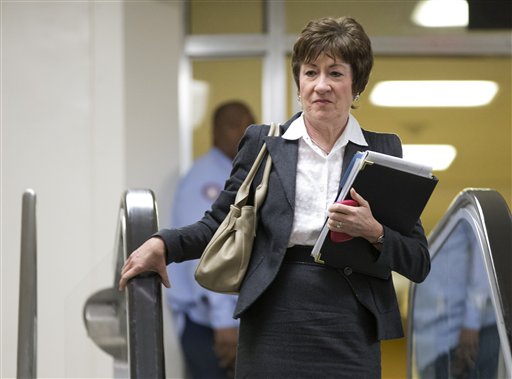
Sen. Susan Collins has unveiled the latest reason to oppose Susan Rice as secretary of state. And it makes even less sense than the previous ones.
At a press conference after meeting with Rice, the U.S. ambassador to the U.N., Collins said Rice’s response to the attacks on the U.S. Consulate in Benghazi, Libya had an “eerie echo” of the bombings of two U.S. embassies in Africa in 1998, when Rice served as the head of the State Department’s Africa region.
“She had to be aware of the general threat assessment and of the ambassadors’ request for more security,” Collins, a Maine Republican, said of Rice’s role in that incident.
But a far more devastating terrorist attack occurred three years later, when a different Rice, Condoleezza, served as national security adviser to President Bush. Indeed, in August 2001, Bush and Condoleezza Rice received a CIA memo headlined: “Bin Laden Determined To Strike In U.S.” If ever a government official “had to be aware of the general threat assessment,” it was Condoleezza Rice then.
Collins didn’t think so, though. It’s easy to “go back now and pick out a clue here and a tidbit there … but we have to keep in mind the environment,” Collins said when the memo surfaced in 2004. “We have to keep in mind the volume of reporting that the president and his advisers are dealing with each and every day.”
The following year, Collins voted to confirm Condoleezza Rice as Secretary of State, praising her “professional experience and personal integrity.”
It gets worse. At Wednesday’s press conference, Collins also accused Susan Rice of playing a “political role” by appearing on five Sunday talk shows to talk about the Benghazi attacks. Rice said the attacks were triggered by an anti-Muslim film—an explanation that now appears incomplete, and which Republicans have said renders her unfit for the secretary of state post.
But Susan Rice is hardly the first top administration official to appear on the Sunday shows during the heat of a presidential campaign and act as a spokesman for the administration.
Guess who said this on ABC’s This Week in 2004: “I think the president did what he always does. He had a chance to show the American people why he’s a strong leader.” That’s right—it was Condoleezza Rice, praising President Bush’s performance in a recent presidential debate with Sen. John Kerry. Of course, Susan Rice’s most vocal opponent, Sen. John McCain, has also appeared to use a different standard to judge the two Rices. When Democrats raised concerns about Condoleezza Rice’s role in leading the U.S. into war with Iraq on the basis of flawed intelligence, the Arizona senator accused them of harboring “lingering bitterness at the outcome of the [2004] election.” Research assistance from Amanda Sakuma
Zachary Roth Recommended


