








Many people quickly gloss over a terms of service agreement at one point or another, an easy enough feat when making online transactions. But few would assume that simply visiting a website or interacting with a brand on social media would amount to signing a contract.
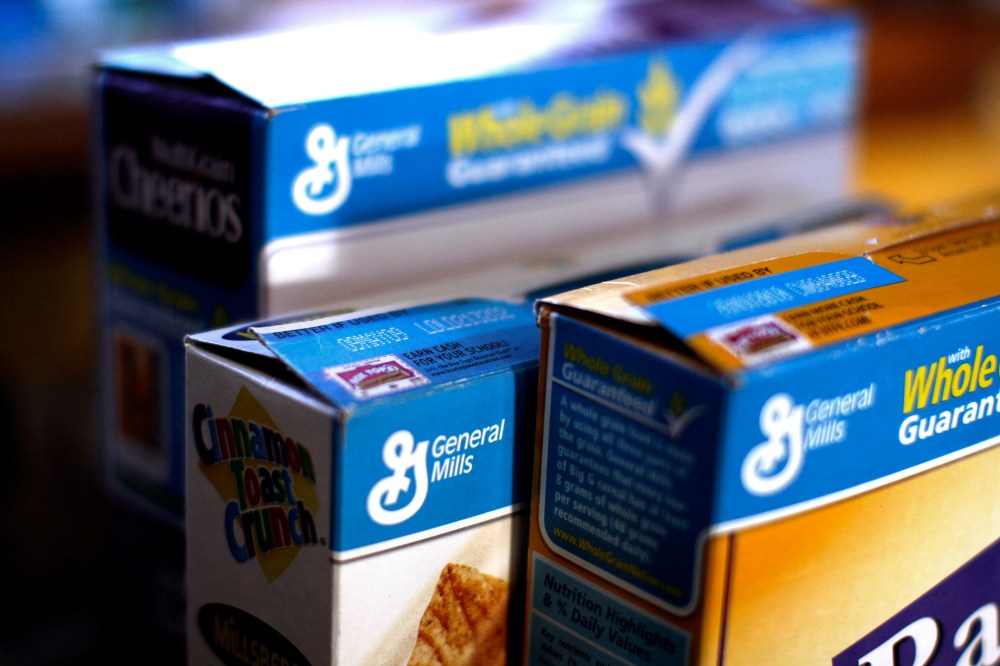
Yet as first reported by the New York Times, General Mills, manufacturer of cereals and other foods, instituted a new policy that appears to bind anyone who so much as downloads a coupon or likes General Mills on Facebook to an arbitration agreement should they try to sue. The Times reported that General Mills has altered its policy after negative feedback generated by its article. The company claims that the new legal policy was “broadly mischaracterized” in media reports and that the policy has not been changed.
Many companies compel consumers into arbitration agreements — private legal proceedings used to settle disputes — just by purchasing their products, but General Mills’ policy, which states that “use of any of our sites or services, or participation in any other General Mills offering, means that you are agreeing to these Legal Terms,” appears to make a broader claim, in that you don’t even have to buy anything or click “I agree” on one of those lengthy service agreements to be bound by their terms.
In a blog post, a General Mills representative appears to write mere “use of any of our sites” out of triggering the terms, stating that “when consumers interact with us online, such as subscribing to an online publication, entering a sweepstakes, or downloading coupons from websites such as Pillsbury.com or BettyCrocker.com, we list the legal terms guiding that interaction. These terms kick in only when you engage and agree, but even then, nothing in the policy precludes a consumer from pursuing a claim.”
So, to use an example given by the Times: if you were allergic to an ingredient in a General Mills product that was mislabeled — too bad, you’ve already given up your right to sue, no matter how dire the consequences.
“What General Mills is really doing is testing the extent to which they can impose these adhesion contracts on unaware customers,” said Reuben Guttman, a board member at the American Constitution Society and a partner at Grant & Eisenhofer. “The average person doesn’t retain counsel to buy cereal.”
This may all sound far-fetched, but the only reason General Mills can even consider going this far is that American courts over the last few decades have tilted the playing field in favor of corporations trying to avoid lawsuits — and few have been as friendly as the Supreme Court under Chief Justice John Roberts. Companies have tried hard to ensure that disputes don’t make it into a courtroom, where damaging information can come out, but are rather funneled into private arbitration procedures, where the outcomes are often more favorable to the company.
“Over the last probably two decades, the court has been moving in a very pro-arbitration direction, making it increasingly more difficult for everyday Americans to have their claims against corporations brought before a court of law,” says Elizabeth Wydra of the Constitutional Accountability Center. “The Roberts court has taken this to an extreme.”
In 2010, the Supreme Court ruled in Rent-A-Center v. Jackson in favor of a company that compelled its employees to sign a forced arbitration agreement as a condition of employment, even if the employee had no meaningful way of refusing the agreement other than by walking away from the job. In 2011, in AT&T v. Concepcion, the high court made it far more difficult for consumers to file class-action lawsuits against companies ruling that federal law protected the fine print in a cell phone contract that barred consumers from bringing them. So companies know that those agreements that we tend to gloss over when we’re buying a phone or signing up for a credit card, that set up terms through which the company itself will rarely lose, are perfectly safe. Although we don’t know whether the courts would agree with any company that contended that you sign a contract if you visit their website, follow them on Twitter or “like” them on Facebook — and General Mills has now said its legal terms wouldn’t apply to the latter two examples — the new policy is just testing the limits of how far the legal system is willing to let companies go. In Concepcion, the Supreme Court ruled that their interpretation of federal law governing arbitration agreements superseded a California state law barring “unconscionable” contracts, so it’s not like more liberal states force stricter rules on companies as a condition of doing business there. Even having to go to court to decide whether or not the arbitration agreement applies could cost more than the restitution a potential plaintiff is seeking, thus dissuading them from trying to go to court in the first place. Some justices on the high court also clearly believe that if you’re swindled by a terrible contract, even one you had little choice in agreeing to, well, that’s your problem. Justice Scalia, who at oral argument so often expresses in less polite terms what the rest of his conservative colleagues on the court are actually thinking, made his perspective clear during oral arguments in the Jackson case in 2010. “It doesn’t seem to me that unconscionability is the same as duress or the same as fraud,” Scalia said at the time. “You can be a stupid person who voluntarily signs an unconscionable contract.” When it comes time for General Mills or some other company to argue before the high court that a consumer ceded their legal rights through a casual interaction on social media, the court may decide that even if the legal terms are unconscionable, well the real problem is you. Because you’re “stupid.”
Adam Serwer Recommended


