








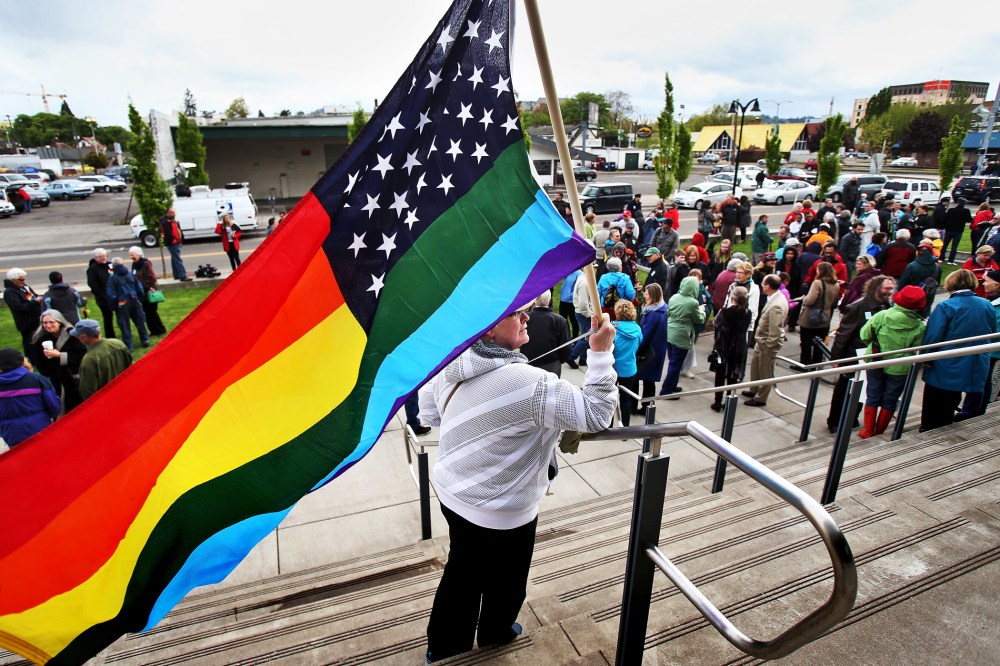
When it comes to recent marriage equality suits, there have been few surprising twists — until now.
Thanks in large part to legal reasoning set forth by the Supreme Court last June, many of the arguments, hearings, and decisions in marriage equality cases have borne striking similarities. And while four, same-sex couples suing to marry in the state of Oregon have made roughly the same case as their predecessors, Wednesday’s oral arguments were a little different: There was no defense.
Earlier this year, Democratic Attorney General Ellen Rosenblum, Governor John Kitzhaber, State Registrar Jennifer Woodward, and the Center for Health Statistics and Multnomah County Assessor Randy Waldruff walked away from Oregon’s decade-old ban on same-sex nuptials, leaving no state defendant with legal standing to argue this week on its behalf. Six other attorneys general have declined to defend their state’s marriage laws in recent years.
Another curveball — U.S. District Judge Michael McShane, a President Obama appointee who will rule on the constitutionality of Oregon’s same-sex marriage ban, happens to be one of only nine, openly gay members of the federal judiciary, according to the Human Rights Campaign. McShane isn’t the first in this position, but his sexual orientation may spark criticism depending on what he decides.
After retired U.S. District Judge Vaughn Walker announced that he was gay in 2011, marriage equality opponents unsuccessfully tried to throw out his landmark decision striking down Proposition 8 — California’s ban on same-sex nuptials. His successor, Judge James Ware, denied the motion, saying “it is reasonable to presume that a female judge or a judge in a same-sex relationship is capable of rising above any personal predisposition and deciding such a case on the merits.”
Arguments for the plaintiffs Wednesday centered on the due process and equal protection rights of gay and lesbian couples.
“We are asking you to make a statement that we don’t get to vote on people’s constitutional rights,” said one attorney, according to Dana Tims, a reporter for The Oregonian who was at the courthouse.
“You are also asking me to make a statement that the voters got it wrong,” Judge McShane pushed back. Earlier in the hearing, he made a similar statement:
"You are asking me to tell voters they went thru a hollow exercising in 2004 (by passing marriage ban) #orgaymarriage
— Dana Tims (@DanaTims) April 23, 2014According to attendees, McShane did not indicate how he would rule, opting instead to wait until a second set of oral arguments on May 14. That hearing was added to the docket just this week after the National Organization for Marriage (NOM) filed a last-minute motion to intervene in defense of Oregon’s ban.
“We have members of our organization who are residents, who each have independent standing — a county clerk, a provider of wedding services, and voters,” said John Eastman, chairman of NOM, to msnbc. “I believe the law fully supports the standing of those individuals, and we clearly have standing to bring the claim on their behalf.” Attorneys for the plaintiffs disagree, noting that NOM waited until the eleventh hour to express support for the law. “I think if they had an interest in this and had clients who had standing to intervene, they could have moved to come in quicker,” said Rose Saxe, senior staff attorney at the American Civil Liberties Union, to msnbc. Whether or not NOM and the people its claiming to represent do have standing in this case “is something the judge is going to have to consider later on in May,” she said. Oregon currently has dual campaigns underway for November ballot initiatives — one that would legalize same-sex marriage, and another that would “protect religious freedom,” a measure many believe could open the door to broad discrimination against gays and lesbians. Backers of the marriage equality initiative have said that they would drop their campaign if Judge McShane issued his decision by May 23 — the deadline to submit signatures for early review. But the May 14 hearing could throw a wrench in that timeframe. Some have speculated that NOM waited so long to file its motion precisely because it wanted to delay a ruling, keep the ballot measure for marriage equality alive, and, in turn, divert resources that would otherwise go toward combatting the religious freedom initiative. But Saxe declined to comment on NOM’s strategy. “The people of Oregon are increasingly coming to support the freedom to marry,” she said. “If we were to get marriage equality from the court sooner rather than later, then there isn’t a need for the ballot campaign. Hopefully, we’ll have marriage equality coming to our clients and other folks in Oregon one way or the other.”
Emma Margolin
Emma Margolin is a reporter at MSNBC.com. Recommended


