








The Supreme Court kicked off its fall session with a bang.
In a surprising move, the justices on Monday denied seven requests (known as petitions for writ of certiorari) to hear challenges against same-sex marriages bans in Indiana, Oklahoma, Utah, Virginia, and Wisconsin. The move immediately legalizes marriage equality in those five states, and paves the way for six more to follow. Yet it also delays a national resolution to the pressing question both sides of the debate have been asking: Do gay and lesbian couples have a constitutional right to wed?
While we don’t yet have a response to that one from the high court, here are some other questions, answered.
Why did the Supreme Court deny the cert petitions?
We don’t know for sure, as the cases were denied without comment. But legal experts had anticipated the justices could reject these seven petitions based on the fact that all of the federal appeals courts have so far ruled in favor of marriage equality. It takes four justices to grant cert. And while the issue of marriage equality has proved to be a matter of great public importance, there is currently no disagreement — or “circuit split” — among the appeals courts for the justices to resolve.
Which states will have marriage equality because of this action?
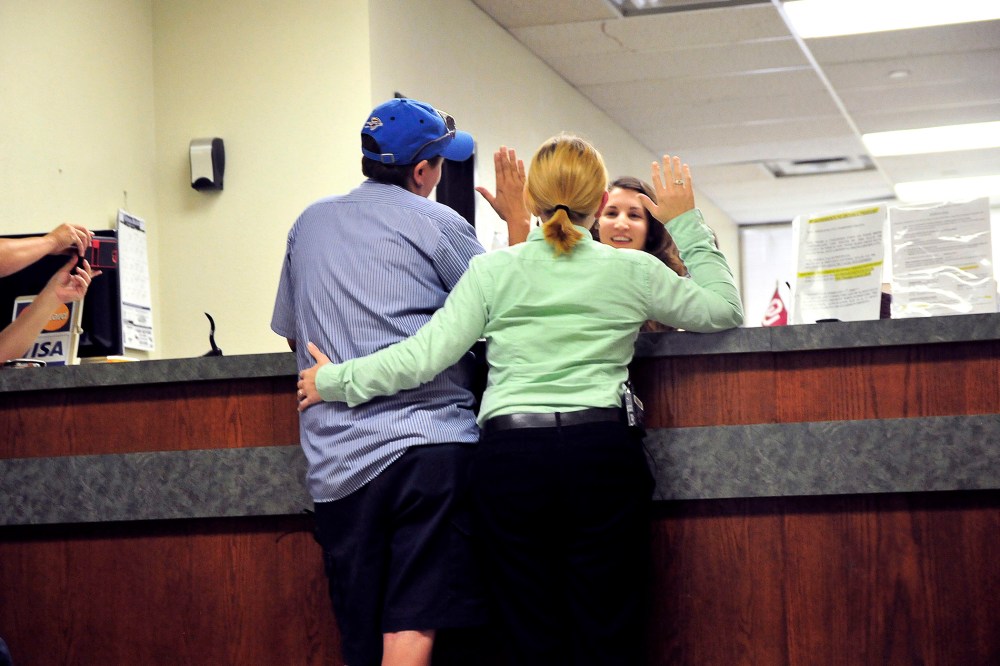
In the immediate term, marriage equality will be legalized in the five states where the rejected cases originated: Indiana, Oklahoma, Utah, Virginia, and Wisconsin. All of those states saw their bans on same-sex nuptials fall in both federal district, and appeals courts. By denying cert in these particular cases, the Supreme Court lets stand those rulings from the 4th, 7th, and 10th Circuit Courts of Appeals — all of which found same-sex marriage bans to be unconstitutional. Hours after the Supreme Court denied cert Monday, county clerks began issuing marriage licenses to same-sex couples in Oklahoma and Virginia. Other states are waiting for lower courts to formally lift their stays.
In the near future, same-sex marriage bans will also fall in six more states — Colorado, Kansas, North Carolina, South Carolina, West Virginia, and Wyoming — which make up the 4th, 7th, and 10 circuits, and are therefore bound to the same appellate rulings that were put on hold pending Supreme Court review. Now that the Supreme Court has declined to review, those holds will be lifted and marriage equality will be the law of the land throughout those three circuits. That will raise the number of states where gay and lesbian couples can marry from 19 plus the District of Columbia to 30 — more than half the nation.
Already, Colorado’s Republican attorney general has said his office will begin working to lift federal and state court orders that halted marriage equality from going forward in that state. South Carolina’s attorney general, however, said he will continue to defend the state’s same-sex marriage ban. That effort will likely fail in court, said James Esseks, director of the American Civil Liberties Union Lesbian Gay Bisexual and Transgender Project, and one of the attorneys representing plaintiffs in Indiana, Virginia, and Wisconsin.
“It may take a little while for some of these cases to get to the end of the line,” said Esseks. “But I think all of these additional states will become ‘freedom to marry’ states in very short order.”
Does this mean the Supreme Court won’t ever take up a marriage equality case?
Not at all. Marriage equality rulings are expected shortly from both the 9th Circuit Court of Appeals, and the 6th Circuit Court, which together heard challenges to seven states’ same-sex marriage bans. The 9th Circuit destroyed arguments in defense of such bans at a hearing last month, so it’s unlikely to provide the kind of circuit split the Supreme Court is looking for. But the 6th Circuit appeared far more sympathetic to same-sex marriage bans, and could very well rule against marriage equality in the near future. The 5th Circuit, widely considered one of the most conservative appeals courts in the nation, will also soon hear challenges to bans in Texas and Louisiana, and could issue a loss for marriage equality as well.
“We’ll have to wait and see what those circuits do,” said Esseks, “but if one them rules for the states and against the plaintiffs, I think the court will grant review. That decision could also happen this term.” What has to happen for other states to get marriage equality? Let’s say none of the federal appeals courts ever rule against marriage equality, leaving the Supreme Court without sufficient reason to take up the issue and deliver a sweeping ruling for the whole nation. In that scenario, marriage equality would spread to the rest of the country in the same way it has throughout the 4th, 7th, and 10th circuits. A challenge to a state’s same-sex marriage ban would go before a district judge. Whatever the ruling, it would be appealed to the corresponding circuit court, which would then find the ban unconstitutional. Given that the Supreme Court has already refused to hear a marriage equality case without a circuit split, it’s unlikely the justices would suddenly change course. So, one by one, the justices would deny cert, legalizing marriage equality throughout the remaining circuits. Let’s say a federal appeals court does rule against marriage equality, forcing the Supreme Court to grant review. In that case, said Esseks, it’s unlikely the justices would uphold a same-sex marriage ban, given the fact that they just cleared the way for it to spread to 11 states and tip the national scale toward marriage equality so dramatically. “The reality on the ground in a whole bunch of states is going to change,” said Esseks. “It would seem strange to me that the Supreme Court would turn around in a year or two, grant review on the marriage issue, and rule the other way, saying to the states that it just forced to change their public policy, ‘Just kidding.’” What’s behind the recent wave of marriage equality victories? The obvious answer here would be DOMA. Since the Supreme Court invalidated a key portion of the federal Defense of Marriage Act (DOMA) in June 2013, clearing the way for the U.S. government to begin recognizing same-sex nuptials, there has been an unprecedented wave of legal victories for the marriage equality movement. Out of 81 cases pending in 32 states, marriage equality has prevailed 41 times and lost only twice in both state and federal court. That’s due in large part to Justice Anthony Kennedy’s majority opinion in the DOMA case, which repeatedly affirmed the equal dignity of gay and lesbian couples — a dignity compromised by defining marriage as an institution between one man and one woman for federal purposes. Once DOMA fell, said Esseks, “it gave lower courts both a sense of where the Supreme Court stood on the freedom to marry, and permission to follow their own instincts.” But the more accurate source of the past year’s historic progress, he said, is an emerging understanding that espouses what the DOMA decision stated outright. It’s the same understanding that led President Obama to declare his support for same-sex nuptials in 2012, the same one that ended the military’s ban on openly gay service members, and the same one that’s inspiring gay athletes to come out and defy cultural norms. It’s the understanding, said Esseks, that gay people are “just people like anybody else.” And it’s that understanding that’s driving these courtroom victories, not the other way around.
Emma Margolin
Emma Margolin is a reporter at MSNBC.com. Recommended


