








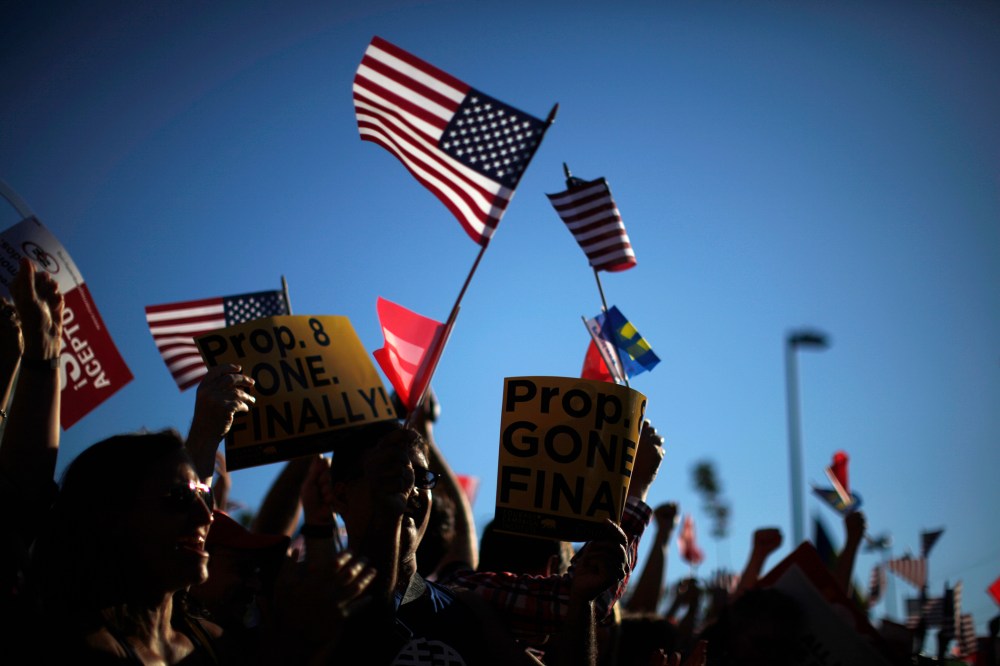
It was a rough day for marriage equality opponents Monday, as the 9th Circuit Court of Appeals seemed prepared to say for the second time that gay and lesbian couples have a constitutional right to wed.
During oral arguments in challenges to two existing same-sex marriage bans — Idaho’s and Nevada’s — and one now-defunct ban — Hawaii’s — a three-judge panel of the San Francisco-based court appeared highly skeptical of any justification for excluding gay and lesbian couples from the institution of marriage.
%22What%20about%20divorce%20%E2%80%93%20does%20Idaho%20prohibit%20divorce%20because%20it%20sends%20a%20bad%20message%3F%20Why%20don%E2%80%99t%20you%20then%20pass%20a%20law%20banning%20divorce%20in%20Idaho%2C%20which%20may%20have%20more%20of%20an%20effect%20than%20this%20%5Bban%3F%5D%22′
Defending bans in both Idaho and Nevada, Monte Stewart of the Coalition for the Protection of Marriage sounded shaky as time after time the judges chipped away at his opaque arguments and left him flailing in logical inconsistencies.
At the core of the traditional man-woman institution of marriage, argued Stewart, is a message that strengthens a child’s “bonding right” with his or her biological parents. Widening that institution to include same-sex couples, he continued, “weakens the social expectation of the child’s bonding right,” and sends the “social message that fathers are not a valuable part of child rearing.”
“Father-child bonding has always been a bigger problem,” said Stewart, in comparison with mother-child bonding. “It is Idaho’s sensible prediction that over time, the men socialized by that new and different marriage institution will weaken in their commitment to abide by the child’s bonding norm.”
“Has that happened in Massachusetts?” asked Judge Marsha S. Berzon, a President Clinton appointee, referring to the first state to legalize same-sex marriage in 2004. “My understanding is no.”
“What strikes me,” she continued, “is that the train has left the station.” Berzon later accused Stewart of using gay people as “scapegoats” in order to “send some vague message.”
Judge Ronald M. Gould, another Clinton appointee who for a while stayed silent, eventually questioned the very term “bonding right,” which Stewart seemed to have invented.
“Where does the phrase ‘bonding right’ get its derivation?” asked Gould. “I don’t think it’s in the constitutional Bill of Rights.”
Judge Stephen R. Reinhardt, a President Carter appointee responsible for some of the most groundbreaking rulings in favor of gay rights, took Stewart’s argument one step further, where again it faltered.
“What about divorce — does Idaho prohibit divorce because it sends a bad message?” said Reinhardt. “Why don’t you then pass a law banning divorce in Idaho, which may have more of an effect than this [ban?]”
To this, Stewart responded: “They may.”
Stewart did not go so far as to say that gay and lesbian people make inferior parents, an argument which, as University of Richmond’s Carl Tobias puts it, has been “obliterated” in federal court. “People look foolish if they make it,” said Tobias to msnbc.
However, Stewart did stress that there are no “crystal balls,” and that the full effects same-sex marriage may have on child-rearing remain unknown.
Monday’s proceedings marked the sixth such federal appeals hearing since a landmark Supreme Court decision gutted the Defense of Marriage Act (DOMA) last year and cleared the way for the U.S. government to begin recognizing same-sex nuptials.
Yet while the DOMA ruling will likely go down in history as having set off an unprecedented wave of legal victories over bans across the country, it was not the one expected to fundamentally alter the course of the marriage equality movement. That distinction was in fact widely predicted to go to a challenge against California’s same-sex marriage ban, Proposition 8, which carried the potential to legalize same-sex marriage at the national level, but ended up being dismissed by the high court on procedural grounds.
Before that happened, however, the 9th Circuit court found Prop 8 unconstitutional, writing in 2012 that the ban “serves no purpose, and has no effect, other than to lessen the status and human dignity of gays and lesbians in California.”
The ruling was ultimately vacated in a 5-4 Supreme Court decision, returning marriage equality to the nation’s most populous state through a lower court’s order. But its significance lives on. Indeed, without having the guide of Justice Kennedy’s sweeping language in the DOMA ruling (or for that matter, Justice Scalia’s cautionary dissent), the 9th Circuit’s Prop 8 decision managed to predate the informal writing competition that has taken over the federal judiciary, as more and more judges recognize their potential roles in making history.
The 9th Circuit has now returned to the same issue, though in a profoundly changed legal landscape. Nineteen states plus the District of Columbia currently allow gay and lesbian couples to wed — more than a twofold increase since the appeals court ruled against Prop 8 in 2012 — and nearly 40 judges in state and federal courtrooms across the country have struck down same-sex marriage bans. Only one federal judge has ruled against marriage equality since the DOMA ruling, and three appeals courts have sided with gay and lesbian couples in five different cases. Another post-DOMA difference was the 2014 case, Smithkline Beecham Corp, DBA GlaxoSmithKline v. Abbott Laboratories, which dealt with whether attorneys could exclude potential jurors solely based on their sexual orientation. Writing for the majority, Judge Reinhardt ruled in January that they cannot; sexual orientation is no longer grounds for peremptory strikes — a significant win for LGBT equality in and of itself. Yet the decision also carried implications far beyond the jury selection process. In his ruling, Reinhardt called for “heightened scrutiny” in discrimination cases involving sexual orientation, a higher standard of judicial review than has typically been applied. With heightened scrutiny, defendants (such as state officials arguing on behalf of same-sex marriage bans) would have to show how a law that treats gay and lesbian people differently serves an important or compelling state interest, not just a legitimate one. Heightened scrutiny essentially shifts the burden of proof off of the plaintiffs, and makes laws that discriminate against same-sex couples more difficult to defend. It didn’t take long for the move to shake up marriage equality cases within the 9th Circuit. Three weeks after the Smithkline ruling, both the Nevada governor and attorney general’s office announced they would not be defending the state’s same-sex marriage ban. “Based on that new standard, we don’t have an argument; the state loses,” said Nevada Attorney General Catherine Cortez-Masto to ABC affiliate KOLO. Both Stewart and Tara Borelli — a senior attorney for Lambda Legal who argued on behalf of the Nevada plaintiffs Monday — agreed that the Coalition for the Protection of Marriage had standing to intervene at the appellate level in defense of Nevada’s ban, because the plaintiffs had lost in the pre-DOMA district court ruling. However, Borelli stated that if the plaintiffs prevailed in the 9th Circuit court, the coalition would not have standing to request review from the Supreme Court. The justices are not required to hear any of the marriage equality cases now marching toward them at lightning speed. Yet given the momentum the movement has generated, as well as the growing chorus of voices calling for a national resolution, many believe the high court will agree to hear at least one of the appeals before it and settle the matter once and for all — an opportunity the justices turned down with the Prop 8 case. %22I%20think%20you%E2%80%99re%20going%20to%20have%20an%20opportunity%20to%20find%20out%20what%20Justice%20Kennedy%20really%20thinks.%22′ To that end, Judge Reinhardt offered up his prediction during Monday’s hearing. “I think you’re going to have an opportunity to find out what Justice Kennedy really thinks,” he said, referring to the justice’s DOMA opinion affirming both states rights, and the basic dignity of gays and lesbians — two concepts seemingly at odds when it comes to same-sex marriage bans. As thrilling as nationwide marriage equality would be, however, Beverly Sevcik and Mary Baranovich, the lead plaintiff couple in Nevada’s suit, have their sights set on a smaller-scale victory. “I know it sounds very simple and basic, but one of the things I’m most looking forward to is having matching rings for the first time in 42 years,” said Sevcik, 76, to msnbc. The two had stopped for lunch in Placerville, California, en route to San Francisco for Monday’s hearing. “It’s really hard to plan a wedding when you don’t know when it’s going to be, but we’re making a list of people we would like to invite and have our vows written out,” said Baranovich, 78. “We’re all ready to go. We just need a date.”
Emma Margolin
Emma Margolin is a reporter at MSNBC.com. Recommended


