








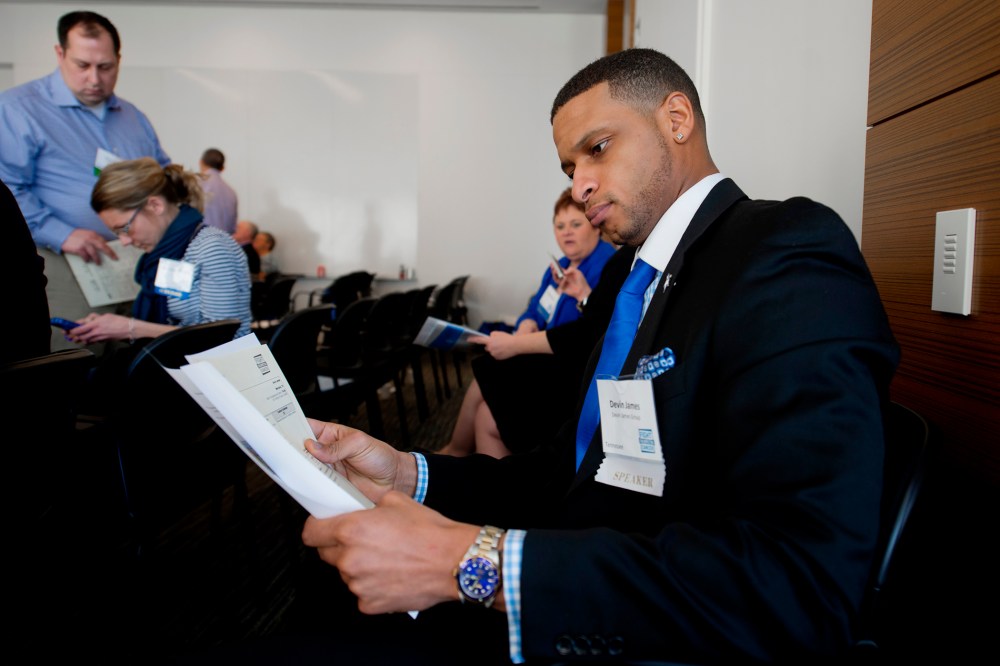
Public relations specialist Devin James was brought in by the city of Ferguson, Missouri to help improve its image in the aftermath of Michael Brown’s killing, but after news surfaced a week ago that he had shot and killed a man — and even possibly fabricated the resume that landed him a contract with the city in the first place — it was his face that ended up needing saving.
The revelation cost the 32-year-old PR operative his job, marking just the latest nightmare in a place that’s recently seen a lot of them. But for James, the ups and downs of this episode pale in comparison to the life that has led him to this uncertain moment.
RELATED: Ferguson spokesman once fatally shot unarmed man
In an exclusive interview with msnbc, James opened up in detail about his killing of a man, the parallels he sees between his life and Michael Brown’s, and ultimately, his redemption.
“For 10 years, I haven’t been able to talk about any of this,” James said, referring to his violent past. “People are saying it’s the worst thing to happen to me, but it’s not. Now I’m in position to tell my side.”
‘A very big problem’
During the first fiery weeks of protest in Ferguson after Brown was killed, James stood on the sidelines and watched as the firm hired by the city to manage the crisis, struggled to understand why black residents were so outraged. That firm, called Common Ground PR and comprised of white corporate marketers, seemed only to contribute to the unfolding calamity.
James said he watched as they stumbled through hastily called interviews between city leaders and the press. They never developed an effective crisis communications plan, James said. And they seemed not to grasp the magnitude of Brown’s killing or the message it sent to many in Ferguson’s long-suffering black community.
“Me and the African-American community knew this was a very big problem,” said James, who is black. “But nobody wanted to hear that.”
Requests sent to Common Ground seeking a response to James’ assertions were not returned on Thursday afternoon.
By coincidence, just days before the Brown shooting, James’ public relations firm, The Devin James Group, had been contracted to help market Ferguson and North St. Louis County’s other small municipalities to visitors and corporations.
Amid complaints over the city’s hiring of a white PR firm to handle the Brown fallout, James was swept into the role of Ferguson’s head spokesman. He would become the city’s bridge between its majority black population and its nearly all-white city leadership.
Yet even as James tried to help cool racial tension in Ferguson, he ended up adding to the swirl of controversy.
James’ $100,000 contract paid by the St. Louis Economic Development Partnership, an agency formed last year to spur economic growth in the region, was abruptly terminated. A spokeswoman said the group cut ties with James after revelations that he’d shot and killed an unarmed man a decade ago during what he now describes as a home invasion and attempted robbery. A jury convicted him of reckless homicide in 2006.
James told msnbc that everyone, including Ferguson officials and members of the Partnership, knew about his past. But in the wake of an exposé in the St. Louis Post-Dispatch and subsequent headlines screaming from national news media, local high-level leaders quickly distanced themselves from him.
For its part, the Partnership insists James’ subcontract was terminated because of a “lack of transparency.” The group learned that James had served time for the shooting from the newspaper, a spokeswoman said.
%22My%20background%20was%20leaked%20for%20the%20purpose%20of%20getting%20me%20out%20of%20the%20picture%20because%20I%20can%20expose%20their%20B.S.%22′
The city of Ferguson has since retained James’ services as a city spokesman on a pro bono basis.
James said he’s sure his history had been leaked to the Post-Dispatch in an attempt to sabotage him for the way he had guided the city’s handling of the fallout in Ferguson. “My background was leaked for the purpose of getting me out of the picture because I can expose their B.S.,” James told msnbc.
Before his termination, James said he’d been making progress in helping Ferguson move forward after Brown’s killing. He helped facilitate police Chief Thomas Jackson’s recent apology to Brown’s family and to peaceful protesters. He was instrumental in organizing a series of town hall meetings aimed at addressing sticky racial issues and offered insight as the City Council planned its proposal to dismantle a warrant system that trapped poor residents in a cycle of exorbitant fines and fees. He also pushed for the creation of a Civilian Review Board as a police department watchdog.
RELATED: To keep peace in Ferguson, DOJ bars media from town hall meetings
James told msnbc he’s met behind closed doors with black community leaders and gone out to shake hands with protestors and gang members, “things the chief and the mayor can’t do,” he said. Both the chief and the mayor are white and have been criticized for insensitive racial remarks and the heavy-handed manner in which police responded to protesters.
“All the changes on the table wouldn’t be happening if I wasn’t in the room,” James said. “You can’t take away the value of someone who has a closer life experience to the primary group that feels it has been done a disservice.”
He added, “Whether you feel I am qualified to do PR is one thing. But I don’t see the connection between a criminal history and PR.”
‘I wish [Michael Brown] would have gotten a second chance’
The day Brown was killed, James sent out a tweet:
“[expletive] crazy.. Unarmed teenage boy #killed by #Ferguson #police Y’all better wake up and stop killing…”
James told msnbc he had been moved to speak out because he saw parallels between his younger self and Brown. “There have been so many instances where I could have been killed,” James said, acknowledging the second and third chances he’s been given.
“I wish he would have gotten a second chance and had the opportunity to live and do other things,” James said of Brown. “Obviously a lot of us wish this never happened but at the same time it has created an opportunity for us to have some of the real conversations we need to have.”
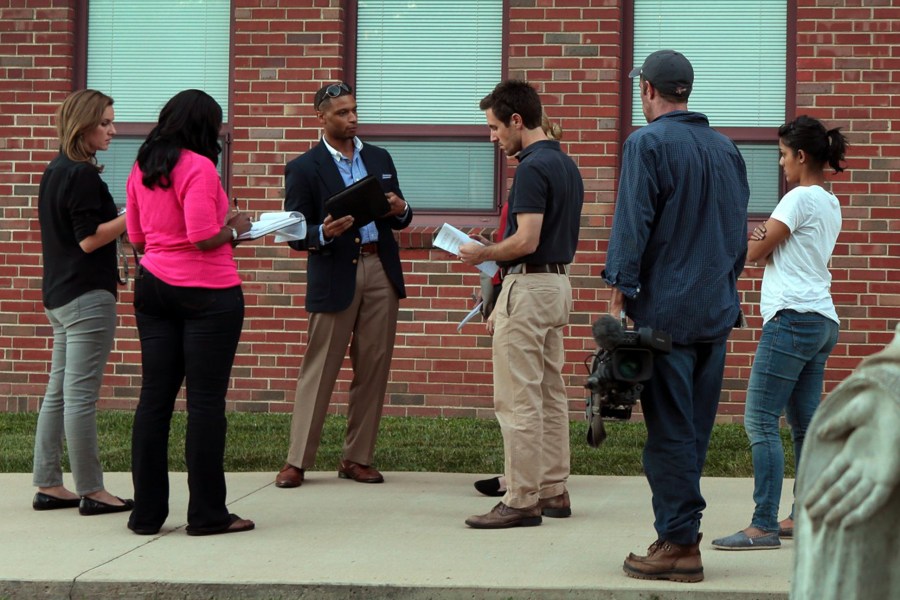
The son of a hard-scrabble neighborhood in Memphis, Tennessee, James told msnbc his past had been troubled indeed. His father was a high-school dropout and street hustler who spent many years behind bars. His mother struggled to make ends meet. In his teens James said he was kicked out of school and eventually joined a gang, doing what he had to do with little family support.
“Street life, gang life, that’s something that is hard to explain to corporate America,” James said.
James said he eventually joined the Job Corps and earned his GED. Through an early version of a STEM program, he was placed in an engineering program at South West Tennessee Community College and later transferred to the University of Memphis to study neuroscience and biomedical engineering.
He took his turn as a rapper and a street salesman hustling T-shirts, hats and CDs. During his senior year at the university, he took a job at an adult bookstore.
That same year James had his first child, a boy. Life took on a sense of urgency. The gang, the violence, the instability started to be a drain. “My allegiance to the gang was no longer a priority,” James said. “And if you have studied gangs, that’s not an excuse. They don’t accept that. You have to die out of this.”
RELATED: Feds call out Ferguson as the city remains on the edge
A day of reckoning came at the bookstore one day. A man walked in, aimed a gun at James’ chest and pulled the trigger. “When the gunman came in he pointed the gun at my heart, I decided to fight him and I managed to get the gun away from him,” James said. “I ended up leaving on a stretcher with a permanent disability, but I was still alive.” The bullet tore up his chest and muscle tissue. His clavicle had to be restructured and a rod was placed in his arm from his shoulder to his elbow. To this day, his range of motion is limited as a result, James said. “Every day,” he said, “I look at the scars.” Shortly thereafter, he dropped out of school. Unable to work, he fell into his old ways. He also got a gun. After months of rehab James said he was finally able to use his arm again. James described that stretch as a “very dark time.” In October 2004, reckoning came banging once again. An acquaintance from his old gang and another man came to his home to rob him, James said. One of them whipped out a 9mm handgun and ordered him to lie down. James said he ran into another room to get his gun. The robbers fled from the house and James gave chase, exchanging gunfire with them as they fled through his yard. James emptied one clip, jammed a second into his pistol, and emptied the second. By the time police arrived, one of the men, Rodney Steward, was dead from multiple gunshot wounds. According to court records, investigators found 2.4 grams of crack cocaine in Steward’s pocket but no weapon. Police said the only bullet casings found at the scene came from James’ gun and that there had been no evidence of bullet strikes on James’ house. James was found guilty of reckless homicide and sentenced to 30 months in a workhouse and five years’ probation. After a few more years of appeals, which were denied, James was jailed for 90 days in 2009. His probation ended last March. RELATED: Michael Brown memorial burned overnight Hampered by a felony record, James said he began to focus on entrepreneurship. In recent years, his firm has helped launch campaigns for the states of Tennessee and North Dakota among other projects. According to a website for the Devin James Group, the agency is certified in 22 states and about 85% of its business is from government and non-profit accounts. “I’ve got reminders every day of what I’ve been through,” James said. “But at the same time I can look at the good things that I’ve done. I try to think about the way I want my kids to remember me.” Ferguson, not a marketing campaign In the wake of Brown’s killing, Ferguson was overwhelmed by protests as the majority black city rose up against what it saw as vicious treatment by the city’s nearly all-white police department and by extension, its city government. Images were beamed across the country of white police officers beating back mostly peaceful black protesters with snarling dogs, tear gas and rubber bullets. James said that’s when he was recruited to replace Ferguson’s outside PR firm and help manage the crisis. “In comes Devin and they’re like, ‘Don’t you have a background, don’t you think you can relate to folks and calm this mess down?’” James said. “They were totally missing the mark. I’m saying to them, ‘I don’t think you understand the severity of the situation. This is not going to be a quick fix. There is not going to be a marketing campaign you can develop to fix this.’” But ultimately, James’ presence did little to improve goodwill, as many saw him simply as a black face of the white power structure that many blacks had come to loathe. His orchestration of Chief Jackson’s apology triggered a backlash, with Brown’s family rejecting it and others calling it too little, too late since it came 7 weeks after one of Jackson’s officers killed Brown and wasn’t delivered in person. Some point to the decision to launch the video apology as James’ ultimate undoing, as it had some local reporters wondering exactly what kind of PR professional would “give a client such terrible advice.” RELATED: Audio of gunfire in Michael Brown case authenticated by app company Hours after the apology, a melee erupted after Jackson waded into a crowd of protesters to march with them as a show of unity. Several people were eventually hauled off in plastic cuffs. That day, the Post-Dispatch published its exposé on James’ past. And all the cards seemed to fall into the flames. “While we admire his personal growth from difficult circumstances and commend him for his high quality work in Ferguson, it was the lack of information about his background that prompted us to make this move,” said a statement released by Elasticity, a marketing group that had subcontracted James. “Mr. James failed to inform us of his prior conviction … As of today, we are developing new vendor due diligence policies which we believe will prevent similar incidents in the future.” James said he’s now focused on helping to rebuild the broken bridges in Ferguson. “There’s no way to go back to the way Ferguson was. I don’t think that benefits anyone. I think we have to build a new Ferguson that’s inclusive to everyone,” James said. “The most challenging part has been trying to get people to understand what many of the people in the black community are talking about, and that the peachy keen life they are accustomed to is not good for everyone else,” James said.
Trymaine Lee
Trymaine Lee is an NBC News correspondent. Recommended


