








The emergence of super PACs and their ability to raise and spend unlimited amounts of money on political campaigns has raised legal questions as to how campaigns and candidates are allowed to communicate or coordinate with them since the Citizens United decision in 2010.
In the past six years, those limits have been tested in various ways. But in the current presidential campaign, the lines are being blurred even more and no candidate is testing the legal limits more visibly or blatantly than Carly Fiorina, whose performance in Wednesday night’s Republican debate has thrust her candidacy into the spotlight.
RELATED: Fiorina bests Trump while stumbling over facts
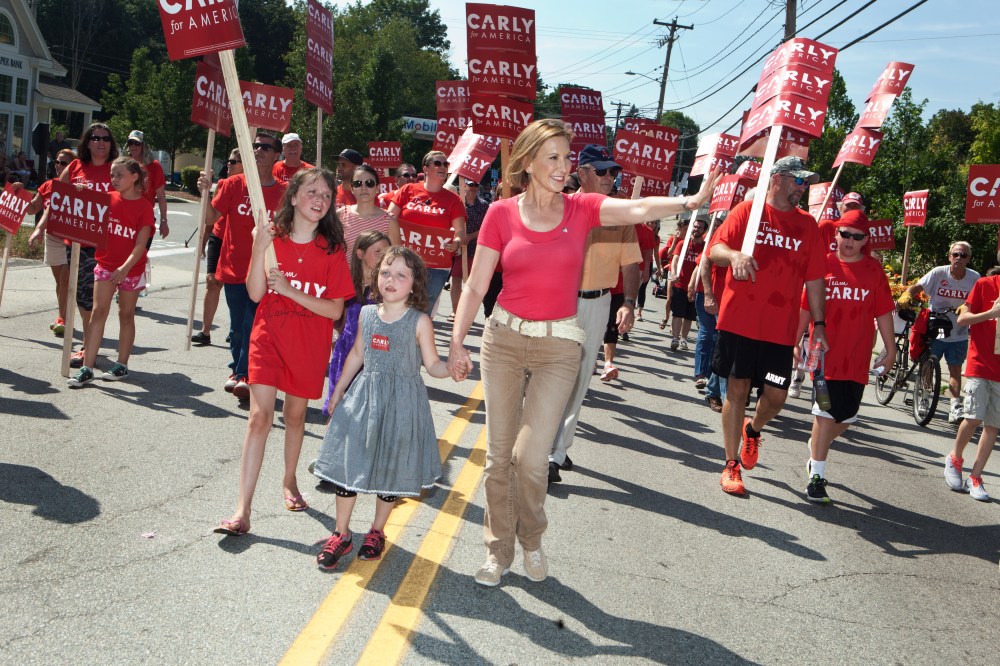
That line-testing was on display on a 90 degree afternoon in New Hampshire earlier this month as four presidential candidates sweated through the Milford Labor Day Parade – Fiorina, Ohio Gov. John Kasich, South Carolina Sen. Lindsey Graham and Vermont Sen. Bernie Sanders.
All four walked along, flanked by supporters carrying signs and touting their candidate.
But Fiorina’s supporters stood out. They wore shirts and carried signs pitching “CARLY for America” — the name of the super PAC backing the candidate, not her campaign.
It was a stark portrayal of the new ways in which candidates of all ideological stripes are testing campaign finance rules to reach new levels of interaction with their big-money outside groups — within legal limits.

CARLY for America is the super PAC; Carly for President is the campaign. The difference between the two is so subtle that the candidate herself occasionally directs voters wanting to learn more about her campaign to her super PAC website: “Check out Carly-for-America-dot-com,” Fiorina says.
The difference between the two is also close enough to have warranted a slight name change after running afoul of FEC regulations that bar independent expenditure committees — those not authorized by a candidate — from using a candidate’s name in their title. After the FEC flagged the violation in a letter to the super PAC, “Carly for America,” a direct reference to the candidate, became the acronym: “Conservative, Authentic, Responsive Leadership for You (CARLY) and for America.
There is one big difference between the groups: During the first half of the year, Fiorina’s super PAC raised $3.46 million, more than twice as much as the $1.7 million raised by the campaign.
As with all candidates, the campaign and the super PAC are not allowed to coordinate spending strategy with one another — but super PAC staffers follow the candidate nearly everywhere she goes.
At a recent town hall in New Hampshire hosted by the Sandown Republican Committee, super PAC staffers arrived early to set up signs inside and outside the venue, manned a table at the venue’s entrance where attendees could ask questions and pick up super PAC literature, and where they signed up potential volunteers. And super PAC representatives helped the local Republican committee take down the chairs and clean up when the town hall was finished.
It’s not just in New Hampshire — at a recent stop in Arizona, the CARLY for America Arizona co-chair co-hosted a private fundraiser for the campaign.
Often the only distinguishing factor between the candidate and the super PAC is the federally mandated small print stamped on the bottom of every flyer:”Paid for by CARLY for America. Not authorized by any candidate or candidate’s committee.”
Supporters at a campaign event in New Hampshire this weekend said they know the difference — and don’t mind.
Butch Maxwell, a retired IT professional, said at a Fiorina event in Alton, N.H. that he “understand[s] why” the super PAC is filling in for the campaign.
“Whatever my feeling may be about the impact that super PACs have on the election process, everybody has one and it tends to level the field,” he said.
Fiorina’s campaign declined to respond to numerous requests for comment about the super PAC’s activities in the field.
In the wild West of campaign finance that’s emerged from the Supreme Court’s Citizens United decision, Fiorina is hardly an outlaw.
“What federal law regulates is coordinated spending of money,” said Paul Ryan, senior counsel at the reform-minded Campaign Legal Center. “The law doesn’t prohibit coordination in some general sense, what the law prohibits is coordination of expenditures.”
Though the lines are fuzzy, Fiorina’s campaign does appear to lean on its super PAC in a way that most other campaigns do not. Her official campaign has one full time staffer in New Hampshire, and 2 part timers. Her super PAC has seven paid staffers. In Iowa she has 2 campaign staffers; the super PAC has five. While other super PACs have a presence at events for the candidates they support, CARLY for America stands out for taking on staffing and other duties at nearly all of her events.
Staffers from the two groups say they speak to each other — indeed, some, like the top staffers for her Iowa campaign and super PAC say they are good friends — but never, they say, about spending money or candidate strategy. Two staffers, one from each group, at one point declined a reporter’s offer to get drinks after the event — “to keep up appearances,” they said.
And staffers from the two groups often work side by side, as her super PAC has taken on many of the grassroots duties that campaigns have done in the past.
But super PAC staffers say every move they make is dictated by publicly available information. Fiorina’s campaign keeps a public Google Calendar of her events that the super PAC monitors.
“We try to see where we can provide from afar,” CARLY for America spokeswoman Leslie Shedd told NBC News in an interview.
The super PAC says they follow that Google calendar as well as local reporters on Twitter who are known to have the inside scoop on campaign events in a state. One CARLY for America adviser told NBC News that if the event is public, they show up; if not, they’ll contact the organizer to ask if it’s okay to come.
CARLY for America declined to offer any details on their interpretation of FEC rules, whether the group gives any guidance on what interactions are and aren’t allowed between super PAC and campaign staffers, or how the decision was made to focus their efforts on a ground game. %22If%20there%20are%20lots%20of%20communications%20between%20the%20super%20PAC%20and%20the%20campaign%2C%20then%20you%20raise%20this%20question%20about%20whether%20there%20was%20information%20passed%20from%20the%20campaign%20to%20the%20super%20PAC%20about%20these%20ads.%22′ As Fiorina greeted voters at MaryAnn’s Diner in Derry earlier this month, a representative from her super PAC stood close by, at one point offering to take a photo of Fiorina and a fan. Even door-to-door canvassing is a joint effort. When Fiorina recently went door-knocking in Manchester, a CARLY for America representative tagged along, just behind the group. Fiorina talks with residents, and then the super PAC staffer steps in to offer literature on the candidate. Shedd said the super PAC tries to be clear about the lines between Carly for America and the campaign. “We are always very clear about the difference,” she said. One of the reasons the lines are blurry is because regulations regarding super PACs are out of date, says former FEC Chairman David Mason. The regulations “were written when everybody was thinking about soft money,” Mason said. “The FEC rules on coordination are all written to address communications — television ads, print ads, billboards, direct mail, that sort of thing — and so there really are no regulations covering things like events and voter drives,” he said. “That’s not to say that there aren’t some legal questions about it.” The rules are unlikely to change anytime soon, with a deadlocked FEC, and a lack of will by many on Capitol Hill to address campaign finance reform. And Fiorina’s supporters aren’t the only ones pushing into the fray. The super PAC backing Louisiana Gov. Bobby Jindal, Believe Again, is playing a similar role by staffing his events and helping with field operations and Jindal is scheduled to appear at town hall meetings sponsored by the super PAC in October. A trio of outside groups supporting former Texas Gov. Rick Perry was picking up the slackfor their cash-poor candidate before he suspended his campaign last week. And Jeb Bush appeared at dozens of fundraisers for his super PAC before he officially declared his candidacy. It’s a move that makes sense for many cash-strapped campaigns, especially when they’re getting off the ground, as the super PACs are often bankrolled by a small handful of millionaires and can raise and spend unlimited sums. “It’s definitely the new normal,” Mason said. Indeed, Shedd said CFA is just following the latest trends in campaign finance. “This is the modern version of what campaigns have turned into. You’ve seen this evolution of how campaigns are operating over time.” But that doesn’t mean it comes without risks. Mason said that frequent communication between the super PAC and campaign could make it tougher to prove innocence later on. “If there are lots of communications between the super PAC and the campaign, then you raise this question about whether there was information passed from the campaign to the super PAC about these ads,” he said. “It could raise some compliance questions.” Still, the risk of prosecution for any of these practices is low. The FEC isn’t known for its rigorous enforcement practices and investigations are rare because they’re hard to prove and because of a partisan deadlock among the commission. Fines are even more rare, and often negligible for groups raising millions of dollars. A New York Times analysis found that fines levied by the FEC in 2014 were the lowest since 2001, amounting to less than $600,000 — in contrast to the $7 billion spent by campaigns and groups on elections that year.
Kailani Koenig
Alex Jaffe Recommended


