








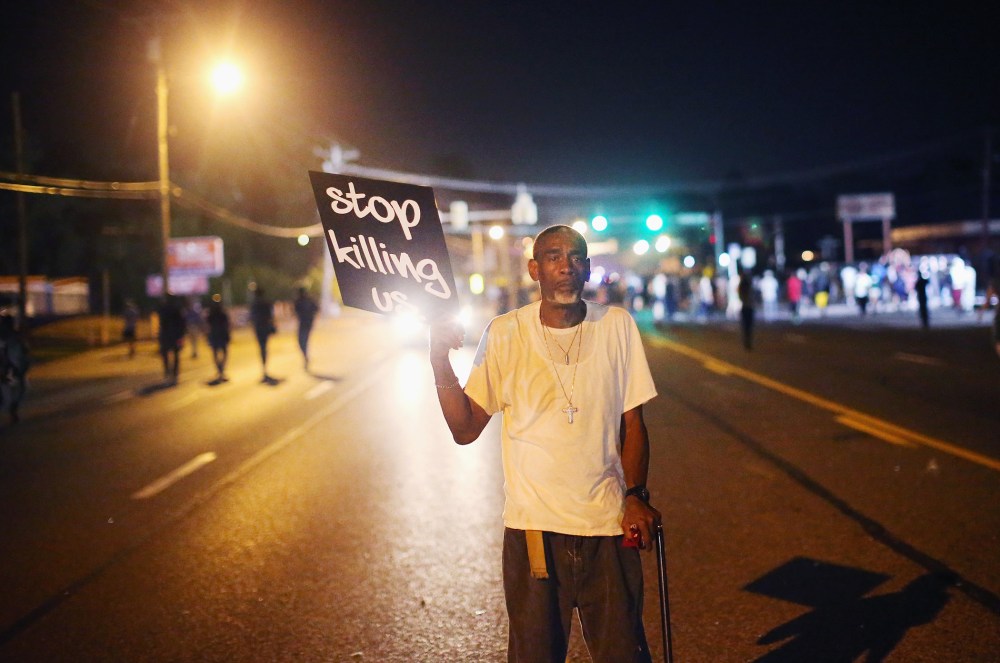
FERGUSON, Missouri — Before Michael Brown’s death, all Taurean Russell wanted was to finish college, teach history and coach high school football. But that changed August 9, when photos of Brown’s lifeless body, shot by a cop and left sprawled in the street, kept appearing on social media.
“I saw a dead body on my timeline. It kept appearing hour after hour and somebody said ‘I hope somebody gets up and does something about it,” said Russell, 30. “Then I heard his mother on TV say, ‘Why did they kill my son.’”
Those words triggered something in Russell. He rallied friends and they headed down to the Ferguson Police Department looking for answers. They didn’t get any so they went back the next day and the day after.
Russell and others incensed by Brown’s killing and the lack of charges against Darren Wilson, the officer who shot Brown, have grown both more impatient and more organized. They’ve joined forces with established activist groups and other youth leaders from across the state and country, crafting a list of demands and studying policy, political science and past social movements.
“You can’t have patience,” Russell said on a recent afternoon. “We been stuck on the same page in history for the last 60 years, patience is gone. Local police came and said y’all need to leave, we stayed. They shot tear gas, we stayed. They shot rubber bullets we stayed and got stronger. They gave us a curfew, we stayed all night.”
As weeks of unrest in Ferguson have cooled and as a huge national media presence recedes, local policy makers, residents and a new crop of social activists will likely be left to pick up the pieces and move the city forward.
St. Louis Alderman Antonio French French has documented the unrest in Ferguson from the beginning and was arrested during the protests. He’s formed an organization called #HealSTL to help bring about political change in Ferguson.
Though Ferguson is nearly 70% African American, most positions of power are held by whites. The school board is all white. The police chief is white, as are 50 of the city’s 53 police officers. Five out of six city council members are also white.
“Now that the smoke has cleared and folks are a little more free of the worry of violence and heavy police presence every night, we’re able to actually get to the hard work of actually trying to repair some of the damage done over the last two weeks and try to repair some of the issues that led to these last two weeks in the first place,” French said.
#HealSTL, a play on a hashtag created during the uprising, recognizes “the deep wounds that have been created by two situations, the death of Michael Brown and the justice system,” French said, adding, “This isn’t an effort to get back to normal, this is an effort to create a new normal.”
French said his organization is drafting a set of specific political goals, registering voters and gauging the untapped pool of potential voters in the city. Historically, black voter turnout has been abysmally low in Ferguson despite being the majority population. There have been few viable black candidates as well.
Over the past several city election cycles, voter turnout in Ferguson has been about 15%, despite much higher turnout rates in presidential election years.
The organization has begun the process of gathering signatures for a recall of Mayor James Knowles III, French said. The law requires that petitions can’t be presented until six months after an election. In this case, that means October. French said the group is already beginning to identify potential black candidates to replace Knowles, who is white.
“I don’t want to downplay it. But I’ve been managing campaigns for 14 years in St. Louis,” French said. “In Ferguson you’ve got the numbers. We can do this all day. I’ve done statewide initiatives and ran three state senate campaigns. This is an area with just 20,000 people. We should be able to do this.”
State Sen. Maria Chappelle-Nadal
Chappelle-Nadal, whose Senate district includes Ferguson, has been on the front lines of the protests since Brown’s death. She was also among the group of largely peaceful protesters tear-gassed by police.
She said she hasn’t been able to shake the experiences of the last few weeks.
“There have been two times where I felt a lot of pain in my heart,” Chappelle-Nadal said. “The day after the tear gassing was one, as I was crying in the shower just traumatized. And the second was [Brown’s] funeral.”
Chappelle-Nadal said it’s time to take a close look at the government’s role in what she described as a violent stripping of protestors’ civil rights. She also wants to empower the young people most affected by Brown’s death and who bear the disproportionate daily burden of police injustice and harassment.
“I think from the very beginning they’ve been the victims of this entire thing. I want to empower them,” she said. “As we move forward we need young people to have as much control as possible, with guidance from those who have already been in politics.”
Chappelle-Nadal said she’s been meeting with young protestors and is working to educate many of them on the political process in order to “redirect the energy they have inside into something positive.”
Chappelle-Nadal said she has also met with Senate leadership to discuss the formation of a committee to review all actions taken by the state during the suppression of protests in Ferguson. She’s also sent out a public call for protesters to submit videos, photos and testimonials of their experiences during the protests.
“We’ve had so many different municipalities and departments of law enforcement engaged in this excessive force, it’s really important that we document all of it,” she said. “It is my personal belief and the belief of some others that there were actually human rights violations in the first few days of tear gassing.”
Patricia Bynes, Ferguson Democratic Committeewoman
Bynes is the Democratic Committeewoman for Ferguson Township and a delegate for the state’s 1st Congressional District. Before Brown’s killing and the unrest that brought Ferguson national attention, Bynes worked as a cog in the local Democratic machine as a liaison between party bosses, candidates and elected officials. In recent weeks her profile has been elevated as the political fate of the black community has become a central concern as the many wounds exposed by Brown’s death include lax black voter participation.
“We’re trying to identify people that want to lead and be the voice of change in this city,” Bynes said. “I hear talk of ‘we are going to do a recall, we are going to do this and that,’ but that can only be led by people in Ferguson. We need to be with them and teach them how to organize and give them the support.”
Bynes said that it’s important for locals to have “a light put on them so that they own this change.”
She said French, the alderman who has become one of the faces of the movement to reshape Ferguson, should reach out to her directly.
“I can’t seem to get a call back from him,” she said. “I think he should take the lead from the community. I don’t know what he’s doing over there, he hasn’t reached out for anything. I know the people in Ferguson that need to lead these efforts.”
She also noted the low voter turnout in Ferguson despite the Democratic Party’s efforts to motivate them, particularly in off-year elections.
“We’ve been doing it, it just hasn’t been well received. They say things were horrible but they weren’t ready to do anything about it,” she said. “Now there’s the motivation. Things are in sync now.”
State Sen. Jamilah Nasheed
Nasheed, whose district is in nearby St. Louis city, has long rankled the political establishment with her outspoken, sometimes audacious style. In the case of Michael Brown, she has been among the most outspoken critics of fellow Democrat Gov. Jay Nixon, along with Sen. Chappelle-Nadal, and is currently pushing to have another Democrat, St. Louis County Bob McCulloch, removed from the investigation into Brown’s killing.
Sen. Nasheed said the immediate next steps for Ferguson include legislation addressing racial profiling and voter education.
“A lot of those young men are being racially profiled each and every day,” Nasheed said. “Michael Brown was a victim of racial profiling. He was simply walking down the street and the police pulled up and just profiled him. As a result of that he lost his life.”
Nasheed also said she’s calling for an audit of the city of Ferguson to look at the city’s hiring practices, how they award contracts and get “a clear vision of how they do business.” But of all the steps moving forward, she said the ones that have nothing to do with policy but everything to do with people, are most critical. “I’ve received so many negative Twitter messages and messages on Facebook. I can tell you this, I’ve never seen so much hatred in my life coming from many of the non-African Americans as a result of this case,” she said. “I’ve had death threats, individuals trying to assassinate my character, simply because I’m standing up for justice. It’s appalling to see so much hatred in the world. I’ve never seen anything like it, and that hurts.” Nasheed was threatened with arrest last week as she tried to cross a yellow police line to deliver petition signatures calling for the removal of county prosecutor McCulloch from the case. McCulloch’s family includes many people who work in law enforcement and his father was killed in the line of duty in the 1960s by a black man. “What the Democratic Party needs to understand is that the African-American community, they are fed up and they are sick and tired of being excluded and ignored,” Nasheed said. “So what you’re going to see in these November elections, as a result of the Michael Brown killing and the way the government is handling the investigation, is a lot of African Americans willing to switch over to the Republican party to send a message.” Earlier this week, Nasheed joined a group of activist organizations, some that have emerged in the shadow of Brown’s killing, in Washington, D.C. to deliver hundreds of thousands of signatures calling on the Department of Justice to “fully investigate, prosecute, and fire all police officers involved in the fatal shooting of Michael Brown.” According to ColorOfChange.org, the website that collected the signatures, the groups collected and delivered nearly 950,000 signatures. State Sen. Courtney Allen Curtis Curtis, whose district includes nearby Florissant, has met with Ferguson Mayor Knowles and several black mayors around the area and has proposed a list of actions to address various police and social issues in Ferguson and beyond. “It’s deeper than the Mike Brown situation. It just brought a whole lot of things to the forefront,” Curtis said. The list of actions include sensitivity training for police, bolstered community policing efforts, greater recruitment of officers from Ferguson, dash- and body-worn cameras for officers, a civilian complaint board and annual county-wide reports on police stops, arrests and outcomes. Curtis has also called for a number of community efforts including the development of outreach centers in Ferguson, mentorship programs with youth and state elected officials, a community liaison, a diversity week and greater business development. “There needs to be more open dialogue where [officials] get actual communications from the community. You’re going to have to sit through that and distil that into a plan that they can come up with together,” he said. Curtis said he’s helping residents organize neighborhood associations so that they can self-organize and “give them the power structure for them to deal with the government and move forward.” “Only after the grieving can that conversation begin. I don’t know when the healing process starts, but we still have to deal with all of the stuff going on in the background,” Curtis said. The background includes the ongoing investigation into Brown’s death, the grand jury hearing evidence and upcoming elections. “The things we don’t control are the investigative process and the outcomes,” he said. “But I’m hopeful that we’ll get there for sure.” Taurean Russell Since being thrust into action by Brown’s death, Taurean Russell said he’s found his true calling. “I haven’t had a day off yet,” said Russell. Russell has become a core member of a group called Hands Up United, which has joined other groups including the Organization for Black Struggle and the Missourians Organizing for Reform and Empowerment to issue a list of demands including Wilson’s immediate arrest and more accountability for police practices. For Russell, the mission is deeply personal. He and other residents have detailed a long, strained history between the many local black communities that make up an inner-ring of suburbs outside of St. Louis city and the mostly white police departments that patrol them. State data on police stops show deep disparities in how often blacks are targeted for traffic stops compared to non-whites. The stops often result in traffic tickets, that when left unpaid lead to additional fines, warrants and sometimes jail time. Russell said a number of traffic tickets led to warrants for his arrest which went on his record and prevented him from finding employment in any of the local high schools, which he’d hope to become a teacher and coach. “My traffic tickets and bench warrants wouldn’t let me work in the public schools,” he said. “My dreams were crushed over something that could have been avoided or if the system wasn’t as racialized as it is.” Russell said the old guard and traditional civil rights organizations don’t resonate with a younger, brasher generation of activists. “A lot of these organizations aren’t on the forefront. They came in for the photo op and pulled out. The people who are actually grassroots and anchored here, people know we are here helping and are going to be here for the long run,” he said.
Trymaine Lee
Trymaine Lee is an NBC News correspondent. Recommended


