








FERGUSON, Missouri — Melanie Walker doesn’t know what will happen when she sends her three young kids to their first day of school on Monday, but she’s scared.
In the last week, riot police have roamed the streets of her otherwise quiet suburban community. Looters wreaked havoc on local businesses. Clouds of tear gas were followed by showers of wooden pellets that rained down on her neighbors and friends.
But most shocking of all, she said, was that a police officer would turn his gun on an unarmed 18-year-old allegedly holding his hands up in surrender as the officer fired off round after round.
“This is only the first or second time I’ve even allowed my kids outside,” Walker said as she brushed back the hair of her 7-year-old sitting at the lunch table beside her. Their family ventured out of their home Saturday to join a back-to-school event in their district, one of their few outings since shutting out the unrest on the streets.
“That’s not freedom if you’re too scared to walk around,” Melanie’s husband, Chaz Walker, said.
%22We%20can%20channel%20it%20and%20make%20it%20an%20educational%20experience.%20We%20must%20let%20the%20students%20talk%20about%20the%20appropriate%20forms%20of%20protest%20and%20how%20to%20go%20about%20it%20in%20the%20right%20way.%22′
Just a few miles down the road, residents were sweeping up the remnants of the protests from the night before, where peaceful demonstrations devolved into tear gas and looting.
Word of the sporadic looting heightened the palpable air of concern among parents and teachers gathered at Normandy High School on Saturday as the community attempted to bring back a sense of normalcy to the community, at least for the sake of the kids returning to their first day of school on Monday.
“We’ll have to be delicate in the way we address it,” said GeNita Williams, principal at the district’s middle school.
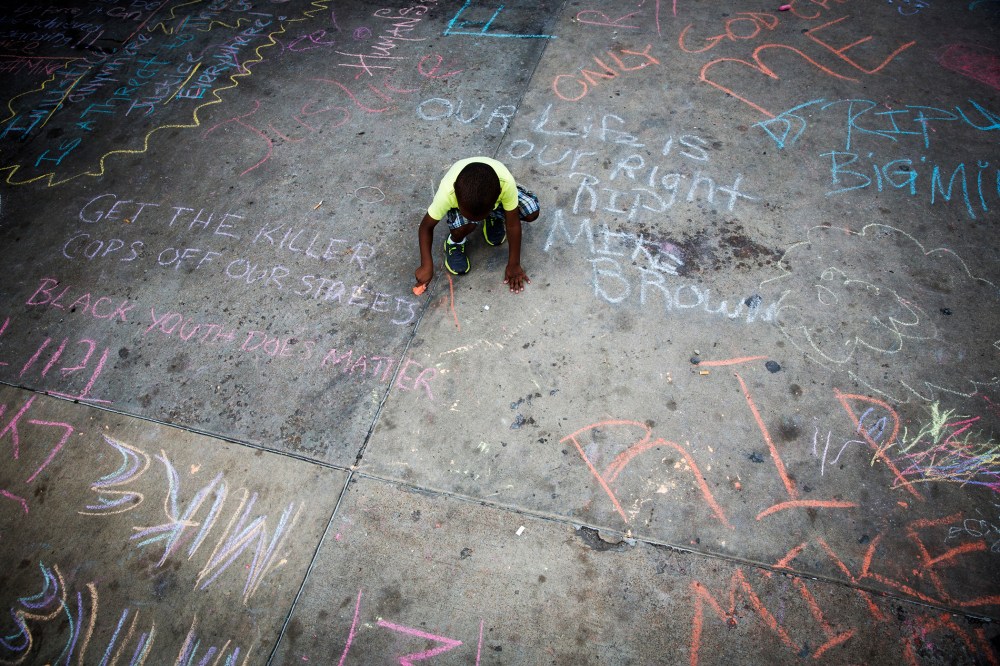
The kids and families of Ferguson have turned out in droves to the protests, symbolizing multiple generations of racial strife in a community where the majority of residents are black while the police and local politicians are almost entirely white. Children as young as toddlers and babies have stood on the front lines of the protests, holding cardboard signs with the simple message: “Don’t shoot.”
Despite their youth, Williams said the kids largely understand the simmering racial tensions and the community’s complicated relationship with law enforcement, and will likely need an outlet once they return to their classrooms.
“We can channel it and make it an educational experience,” she said. “We must let the students talk about the appropriate forms of protest and how to go about it in the right way.”
Tensions had seemed to ease on Thursday after Missouri Governor Jay Nixon assigned Highway Patrol Captain Ron Johnson, a black man who grew up in Ferguson, to take over security. But the local police department provoked fresh outrage Friday after releasing a series of conflicting statements on the events leading up to Brown’s death, without providing any new details about the shooting itself. With the community back on edge after what seemed like a reprieve from unrest, state officials on Saturday issued a crackdown on protests for the late hours of the night. Missouri Democratic Gov. Jay Nixon declared a state of emergency and ordered a curfew on the area that has served as a hotbed for discontent. %22It%E2%80%99s%20at%20the%20point%20that%20you%E2%80%99re%20tired%20of%20the%20injustice%20and%20you%E2%80%99re%20tired%20of%20being%20picked%20on%20all%20of%20the%20time.%22′ “This is not to silence the people of Ferguson or this region or others, but to contain those that are drowning out the voice of the people with their actions,” Nixon said in a raucous press conference Saturday that was at times overshadowed by the angry crowd response. “We will not allow a handful of leaders to endanger this community.” Despite their fears for their children, the Walkers said they went out to join the peaceful protests earlier in the week and to stand in solidarity with the residents fed up with the state of affairs between the community and law enforcement officials. “It has always been a problem,” Chaz said, looking at his 13-year-old son who will be entering middle school this year. “It has always been this way.” Both he and his wife seemed skeptical that the protests could have the types of lasting impacts on the community that people were seeking. ”It’s at the point that you’re tired of the injustice and you’re tired of being picked on all of the time,” Chaz said. “People are at a point where you can’t take it anymore.”
Amanda Sakuma Recommended


