








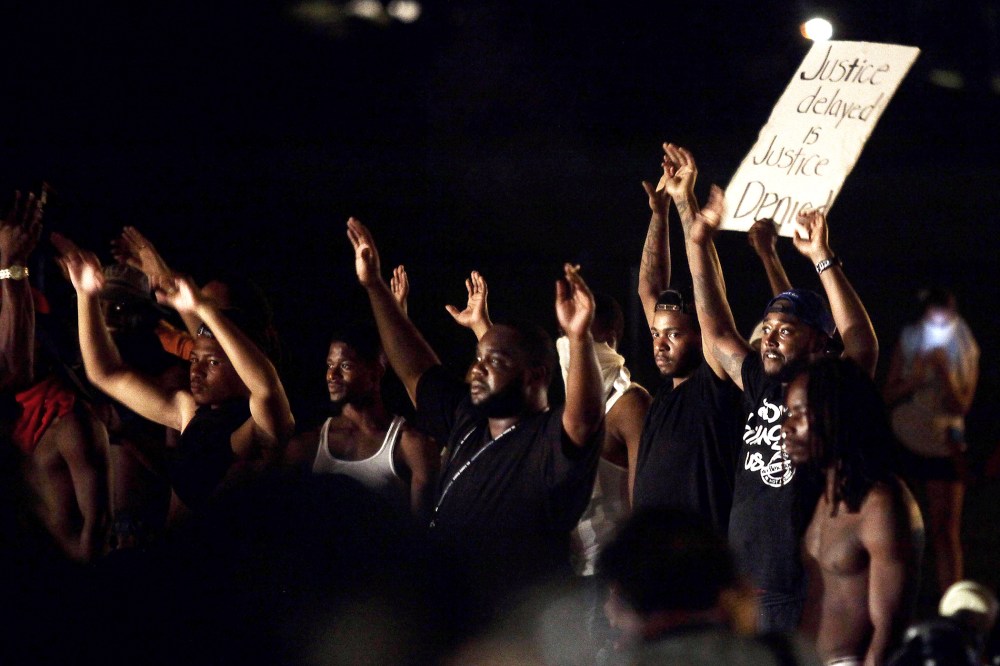
Three young black men were dead at the hands of the police. The police claimed a gun battle, but no weapons were ever found and witnesses said it was an execution. Nonetheless, the officers were not indicted — and the local newspapers were not willing to investigate or press the issue. The community was outraged; the families bereft.
%22This%20was%20not%20Ferguson%2C%20Missouri%20in%202014.%20It%20was%201967%20Detroit%20and%20Rosa%20Parks%20was%20outraged.%22′
This was not Ferguson, Missouri in 2014. It was 1967 Detroit and Rosa Parks was outraged by the pattern of police abuse and harassment which had led to the 1967 uprising and the lack of police accountability for their violent behavior during the riot.
Two weeks ago, fierce protests erupted in Ferguson following the police killing of 18-year-old Michael Brown. While there has been a great deal of criticism of the aggressive police response to the protests, there has been an undertone of concern and fear about the protesters. Many have cast the young protesters as dangerous and reckless and not living up to the legacy of the civil rights movement. Cast as a generation gap, these framings misrepresent these young protesters and the history of the civil rights movement.
Such framings hold up a fable of the civil rights movement — those good old days of meek seamstresses, dreamy ministers, and long-suffering black people — which not only distort the history of the movement but demonize present-day protesters. They memorialize a civil rights movement without young people in the vanguard, without anger, without its longstanding and ongoing critique of the criminal justice system. Indeed, we gravitate to this fable of a quiet, not-angry seamstress who wanted a seat on the bus rather than a lifelong activist who saw discriminatory law enforcement as one of the key injustices black people faced in part because we have grown comfortable with a Rosa Parks (and a Martin Luther King) who make us feel like we’ve overcome. We cordon off the movement in the past, misusing it to criticize young people and missing the lessons it offers us today.
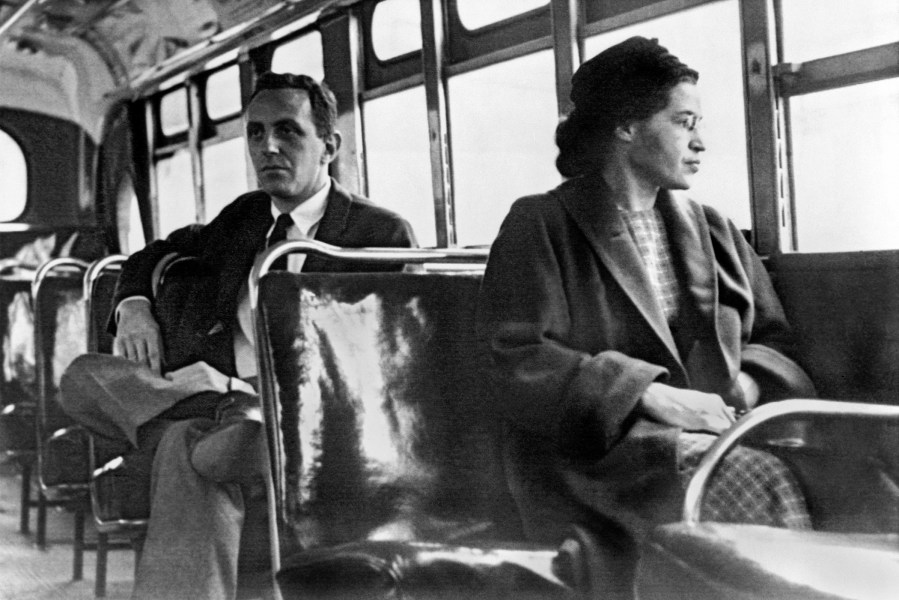
Rosa Parks’ history and that of the movements in which she took part provide a different way into understanding what has been happening in Ferguson. They are a reminder of how longstanding these criminal justice issues have been and how activists like Rosa Parks spent a lifetime challenging them. They demonstrate how people’s grievances reach a breaking point, and how the “resistance to change,” as Parks would put it, produces these uprisings. And they show how young people have been key to the struggle and the ways adults like Rosa Parks insisted on standing with young people.
There is no way to understand Rosa Parks’ bus stand without understanding her lifetime of work protesting the injustices of the criminal justice system. She began her political activism working alongside her husband Raymond to free and defend the Scottsboro boys, nine young men wrongly accused of rape and sentenced to death in 1931 Alabama. Joining the Montgomery branch of the NAACP in 1943, she and militant union activist E.D. Nixon would spend the next decade transforming it into an activist branch. One of the main issues they focused on was criminal justice — both attempting to get the law to be responsive to white brutality and sexual violence against black people and to protect black people, largely men, from legal lynching. This was dangerous work, as she traveled through Alabama hearing people’s stories and trying to get them to file affidavits to the Department of Justice.
In key ways, the Montgomery bus boycott was not just a reaction to bus segregation but also to this pattern of injustice in the criminal justice system, in particular the recent acquittal of the two men who lynched 14-year old Emmett Till. Four days before Rosa Parks made her bus stand, she attended a packed mass meeting at Martin Luther King’s Dexter Avenue Baptist Church. She was filled with despair and anger as the organizer for the case, T. M. Howard, brought news of the acquittal and the need to press on for justice. Four days later, when bus driver James Blake told her to move from her seat, Parks thought of Emmett Till and, “pushed as far as she could be pushed,” refused. The community too had reached a breaking point and began a year-long boycott of Montgomery’s buses.
%22Such%20framings%20memorialize%20a%20civil%20rights%20movement%20without%20young%20people%20in%20the%20vanguard%2C%20without%20anger%2C%20without%20its%20longstanding%20and%20ongoing%20critique%20of%20the%20criminal%20justice%20system.%22′
Forced to leave Montgomery in 1957 for Detroit, Parks took up the struggle in the North. In 1965, she was hired by newly-elected Congressman John Conyers to work in his Detroit office and was well aware, from her own experiences as well as constituents, of the long history of police abuse and harassment that had pushed people to the breaking point. Living a mile from the riot’s epicenter — “the heart of the ghetto,” as she called it — she witnessed the massive police reaction that ensued. “What really went on was a police riot,” Conyers observed.
The riot was personally devastating to the Parks family; Raymond Parks’ barber shop was looted and he was harassed by police for trying to protect his shop. Nonetheless, Rosa Parks sought to contextualize the “rebellion” as “the result of resistance to change that was needed long beforehand.” Patterns of police harassment and brutality had been documented for years with no change in police practice. Parks thus located the uprising in the context of white resistance and deafness to black grievances in Detroit. Dispirited by the looting and random violence, Parks nonetheless contextualized people’s anger—marking the ways that “the establishment of white people … will antagonize and provoke violence. When the young people want to present themselves as human beings and come into their own as men, there is always something to cut them down.” Like with the protests in Ferguson, Parks understood that the longstanding pattern of discriminatory law enforcement was what underlay the uprising. On the urging of SNCC leader H. Rap Brown, young militants took up the call for a “People’s Tribunal” to hold the police accountable for their actions during the riot and the police killings of the three young men at the Algiers Motel. They knew Parks’ commitment to justice — and asked the 54-year old Parks if she would be willing to serve on the jury. She said yes. Organizers were forced to hold the Tribunal in a church when the original theater, fearing police would attack the place, backed out. They kept the witnesses out of sight fearing police retaliation. The church was packed to the rafters. The jury found the police guilty of all charges. Believing that it was “better to protest than to accept injustice,” she stood with these young people and their attempts to get justice — in the People’s Tribunal and in the emerging Black Power movement (attending the 1968 Black Power conference in Philadelphia, the 1972 Black Political Convention in Gary and numerous mobilizations in Detroit). She visited the Black Panther Party School in Oakland and took part in numerous prisoner defense support committees (including the Wilmington 10, Angela Davis, Joanne Little, and Gary Tyler). Similar to the movement emerging across the country around Ferguson, Parks understood the importance of adults, of movement elders, to nurturing that spirit of organizing and resistance emerging with young people. Thus, to substantively consider the Ferguson protests in the context of the civil rights movement means seeing the ways they are tied to, rather than apart from, this longer movement history. Rosa Park’s example reminds us of the longstanding struggle against racial injustice in law enforcement and the criminal justice system — and of the responsibility of adults to stand with, rather than be afraid of, young people who militantly challenge the injustices of our time. Jeanne Theoharis is Distinguished Professor of Political Science at Brooklyn College of CUNY and the author of “The Rebellious Life of Mrs. Rosa Parks,” which won a 2014 NAACP Image Award.
Jeanne Theoharis Recommended


