








I used to work at a large foundation, and even though we funded groups working on issues of inequality, many of them seemed to feel that having women on their staff or among their membership meant they were addressing gender disparities. I kept encountering this widespread perception — occasionally stated explicitly, but most often suggested implicitly — that the women’s movement had succeeded and it was time to move on to other battles. It was as if longstanding indicators of sexism had become so normalized that they failed to garner attention any longer, even among those who work on issues of inequality for a living.
Fast forward a couple of years and feminism is having a moment in the spotlight again. Everyone from Beyoncé to Sheryl Sandberg is proudly wearing the feminist badge, and I am thrilled they are. Harvard Business School has centralized the needs and experiences of its female students, and even issued an apology for its past treatment of female students and professors. The conversation about violence against women and sexual harassment has started to enter the mainstream.
%22Only%2012%25%20of%20workers%20have%20access%20to%20paid%20family%20leave%2C%20and%2040%20million%20workers%20lack%20paid%20sick%20days.%22′
But here is what hasn’t changed: women then and now are struggling mightily to achieve economic security. It is true that women are earning more college degrees than men, and women are primary or co-breadwinners in two-thirds of all households. But all the talk of women becoming breadwinners masks what is often a dire economic situation.
Two-thirds of working women earn less than $30,000 a year. Supporting a household on that amount is no small feat. A 2010 study from the Insight Center for Community Economic Development shows nearly half of all single black and Hispanic women have zero or negative wealth. As the report points out, this means it would be difficult or impossible to take an unpaid sick day or have a major appliance repaired without going further into debt.
Women consistently, discouragingly, make less than their male counterparts, and the lack of good health and family benefits make it harder for women and men alike to take care of their families and pursue a career. Only 12% of workers have access to paid family leave in the United States, and 40 million workers lack paid sick days. The most common reason that people eligible under the Family and Medical Leave Act don’t take it is because they cannot afford to do so. That’s not right.
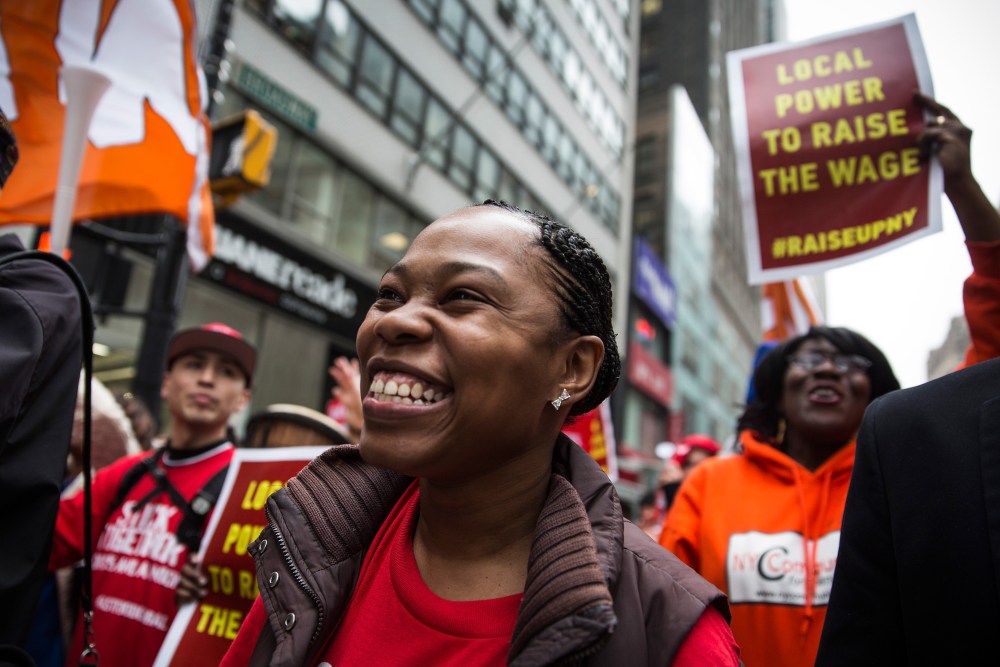
%22It%E2%80%99s%20not%20complicated%20%E2%80%94%20women%20deserve%20equal%20pay%20for%20equal%20work%2C%20and%20a%20living%20wage.%22′ In today’s economy, many women and men work at home and outside it. The world has changed. These changes have a huge impact on all of us, and our workplace practices and rules need to catch up in a hurry. Work needs to be a productive and safe environment for both women and men, and wages and benefits need to keep up with a working family economy. It’s not complicated — women deserve equal pay for equal work, and a living wage. When women are paid fairly, it grows our economy and helps all families make it work. Hardworking families deserve to make more than a decent living — we deserve to have a decent life. The time is ripe to push for an ambitious economic security agenda for women and families. Companies need our skills and talents. Advocates need our support to succeed on almost every issue. Politicians need our votes to win. We can use our power to make sure women are paid what they deserve and enact policies that allow both parents to spend time with their newborns; to make child care more affordable, and create flexible work environments. All American families — moms, dads, and kids — should be able to make it work. Our country will be the better for it. Vivien Labaton is the co-director of Make It Work, a national campaign working to advance economic security for women and families.
Vivien Labaton Recommended


