








Updated at 2:42 p.m. ET: A federal court in Washington on Thursday blocked a Texas law that would require voters to present photo IDs to election officials before being allowed to cast ballots in November, saying it would place an unfair burden on minorities and the poor.
A three-judge U.S. District Court panel ruled that that SB 14, described as the most stringent voter ID law in the country, imposes “strict, unforgiving burdens on the poor” and noted that racial minorities in Texas are more likely to live in poverty.
“Texas, seeking to implement its voter ID law, bears the burden of proof and must therefore show that SB 14 lacks retrogressive effect. But as we have found, everything Texas has submitted as affirmative evidence is unpersuasive, invalid, or both,” the opinion said.
“Moreover, uncontested record evidence conclusively shows that the implicit costs of obtaining SB 14-qualifying ID will fall most heavily on the poor and that a disproportionately high percentage of African Americans and Hispanics in Texas live in poverty. We therefore conclude that SB 14 is likely to lead to ‘retrogression in the position of racial minorities with respect to their effective exercise of the electoral franchise.’”
The ruling was the second legal blow to Texas this week. On Tuesday, another federal court panel threw out a Texas redistricting plan, finding evidence of discrimination in voting maps drawn by the state’s Republican-controlled Legislature.
The decision on the voter ID law involves an increasingly contentious political issue: a push, largely by Republican-controlled legislatures and governor’s offices to impose strict identification requirements on voters.
Republicans are aggressively seeking the requirements in the name of stamping out voter fraud. Democrats, with support from a number of studies, say that fraud at the polls is largely non-existent and that Republicans are simply trying to disenfranchise minorities, poor people and college students — all groups that tend to back Democrats.
Who can vote?: Special series on voter ID issues
The ruling comes in the same week that South Carolina’s strict photo ID law is on trial in front of another three-judge panel in the same federal courthouse. A court ruling in the South Carolina case is expected in time for the November election.
Texas Gov. Rick Perry signed SB 14 into law on May 27, 2011. The law has yet to take effect because the state needs “preclearance” for any change in voting procedures from either the U.S. attorney general or a three-judge U.S. District Court panel.
Watch the most-viewed videos on NBCNews.com
The judges said such voter ID laws might well be approved if they ensure that all prospective voters can easily obtain free photo IDs, and that any underlying documents required to obtain that ID are truly free of charge.
But the judges noted the Texas Legislature tabled or defeated amendments that would have, among other things, waived all fees for indigent persons who needed the underlying documents and reimbursed poor people for ID-related travel costs.
Stay informed with the latest headlines; sign up for our newsletter
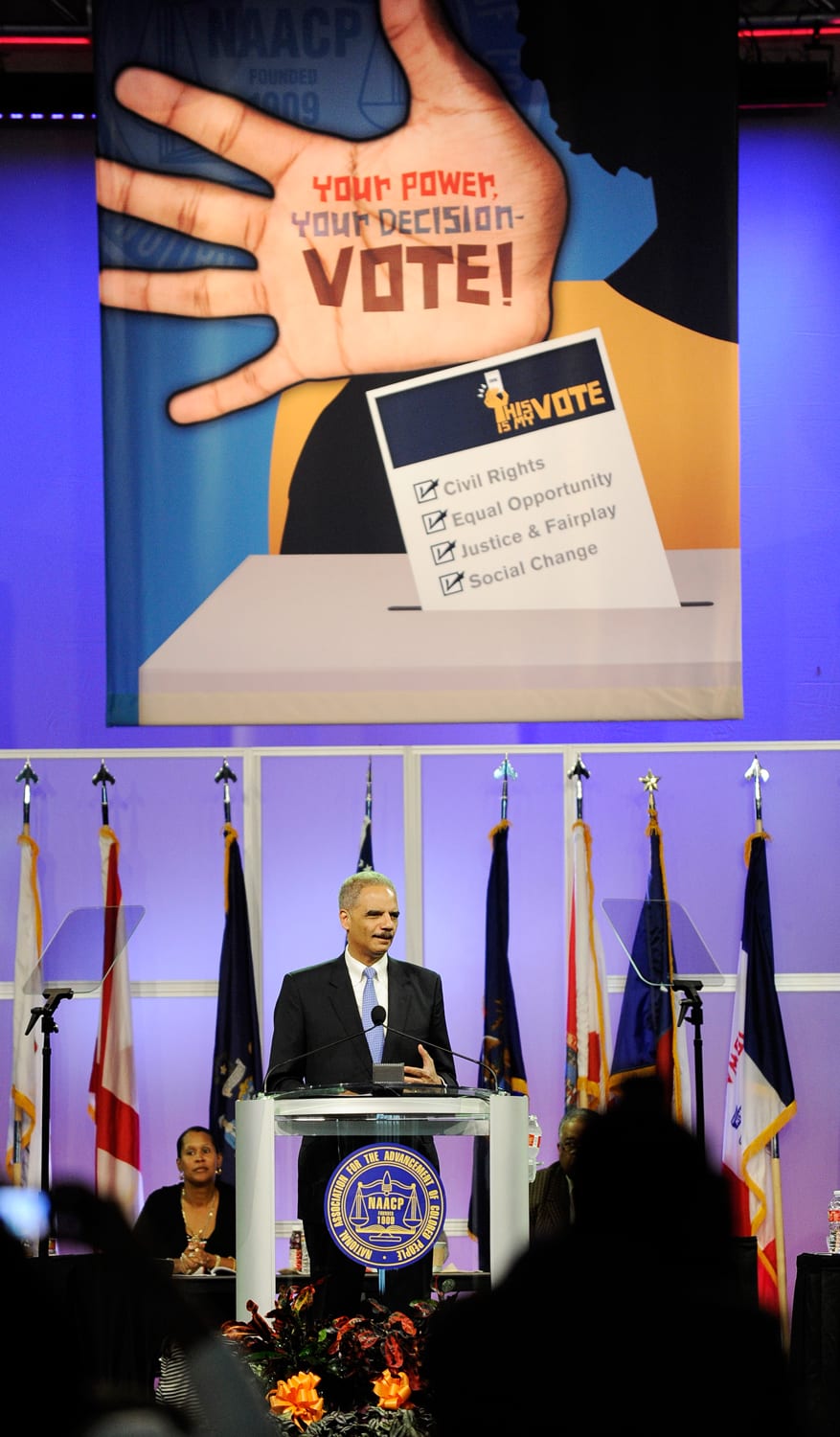
In the Texas case, the Justice Department called several lawmakers, all of them Democrats, who said they detected a clear racial motive in the push for the voter ID law. Lawyers for Texas argued that the state was simply tightening its laws. Texas called experts who demonstrated that voter ID laws had a minimal effect on turnout. Republican lawmakers testified that the legislation was the result of a popular demand for more election protections. During an appearance at the NAACP convention in in Houston in July, Attorney General Eric Holder said Texas’ photo ID requirement amounts to a poll tax, a term that harkens back to the days after Civil War Reconstruction when blacks across the South were stripped of their right to vote. The attorney general told the NAACP that many Texas voters seeking to cast ballots would struggle to pay for the documents they might need to obtain the required photo ID. In a statement Thursday, Holder said he was pleased by the court’s action. “The court’s decision today and the decision earlier this week on the Texas redistricting plans not only reaffirm — but help protect — the vital role the Voting Rights Act plays in our society to ensure that every American has the right to vote and to have that vote counted,” he said. White House spokesman Jay Carney said the Texas law does not comply with the landmark Voting Rights Act of 1965, which outlawed discriminatory voting practices blamed for the widespread disenfranchisement of blacks. “As you know this administration believes it should be easier for elligible citizens to vote, to register and vote. We should not be imposing unnecessary obstacles or barriers to voter participation,” Carney said. Texas Attorney General Greg Abbott said the state will appeal the panel’s rejection to the U.S. Supreme Court. “The Supreme Court of the United States has already upheld voter ID laws as a constitutional method of ensuring integrity at the ballot box,” he said in a statement. “Today’s decision is wrong on the law and improperly prevents Texas from implementing the same type of ballot integrity safeguards that are employed by Georgia and Indiana – and were upheld by the Supreme Court. The State will appeal this decision to the U.S. Supreme Court, where we are confident we will prevail.” The Associated Press contributed to this report compiled by NBC News’ James Eng. More content from NBCNews.com:
The Cycle Staff Recommended


