








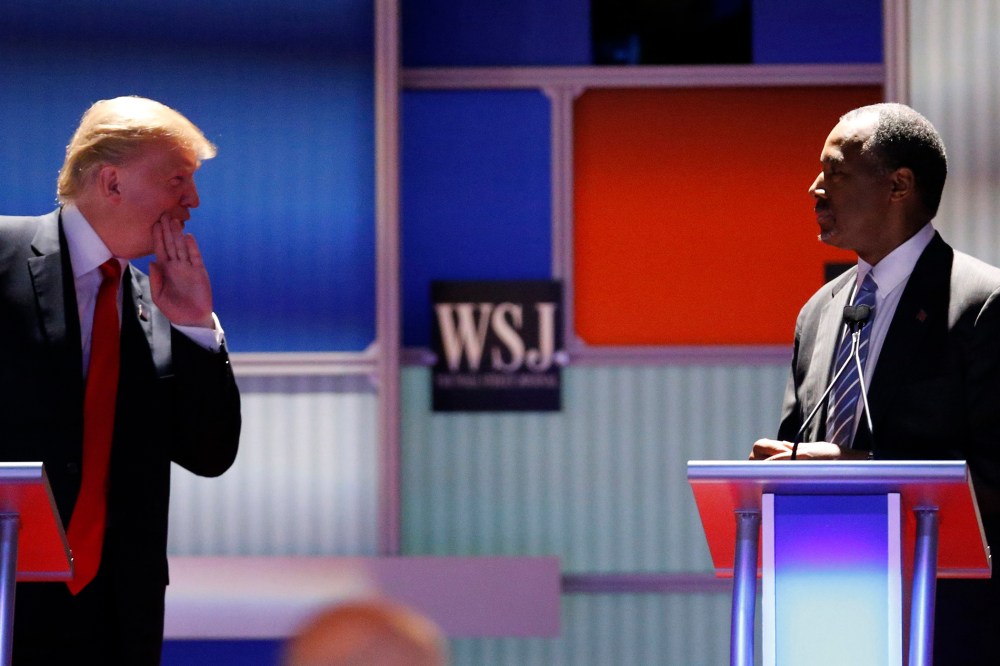
Some of the biggest questions of the 2016 election so far have surrounded the strong support for “outsider” candidates, especially in the Republican primary contest:
- With Donald Trump and Ben Carson leading the Republican race for the nomination, how do supporters of these “outsiders” compare to the average Republican primary voter?
- Do Trump and Carson attract the same kind of supporter?
- And—perhaps more importantly—what are the implications of these findings for the Republican race as the primary season continues?
It is possible to bring data to these questions by analyzing a recent online poll of nearly 3,400 registered Republicans conducted by NBC News and SurveyMonkey between October 27th and 29th. This unique poll has roughly eight times the number of Republican voters found in traditional election polls with sample sizes of about 1,000 respondents. This makes it possible to quantify the nature of support for specific candidates like Trump and Carson because we have enough of their supporters in the poll to draw accurate inferences.
RELATED: Trump on refugees: Create ‘safe zone’ in Syria, don’t ‘destroy all of Europe’
Two big differences between the candidates are clear. First, Carson’s supporters are far more religious than those supporting Trump and the other Republican candidates. Second, Trump’s followers are considerably more pessimistic about whether the American Dream still holds true than supporters of Carson and other Republicans. This suggests that there are optimistic and pessimistic “outsider” voters, and that Trump and Carson appeal to different segments of the Republican Party.
Whereas the supporters of Trump, Carson, and so-called “establishment” candidates like Jeb Bush, Chris Christie, Ted Cruz, John Kasich, Rand Paul, and Marco Rubio are remarkably similar in terms of demographics such as age, race, and gender, they differ significantly on a number of important political attitudes, and substantial differences emerge on voter characteristics and opinions.
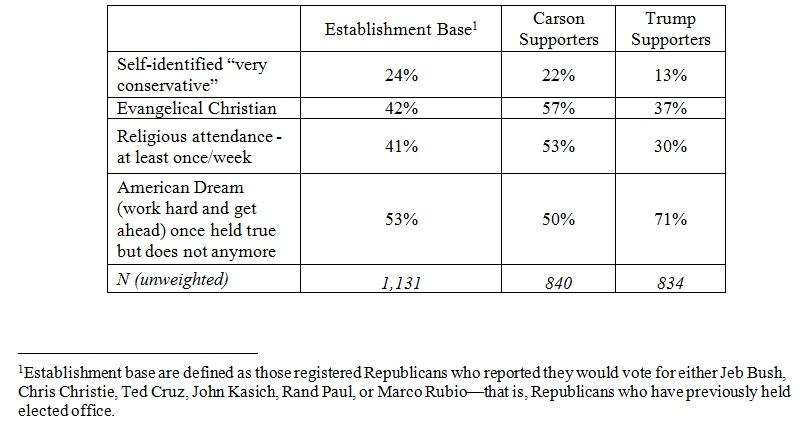
First, Trump supporters are significantly less likely to call themselves “very conservative” compared to Carson’s supporters and those who support establishment candidates Bush, Cruz, Rubio, Kasich, Paul, and Christie. This difference may be traced to the importance of social issues: Trump’s followers are much less likely to attend weekly religious services and self-identify as an evangelical Christian.
Second, while Trump’s supporters are less religious than the average Republican, Carson’s supporters are 12 percentage points more likely to attend weekly services and 15 percentage points more likely to identify as an evangelical Christian than the average Republican supporter. The 23 percentage point gap between Carson and Trump supporters on religious attendance is remarkably large and suggests that while both may be “outsiders,” they appeal to different kinds of Republicans.
Differences between Trump and Carson also emerge in terms of their supporters’ opinions regarding whether the American Dream of succeeding through hard work still holds true. Similar to the views of other Republican supporters, 50% of Carson’s supporters believe that while the American Dream once was true, it does not hold true anymore. Trump’s supporters, on the other hand, are significantly more likely than establishment candidates or Carson supporters—by a margin of 18 and 21 percentage points, respectively—to endorse this statement.
RELATED: Carson: al Qaeda was not a threat in 2003
While both Carson and Trump are “outsider” candidates, our results reveal that they currently appeal to two different types of Republican voters. Carson draws the support of religious conservatives and Trump is favored by economic pessimists. It is therefore unclear how these supporters would respond should either Trump or Carson drop from the race. It is similarly tricky to figure out how support in the race might consolidate going forward. Whereas Trump’s supporters are much more pessimistic than those supporting “establishment” candidates in their views of the American Dream, Carson’s supporters more closely match the religiosity of those Republicans supporting other candidates. Depending on the relative importance of these differences, this may give us hints about how voters’ loyalties may change over time. This NBC News online poll was conducted by SurveyMonkey from October 27 to 29th among national samples of adults aged 18 and over. Respondents for this non-probability survey were selected from the nearly three million people who take surveys on the SurveyMonkey platform each day. A full description of our methodology and error estimates for each survey can be found here. The online poll was produced by the Analytics Unit of NBC News in conjunction with Penn’s Program on Opinion Research and Election Studies with data collection and tabulation conducted by SurveyMonkey. This article first appeared on NBCNews.com.Recommended



Carrie Roush

Susan Del Percio is a Republican strategist and a political analyst for MS NOW.
Josh Clinton