








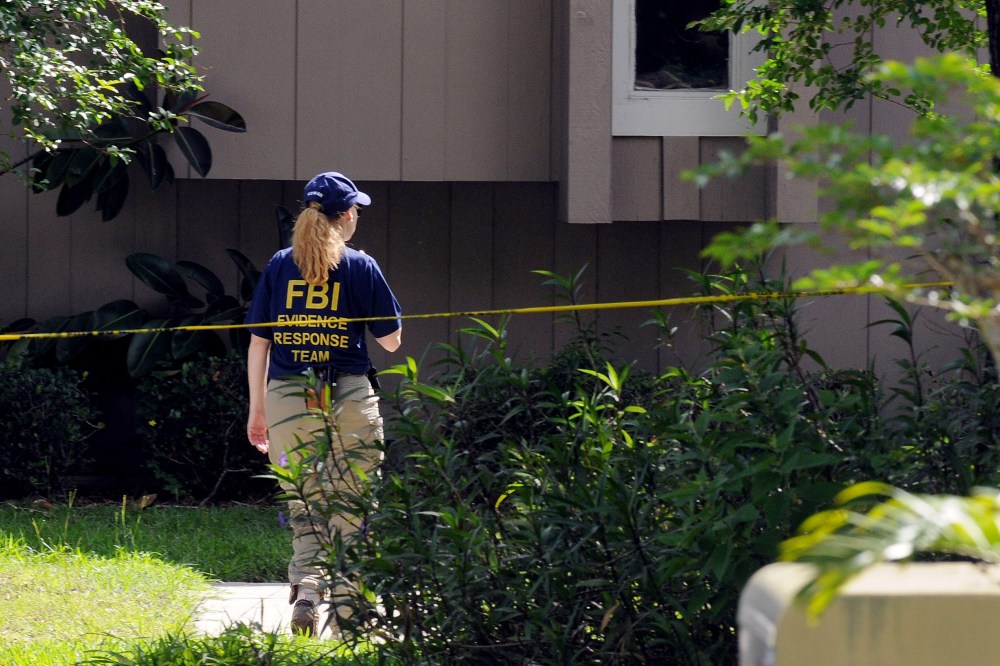
The Council on American-Islamic Relations (CAIR) is moving ahead with a plan to sue the Federal Bureau of Investigations over what CAIR says is the wrongful shooting death of Ibragim Todashev, friend of the late alleged Boston Marathon bomber Tamerlan Tsarnaev, msnbc has exclusively learned.
On Monday, the Florida chapter of the nation’s largest Muslim civil liberties advocacy will send a “notice of claim” — a precursor to a civil lawsuit — to the FBI alleging negligence and misconduct in the fatal shooting of the 27-year-old Todashev in his Orlando home in May of 2013.
The actual civil lawsuit, which will seek $30 million in damages for Todashev’s family, is expected to be filed this spring, said CAIR Florida’s chief executive director Hassan Shibly.
“We want to send a strong message to the FBI that they can’t engage in … predatory behavior and misconduct … We also want a change of policy so this never happens again,” said Shibly.
RELATED: Filmmaker exposes FBI counter-terrorism strategy
The father of the Florida man, Abdulbaki Todashev, told msnbc through a translator that “We expect justice for our son for the evil that was done to him.”
Todashev, a Chechen-born mixed martial arts fighter who had trained with Tsarnaev in Boston, was killed by FBI agent Aaron McFarlane after Todashev reportedly became violent after hours of questioning about the Boston attacks and a separate 2011 triple homicide in Waltham, Mass. Investigators said in the state attorney’s report that Todashev had implicated both himself and Tsarnaev — who was killed in the days following the Boston Marathon bombings — in the Waltham murders, which were unsolved prior to Tsarnaev’s death.
%22We%20want%20to%20send%20a%20strong%20message%20to%20the%20FBI%20that%20they%20can%E2%80%99t%20engage%20in%20this%20type%20of%20predatory%20behavior%20and%20misconduct.%22′
In its “notice of claim,” CAIR asserts that Todashev “did not pose a threat of serious bodily harm to McFarlane or any other person” and that “none of the agents present sought to intervene to prevent the excessive force, though able.”
The Florida state attorney and the U.S. Department of Justice both issued separate reports last spring clearing McFarlane of any wrongdoing, ruling he was acting in self-defense when he shot and killed Todashev. The state report details how Todashev, who had been writing a confession, allegedly lunged forward at law enforcement officers with a metal pole after throwing a coffee table top. According to the report, the FBI agent fired three to four shots, but Todashev was still able to advance toward the officer, at which point more shots were fired by the agent. An autopsy report showed Todashev was shot seven times.
CAIR and other advocacy groups have maintained that the circumstances of Todashev’s death remain murky, with some officials making contradictory statements to news organizations about whether or not the Florida man was armed when he was killed. They question why he was shot so many times, and point to McFarlane’s checkered past. A Boston Globe investigation claimed McFarlane had previously been at the center of two police brutality lawsuits and four Internal Affairs investigations during his time at the Oakland Police Department in California. CAIR’s “notice of claim” asserts that the FBI was negligent in hiring McFarlane.
Chris Allen, a spokesperson for the FBI, said the agency does not comment on ongoing litigation. The pending lawsuit comes as several police killings have rocked communities across the country, raising concerns about police practices. That includes last year’s death of Michael Brown in Ferguson, Missouri and Eric Garner in Staten Island, New York. RELATED: FBI obstructs oversight, DOJ Inspector General says Shibly said these deaths, along with Todashev’s, “reflects the dramatic loss of liberty Americans have been facing in the last decade-and-a-half since 9/11 with a lot more deference to authority at the expense of our liberty, which is what makes America so great to begin with … It’s clear we can’t trust law enforcement to police themselves.” He added that if not for the “FBI wrongly targeting the Muslim-American community, I don’t think he would be dead to begin with.” Separately, the jury selection process in the trial of accused Boston bomber Dzhokhar Tsarnaev, the younger brother of Tamerlan Tsarnaev, is ongoing. The siblings are suspected of planting bombs that killed three people and injured 264 near the finish line of the Boston Marathon on April 15, 2013.Recommended


