








James Holmes entered a movie theater in Aurora, Colorado, during a midnight showing of “The Dark Knight Rises” nearly three years ago and committed one of the deadliest mass shootings in U.S. history. Holmes now faces the death penalty, and his trial, which began this past April, is soon coming to a close. Closing arguments are expected to be delivered on Tuesday.
In the meantime, here is everything you need to know about The State of Colorado v. James Holmes.

Who’s involved?
James Eagan Holmes, 27, was a former neuroscience Ph.D. candidate. He wounded 70 people, and killed 12 who ranged in age from 6 to 51. Holmes legally purchased the multiple firearms he used in the shooting from three Colorado gun stores.
Judge Carlos Armando Samour, Jr. is presiding over the case. He was born in El Salvador and immigrated to the United States with his family when he was 13 years old. Interestingly, Samour attended Columbine High School, the scene of another mass shooting that occurred 13 years before the shooting in Aurora. He is a former defense attorney, as well as a former prosecutor. This is Samour’s first death penalty trial.
The judge issued 9,000 jury summonses, reportedly the largest amount in U.S. history. After jury selection, the trial began with 12 jurors and 12 alternates — 19 women and 5 men, most of whom are white.
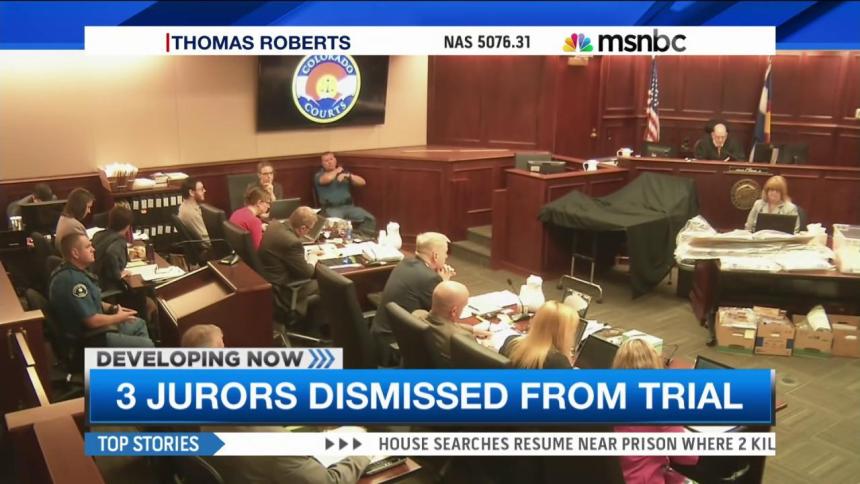
The jury is now down to 12 jurors and seven alternates because five jurors were dismissed. On June 9, three jurors were dismissed because one was watching news coverage and discussed the case with the other two. In mid-June, a fourth juror was dismissed because her brother-in-law was shot in a robbery the week prior. Two days later, a fifth juror was dismissed for not being candid about a recognizing a witness who testified at the trial in May.
What are the charges?
James Holmes is facing 166 counts: 24 counts of first degree murder, 140 counts of attempted murder, one count of possession of explosives, and a final count of crime of violence, which is a sentence enhancement charge.
What is the evidence?
Most of the evidence against Holmes came via witnesses called by the prosecution. They were primarily victims and eyewitnesses in the theater, but also many police officers, doctors and employees of the store where Holmes made purchases relevant to the shooting. The defense is still calling witnesses who have mostly been psychologists and psychiatrists. As of today, approximately 250 witnesses were called for the case.
A crucial yet controversial piece of evidence for both sides is Holmes’ notebook, or journal, that contained musings on life and death, as well as details on the planning of the theater shooting.
RELATED: James Holmes trial: Three jurors dismissed after talking about case
Video statements will also play heavily into the jurors’ deliberation. The jurors watched 22 hours of Holmes being interviewed by a psychiatrist. Video of Holmes with police was also entered into evidence, but the defense battled to have the footage suppressed as violative of Holmes’ 5th Amendment right against self-incrimination.
What is Holmes’ defense?
Holmes’ defense team has acknowledged he committed the shooting but has entered a “not guilty by reason of insanity” plea. Colorado is only one of 11 states that puts the burden on the prosecution in an insanity plea. That means the prosecution will have to prove Holmes was sane at the time of the crime. To succeed with this defense, Holmes must:
- Be “so diseased or defective in mind at the time of the commission of the act as to be incapable of distinguishing right from wrong with respect to that act,” or
- Suffer “from a condition of mind caused by mental disease or defect that prevented the person from forming a culpable mental state that is an essential element of a crime charged.”
What comes after the trial?
After this guilty-or-not phase of the trial concludes, then comes the sentencing phase. If Holmes is found guilty of any of the murder charges, another mini-trial will be held on whether he should receive the death penalty. The same jury will decide this and must return a unanimous verdict in order to sentence Holmes to death.
Why did this case take so long to go to trial? The theater shooting happened nearly three years ago. The case took so long to go to trial because of multiple lengthy psychiatric evaluations, motions regarding the death penalty, as well as motions regarding the insanity defense. Why did Holmes commit this mass shooting? Motive is not an element to a charged crime, therefore the prosecution does not have to prove it. However, prosecutors usually like to serve one up when they can. In this case, the videotaped interview of Holmes by a psychiatrist demonstrates five potential motives: How long will the jury deliberate? The jury can take hours, days or even weeks. There is no way to know for sure but, considering there were hundreds of witnesses and exhibits, including dozens of hours of video and a complicated defense of insanity, I predict it will take the jury several days. Where will Holmes go after the trial? The trial is being held at the Arapahoe County Justice Center in Centennial, Colorado — the defense team filed a motion to change venue in April 2014 but that was denied. After the trial, there are three possibilities as to where Holmes will end up. It all depends on the verdict. RELATED: 2,000 unneeded jurors released from selection of Aurora movie theater trial If Holmes is found “not guilty by reason of insanity” that is an absolute finding; meaning it applies to all 166 counts he is facing. In such case, Holmes goes to a state psychiatric hospital with the slight possibility of being released in the future. If Holmes is found guilty of any of the murder counts but is not sentenced to death, Holmes gets life without parole and goes to prison. If Holmes is found guilty of any of the murder counts and the jury votes unanimously for the death penalty, Holmes goes to death row. He will likely be appealing the sentence for many years and thus would not face execution for a long time. Since Colorado reinstated the death penalty in 1975, only one man has been put to death. That was in 1997. Currently, three men are on death row awaiting execution.
Seema Iyer Recommended


