








GREENSBORO, N.C.— Thirty-five years ago on Nov. 3, a pack of Ku Klux Klan and Nazi gunmen rolled through this city in a caravan ten cars deep and opened fire on a crowd of protesters at an anti-Klan rally.
The crackle of gunfire sent folks scattering under a bright fall sky, some dragging small children behind them. Some diving behind parked cars and news vans. Others were shot down in the street with gunshots to the face and head
Slideshow: Issues that matter to new voters in North Carolina
Five labor organizers were killed that bloody day, now known as the Greensboro Massacre. But not a single person was ever convicted, not nary a one of the sixteen gunmen arrested in the killings ever served a single day in prison. Nor had any of the police officers or officials who were tipped-off about the posse’s plans for murder.
%22Five%20died.%2010%20were%20wounded.%20To%20some%20extent%20it%20remains%20one%20of%20the%20most%20frightening%20events%20in%20this%20city%E2%80%99s%20history%22′
All-white juries acquitted them in two separate criminal trials.
On the eve of Tuesday’s elections, some of the locals who were there that day in 1979 or who were steeped in the struggles of the day— against economic inequality, voter suppression and racial violence— reflected on how much has changed over the decades and how much has remained the same.
“It was 35 years ago today,” said the Rev. Nelson Johnson, who was stabbed by one of the Klan that day. “Five died. 10 were wounded. To some extent it remains one of the most frightening events in this city’s history. In some sense people have moved on from it. But the implications of what’s going on today are strikingly similar.”
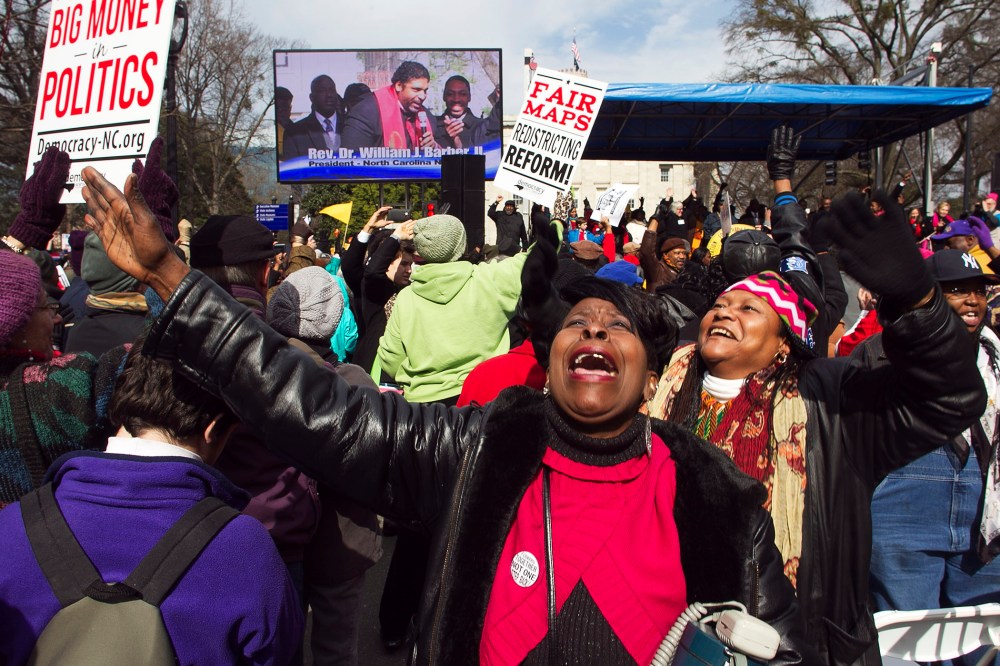
Johnson stood in the center of a Government Plaza in downtown Greensboro, under a bright sky not too much different than that one more than three decades earlier. This day though he was setting up a lectern and chairs for a rally, not dodging gunfire. As a part of coalition of activists and clergy, Johnson has joined a broad swath of black and white, middle-of-the-road folks and progressives, as part of the Moral Mondays movement. The movement began as a call to civil disobedience at the Statehouse in Raleigh to protest a slew of recent legislation that suppressed minority votes, restricted women’s rights or hurt the poor and low-income workers.
%22They%20are%20spending%20an%20ungodly%2C%20gross%20amount%20of%20money%20right%20now%20to%20take%20us%20back%22′
With a hotly contested Senate race between the Democratic incumbent Kay Hagan and ultra-conservative Republican candidate Thom Tillis, movement organizers held one last rally to energize voters. The political differences between Hagan and Tillis couldn’t be more stark, as Tillis is running largely with the financial support of the Koch brothers and a track record as Speaker of the House that has included pushing through some of the most repressive voting laws in the country.
The race is also shaping up to be perhaps one of the most expensive in history, expected to top $100 million in spending.
Related: ‘Everything is at stake’ in North Carolina US Senate race
“They are spending an ungodly, gross amount of money right now to take us back,” Rev. William Barber, the leader of the Moral Monday movement, said during Monday’s rally. Barber and others invoked the anniversary of the Greensboro Massacre, saying the significance of the day and the progress still to be made, shouldn’t be lost on anyone.
“The community was so fractured back then,” said Joyce Johnson, Rev. Johnson’s wife and a longtime organizer and activist who was instrumental in many of the political movements around Greensboro from the 1960s on. “A lot of people actually blamed us for bringing them there that day.”
Hours before the rally Mr. and Mrs. Johnson attended a small gathering of elders who’d been on the scene of the shooting that day or on the social activism seen at the time.
“I think there are so many of the same political, economic and social manifestations of what people don’t want in their lives,” she said. “We see what we have moved away from and have a sense of where we can go. I still believe some of us, like myself, have been blessed to continue to be action oriented. And we are blessed to be intergenerational.”
After decades of activism through the 1960s, 1970s and 1980s, the Johnson’s founded the Beloved Community Center in the early 90s with some of their old compatriots from the earlier equality movements. It has served, as one volunteer said, as “the mecca” of Greensboro activism ever since.
“The realities haven’t changed much in the things young people were fighting for in the 60s to what they’re fighting for now,” said Terence Muhammad, who came up through the center in the mid-90s and continues to volunteer there now. “It may be a different look, a different style, but the heart of it is still the same.” “We talk about Ferguson,” Muhammad said, referring to the Missouri city steeped in unrest since the killing of an unarmed black teen by a police officer this summer. “But Fergusons happened in the 60s and in every decade since.” Clyde Barnes, another co-founder of the Beloved Community Center and veteran activist who worked side by side with the Johnsons throughout the tumult of earlier protest movements, said he thinks the energy around Tuesdays Senate race among black voters especially is a testament to ongoing engagement at the grassroots level. Analysts believe the Hagan/Tillis race could likely come down to black voters. Black voter participation in early voting has surged some 45% from 2010, a remarkable jump and indicator of voter mobilization. The most recent polls show Hagin with a very narrow lead over Tillis, and any bolstered black voter turnout would overwhelmingly support Hagin, the Democrat. “I think some people are looking at traditional metrics and not grassroots efforts,” said Barnes, who a decade before the Greensboro Massacre was himself at the center of a deadly clash between police and student protesters. “You can’t measure that in polling.” On Monday night, about an hour and half after Nelson stood in the practically empty plaza recalling that terrible day, he took to the lectern he’d set up and roared before a crowd of a hundred or so people. “Thirty-five years ago five people were killed on this day in Greensboro,” Nelson voice boomed out into the mass. “But the light is shining through the darkness right now and we are happy to have a break through.” Nelson then led a chant of “now is the time, tonight and tomorrow, forward together, not one step back.” “Vote!” he yelled out, stepping away from the microphone.
Trymaine Lee
Trymaine Lee is an NBC News correspondent. Recommended


