








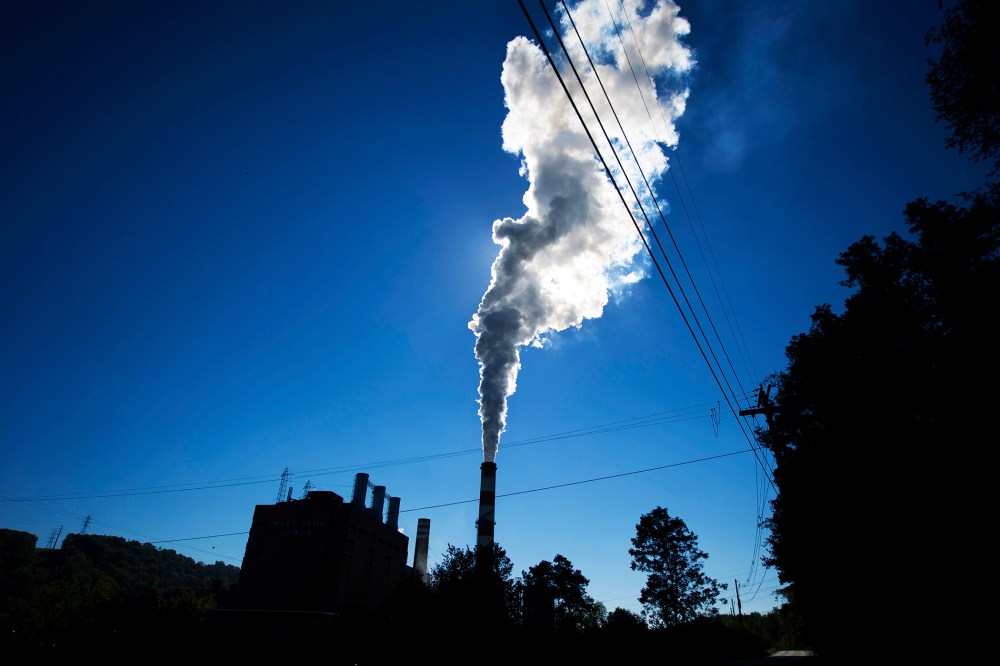
Environmentalists scored a big win at the Supreme Court Tuesday when the high court upheld an Environmental Protection Agency rule meant to reduce interstate air pollution. Chief Justice John Roberts and Justice Anthony Kennedy sided with the high court’s Democratic appointees.
“EPA’s cost-effective allocation of emission reductions among upwind States, we hold, is a permissible, workable, and equitable interpretation of the Good Neighbor Provision,” wrote Justice Ruth Bader Ginsburg. The “Good Neighbor Provision” refers to the part of the Clean Air Act that compels states to reduce the amount of air pollution they contribute to other states.
States are obligated to meet certain emissions standards under the Clean Air Act, but sometimes pollution from neighboring states affects their ability to meet those standards. Those upwind states are supposed to adopt practices that prevent their pollution from affecting downwind states. That pollution can be nothing short of lethal, a brief filed in the case from the American Thoracic Society noted that “Air pollution measurably and substantially shortens lives.”
In 2011, the EPA established a rule for how upwind states could reduce the effect of their emissions on downwind states, but several states and cities challenged the rule, arguing that the EPA’s determination for who should reduce emissions and how wasn’t exactly proportionate to the amount of pollution each state was producing.
Scientific experts said that the nature of air pollution, which is affected by things like wind, atmospheric conditions, and humidity made that standard scientifically impossible to meet — sometimes reducing a state’s contribution to air pollution in one state will also significantly reduce its contribution to a third state.
The decision was a rare loss at the high court for the Chamber of Commerce, and a rare win for the EPA, which has been a particular target of conservative ire under the Obama administration. The Wall Street Journal editorial page has referred to the EPA as a “rogue agency,” one Fox News host called the agency “job terrorists.” That rage was reflected in Justice Antonin Scalia’s dissent joined by Justice Clarence Thomas (Justice Samuel Alito was recused). Scalia argued that the EPA’s rule was unlawful because the Clean Air Act didn’t give the agency the authority to make a cost benefit analysis in determining how each upwind state should go about reducing its emissions contributions to downwind states. Using part of a phrase popularly attributed to Karl Marx, the author of the Communist Manifesto, Scalia referred to the EPA’s rule as an “from each according to its ability” approach. Before reading his part of his dissent from the bench, Scalia said “these are not cases of Earth-shattering importance” but then said the decision “feeds the uncontrolled growth of the administrative state at the expense of government by the people.” According to the EPA’s analysis, the rule upheld by the high court could “prevent between 14,000 and 36,000 premature deaths annually.”
Adam Serwer Recommended


