








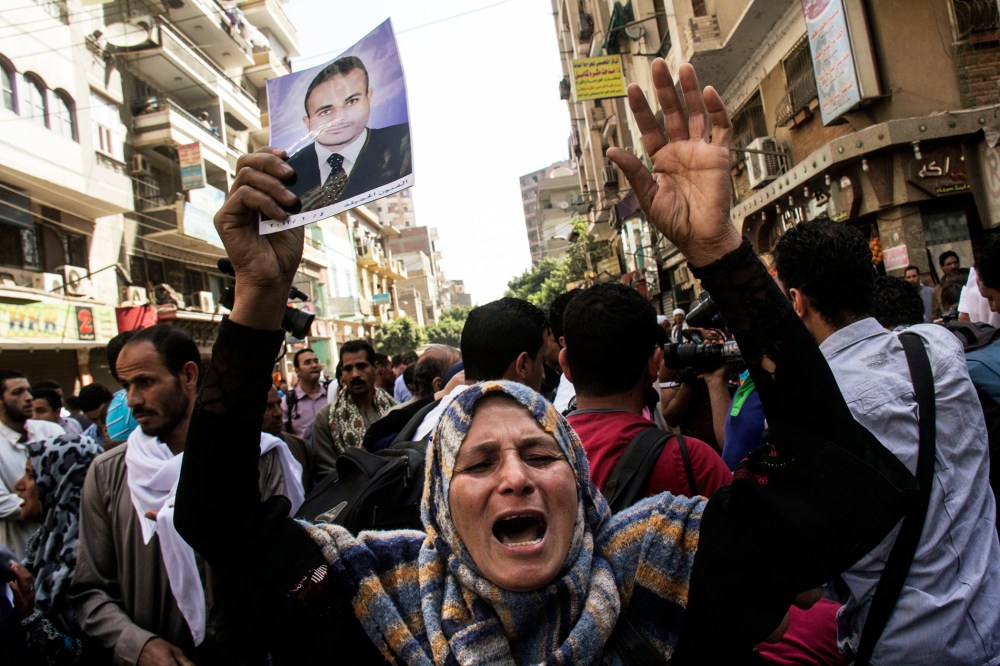
The Egyptian military’s brutal crackdown on dissent reached new heights Monday when a court sentenced 683 supporters of ousted President Mohamed Morsi, including the Muslim Brotherhood’s spiritual leader, for charges that included the killing of a police officer during nationwide clashes last summer. The Obama administration, meanwhile, has taken little action, continuing a pattern that began in July when it refused to label the military’s removal of the freely-elected Morsi as a “coup.”
In a meeting Tuesday with Egyptian Foreign Minister Nabil Fahmy in Washington, Secretary of State John Kerry said he was “deeply disturbed” by the recent events in Egypt. Yet Kerry did not mention President Barack Obama’s decision last week to resume delivery of half of the annual $1.3 billion military aid package and ten Apache attack helicopters to Egypt, which was delayed last year after the Egyptian military killed over 1,000 unarmed citizens in an armed attack on a sit-in protest.
Sen. Patrick Leahy (D-Vt.), head of the Senate subcommittee that determines foreign aid appropriations, declared Tuesday he would not authorize the release of the $650 million to Egypt. His committee does not have jurisdiction over the helicopter deliveries.
In not labeling the military takeover a coup, the Obama administration bypassed a law that would prevent the U.S. from funding any foreign government that took power in a military coup. Yet the scale of the crackdown has made this support increasingly difficult to justify.
Leahy, who authored that law, called Egypt’s Monday ruling the result of a “sham trial.”
“It’s an appalling abuse of the justice system, which is fundamental to any democracy,” Leahy told the Senate Tuesday. “It does not show democracy. It shows a dictatorship run amok. It is a total violation of human rights.”
While Leahy and some other U.S. politicians have spoken out against the Egyptian military’s abuses, the Obama administration’s response should give the military little reason to change its approach, as Obama has taken few actions to slow the military’s oppressive behavior.
According to Robert Springborg, an expert on the Egyptian military and professor at the Naval Postgraduate School, Washington is less concerned with human rights abuses than the growing Islamist threat to Egypt’s interim government. Led by Field Marshal Abdel Fattah al-Sisi, who is expected to win Egypt’s upcoming presidential election, the Egyptian military has thus far focused on the restive Sinai peninsula. But a recent series of bombings in Cairo raised fears that the terrorist campaign has expanded.
The Obama administration appears to share that fear. “I think [the Obama administration does] believe there is a serious threat there,” Springborg says. “The Egyptian military can do almost anything, and there won’t be any response from Washington.”
But support for the military despite Egypt’s growing human rights abuses may create more malice toward the U.S. in the long run, Springborg warns.
“The consequence of all of this, it is now being read throughout the Arab and indeed Muslim world that the United States has gone into a profoundly anti-Islamic framework and is willing to send the dogs after them, wherever [they] are,” he says. It wouldn’t be the first time. While U.S. presidents have often spoken boldly about protecting human rights around the world, national security concerns have usually taken precedence. President Jimmy Carter famously championed human rights, yet toasted the Shah of Iran — who headed a notoriously brutal security state — as an “island of stability” in the Middle East. Similarly, the U.S. continues to support Saudi Arabia, one of the worst human rights offenders in the world, in exchange for the kingdom’s cooperation in fighting terrorism. In the past, American prioritization of realpolitik over human rights has generated violent blowback: Iranian crowds can still be heard chanting “Death to America” at rallies today. Such blowback may soon come from Egypt, says Mohamed Mahmoud, an Egyptian American who is vice president of Egyptian Americans for Democracy and Human Rights, a group that opposes the military takeover. “When you keep the people of Egypt, keep them jailed, keep them killed, and these judgments take place,” he says, “this is going to get back to America again.”
Jake Meth Recommended


