








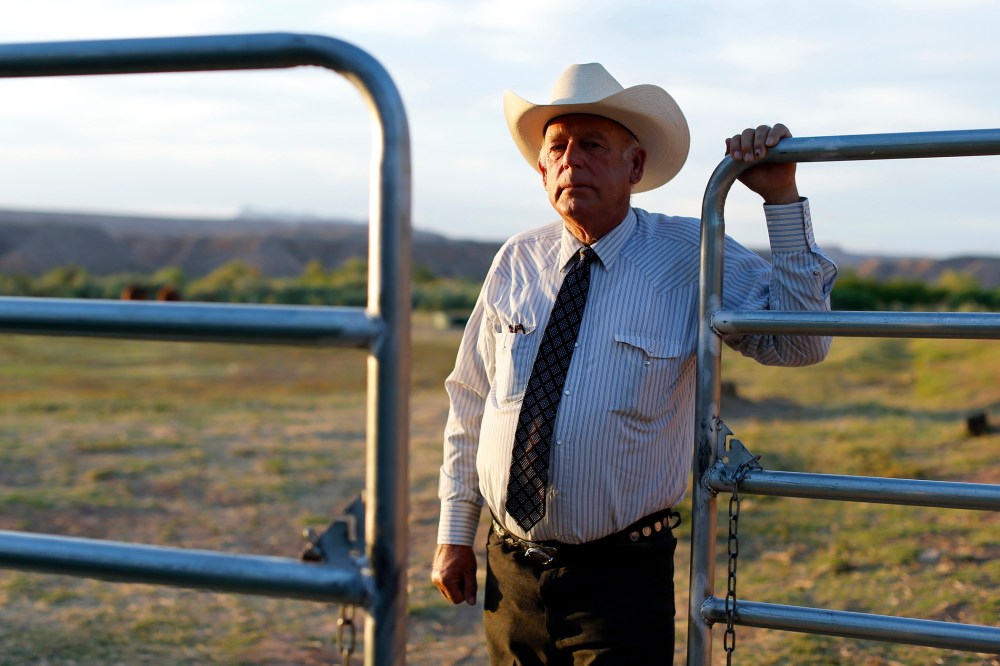
Don’t let Cliven Bundy see a copy of Peter Barnes’s new book, “With Liberty and Dividends For All.”
Bundy, the Nevada rancher who turned his refusal to pay cattle grazing fees into an improbable cause célèbre, told a Utah gathering of the reactionary Independent American Party on Aug. 2 that God had called on him to prevent a civil war. But “With Liberty and Dividends For All” argues that the federal government isn’t collecting enough revenue from businesses that use resources belonging to all Americans.
Barnes’s book, published this week, proposes collecting those fees in earnest and using them to furnish cash dividends to U.S. citizens, thereby reducing the wealth inequality that, according to Thomas Piketty’s “Capital in the 21st Century,” risks reviving the aristocracy of inherited wealth. The dividends idea may seem an unacceptably radical solution, but Founding Father Tom Paine once proposed a similar idea. What’s more, this scheme already exists in Alaska, where it’s been championed by a succession of Republican governors — including Sarah Palin.
Barnes has an expansive concept of what he calls “co-owned wealth” or “the commons”— goods owned by everybody because they derive from nature, from our ancestors, or from our economy as a whole.
Natural resources are the most concrete category: the air we breathe; the water we drink; government-owned forests and grasslands; and so on. In Barnes’s view, President Obama’s cap-and-trade bill to reduce carbon emissions failed in 2010 in large part because the tradable permits to release carbon into the atmosphere were provided free of charge rather than auctioned off, with proceeds allocated directly to the public (as Obama originally envisioned). Energy-state legislators resisted the auction idea, and Barnes argues that once it was discarded, the public lost its financial interest in the outcome.
A similar political logic may explain why the federal government receives below-market compensation for oil and mineral leases and, yes, grazing rights. (The Bureau of Land Management’s grazing fee that Bundy refuses to pay is $1.35 per animal unit month; private ranchers charge from anywhere from $8 per AUM to $23 per AUM.)
A second category of co-owned wealth is the legacy of previous generations: scientific breakthroughs, legal and political systems, and the financial infrastructure. Barnes proposes financial transaction fees (doesn’t the market belong to us all?), fees for protecting intellectual property through patents and copyrights, and fees for use of the electromagnetic spectrum. Such fees, when collected at all, don’t begin to reflect the true value of the commons.
A third category is the physical infrastructure that aids commerce (roads, bridges and the like). At one time the interstate highway system was funded entirely through a gas tax and other user fees. But today, both Congress and the Obama administration balk at raising the gas tax high enough to cover a growing shortfall. Instead, Congress recently resorted to various budget gimmicks to fund the highway system for less than a year. Only some of these common resources were envisioned by Tom Paine. But in his 1797 pamphlet “Agrarian Justice,” Barnes points out, Paine devised a dividend scheme derived from common wealth. Paine proposed creating a national fund that would pay out 15 English pounds to all citizens at age 21 and 10 pounds per year to everyone over the age of 55. The revenue would come from a tax on “natural property” — i.e., wealth created not through the efforts of man but through “the Creator of the universe — such as the earth, air, water.” One hundred seventy-nine years later, in 1976, Jay Hammond, the Republican Governor of Alaska, established something similar in the Alaska Permanent Fund, which pays annual dividends to all Alaskans (excepting incarcerated or recently-sentenced criminals) out of a fund derived from private oil royalties to the state for drilling on Alaska’s North Slope. In 2008 Sarah Palin boosted the fund (and therefore the dividends) by imposing an excess profits tax. Sounding very much like a liberal Democrat, Palin explained that resource extraction was “for the maximum benefit of the people, not the corporations.” Might this idea fly in Washington? Hard to say. But nobody can complain that it isn’t conservative enough.
Timothy Noah Recommended


