








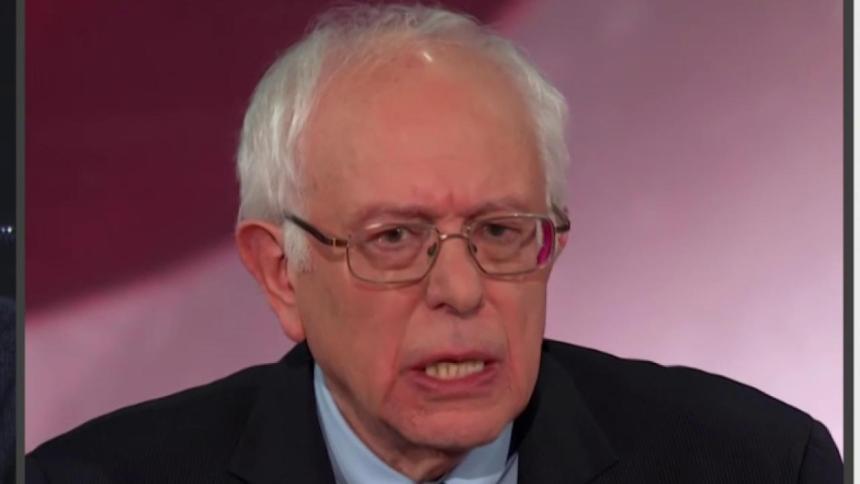
CHARLESTON, South Carolina — It’s a cliché that after every presidential debate, campaign advisers head to the “spin room” to declare to reporters that “there was only one president on the stage tonight,” and it was the candidate they work for.
But at the NBC News/YouTube debate here Sunday night, Bernie Sanders won by sounding more revolutionary than presidential. That’s no surprise for Sanders, who has adopted the posture of an outsider insurgent for his entire career and made “political revolution” a slogan of his 2016 presidential campaign.
But with the possibility that he could make it to the White House no longer unfathomable, does Bernie Sanders actually want to be president?
It’s a seemingly stupid question to ask about a person who has worked themselves to the point of exhaustion every day for the past eight months to achieve that goal. But when Sanders got into the 2016 race with an announcement at a hastily arranged press conference behind the Capitol building in April, everyone assumed the answer was obviously “no.”
RELATED: Sanders surges in debate that gets at core of Democratic divide
While he denied it, of course, the world assumed that Sanders was there to influence the political conversation, raise issues important to his movement, and to push presumed nominee Hillary Clinton to the left. Many compared him to Ron Paul, the libertarian Republican who ran for president twice — with no hope of winning — on a message of revolution.
That analysis served fine for most the campaign. But something changed when the calendar turned to 2016: For the first time, if you squint hard enough, you can see Bernie Sanders putting his right hand on the Torah as Chief Justice John Roberts administers the oath of office on the steps of the Capitol in a year’s time.
He now leads the polls in New Hampshire, has closed the gap in Iowa, and is eating into Clinton’s large national lead with just days to go before the first party nominating contests. Winning the Democratic nomination no longer seems out of Sanders’ reach, and that means the presidency isn’t either. Polls testing hypothetical general election match ups — as statistically unreliable as they are this far out — show Sanders beating most Republican candidates, and in some cases by larger margins than Clinton.
Sanders is beginning to let his imagination go there. After the State of the Union address last week, he admitted to NBC Nightly News anchor Lester Holt that, as he sat in the House chamber watching Obama give his final State of the Union address, he imagined himself giving the presidential address. “Well, actually, to be honest with you, that thought did go through my head,” he said with a sheepish laugh. “Yes, it did.”
Even if the probability of a Bernie Sanders presidency only climbed from zero to slightly more than zero, it’s still a development that’s leading many, including the Clinton campaign, to call for holding his candidacy to a higher standard than the one it’s been judged against thus far. On Monday, a slew of wonky liberal columnists turned a more critical lens on Sanders after he released his single-payer health plan Sunday.
Paul Krugman, the Nobel laureate New York Times columnist, essentially accused Sanders of selling his supporters a bill of goods with the health care plan. “[F]or all the talk about being honest and upfront, even Sanders ended up delivering mostly smoke and mirrors,” Krugman wrote.
Ezra Klein, the Vox founder who is a trusted voice on the left on health reform, last week took Clinton to task for a disingenuous attack on Sanders’ health care plan. But on Monday, he eviscerated Sanders’ plan, calling it a “puppies-and-rainbows” fantasy.
RELATED: Sanders wrestles with Clinton on foreign policy
Klein’s colleague Matt Yglesias, widened his scope to point out a number of other Sanders platform items that are more slogan than policy. And New York writer Jonathan Chait took a wider view still, challenging the entire premise of the Sanders’ campaign.
The silver lining for Sanders is it means people are taking him seriously. But they’re raising their expectations for him, as well.
The new reality of Sanders’ position in the race “means that we in the media need to start taking his campaign seriously,” Yglesias wrote, “but also that Sanders himself needs to take his campaign seriously.”
Sanders’ campaign embraces its ragtag image and is much smaller than Clinton’s. But Sanders has been a member of Congress for more than two decades, introduced hundreds of pieces of legislation, and is currently the ranking member of the U.S. Senate Budget Committee. When he took over that position last year, he assembled a who’s who of lefty policy wonks to work for him. Sanders campaign defends the health care plan by saying it should be viewed more as a vision statement than ready-to-introduce legislation, and notes that Clinton has not released fully detailed plans either for a number of her policies. As Clinton could tell Sanders, details are messy and limiting and don’t exactly fire up the base. But “details matter,” as Clinton is now fond of saying, if you’re actually president or might be one day. Sanders has so far not been held to that standard. So does he want to be president? Do all of his supporters? Or would they rather Sanders continue being a movement leader, and enjoy the freedom that comes with that? It was a question Sanders got a lot early on, but not recently, and not since polls tightened in Iowa, spokesperson Michael Briggs said Monday. RELATED: Sanders and Clinton clash on health care at Dem debate Of course, Sanders has said many times that he wants to be president, but most in the media assumed he was just saying that to avoid disqualifying himself. “Of course he believes that,” Briggs said. Did Sanders get more than he bargained for? Did he he expect a glorious but doomed ideological crusade and instead may get something more? Briggs rejected that, too. “Did things get bigger faster than he expected? Definitely. But he always believed it when he said he wanted to be president,” he said. Still, it’s clear from more candid conversations with Sanders aides that going all the way to the White House is not something they think about too often. In the spin room after Sunday night’s debate, Sanders campaign manager Jeff Weaver was beaming about his boss’ strong performance. With just two weeks to go before Iowa and Sanders polling better than he has been the entire campaign, Weaver had reason to be bullish about the distance his candidate would go. “This campaign is going all the way to the convention,” he boasted, referring to the July event that would nominate the Democratic Party’s candidate for the presidency.
Alex Seitz-Wald Recommended


