









Responding to years of criticism from parents, students and educators, the College Board announced Wednesday a series of far-reaching reforms to the SAT.
The goal is to reduce the advantage enjoyed by richer students who can afford test-prep classes. But some say the only effective way to do that is to ditch tests altogether.
In the new SAT, set to go into effect in 2016, the writing section will be optional. That will return the test’s top score to 1600, as it was before the College Board added the essay requirement in 2005. The proposed changes also include replacing obscure vocabulary with words more commonly used in college coursework, like “empirical” and “synthesis,” and focusing the math questions on a narrower range of topics.
“It is time to admit that the SAT and ACT have become disconnected from the work of our high schools,” College Board president David Coleman said in a speech at the SXSW Conference in Austin announcing the changes. “Too many feel that the prevalence of test prep and expensive coaching reinforces privilege rather than merit.”
Coleman announced that the College Board would work with Khan Academy, a non-profit educational website, to provide free practice problems and instructional videos online. The College Board will also provide four fee waivers for college applications to all low-income students, in order to encourage capable test-takers who, experts believe, are often discouraged by their low socioeconomic status from applying to competitive colleges – many of which offer free tuition to qualified applicants.
But not everyone thinks the changes to the SAT go far enough.
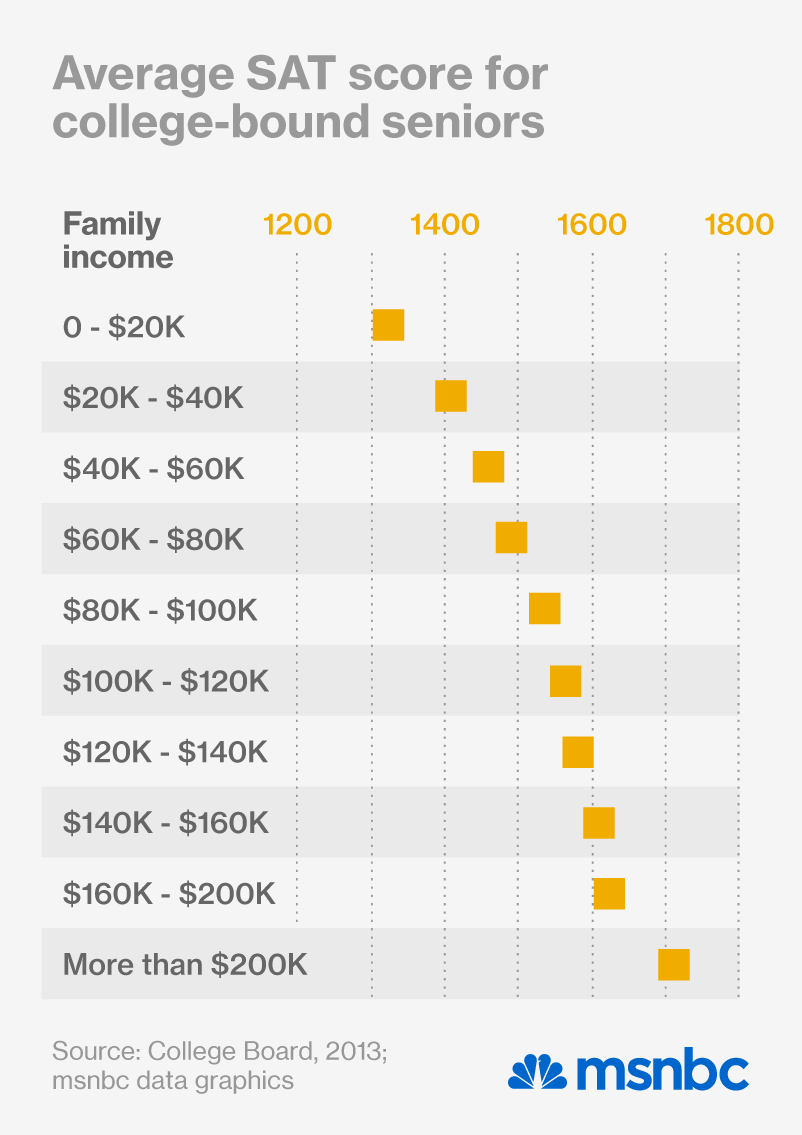
“Providing free test prep to low-income students is certainly a step in the right direction,” Richard Kahlenberg, a senior fellow at The Century Foundation, told msnbc. “But it obviously doesn’t by itself make up for the enormous disparities in the educational opportunity between low-income and wealthier students – disparities that show up dramatically in the SAT.”
“Scoring 1400 on the SAT means something very different for a student who has been handed all sorts of advantages in life compared with a student who has grown up in a single-parent, low-income household and attended mediocre schools.”
Joseph Soares, the author of SAT Wars: The Case for Test-Optional Admissions, goes further.
“This revision is intended to shore up the weakened position of the SAT relative to the ACT in the test-market, and to keep colleges from going test-optional,” Soares wrote in an email to msnbc.
Soares argued that almost any test requiring preparation, especially preparation involving a computer, will privilege students from more affluent backgrounds. “Test prep is unfair and transmits social inequalities,” Soares wrote. The partnership with Khan Academy, he added, will help those with access to computers and the internet, but leave behind those without. Soares is a sociology professor at Wake Forest University, one of the largest and most prestigious institutions to have gone “test-optional” — giving high school students the choice of whether or not to submit SAT or ACT scores as a part of their application. Racial and socioeconomic diversity has skyrocketed since Wake Forest adopted the policy in 2009, Soares said, with no adverse effect on academic quality: GPA for both entering high school students and first year Wake Forest students have gone up each year. Academic research consistently finds SAT scores to be a relatively poor predictor of how well students perform in college. High school grades are more accurate, and have a far lower correlation with students’ socioeconomic background. The most recent study [PDF] of test-optional schools, released last month by William C. Hiss and Valerie W. Franks, is the largest-ever study of its kind, covering 33 colleges and 123,000 students. It found high school grades did a better job of predicting undergraduate success than test scores alone. And there was virtually no difference between the college grades and graduation rates of applicants who submitted and those who didn’t submit test scores. The non-submitters were much more likely to be non-white, the first in their families to go to college, female, or Pell Grant recipients. “The president of the College Board got it right when he said ‘what this country needs is not more tests but more opportunities,’” Soares says. “Opportunities come out of America’s high schools, not the test industry. If the Board wants to help, they should focus on the AP and dump this discriminatory distraction from the educational experience of our nation.”
Benjamin Landy Recommended


