








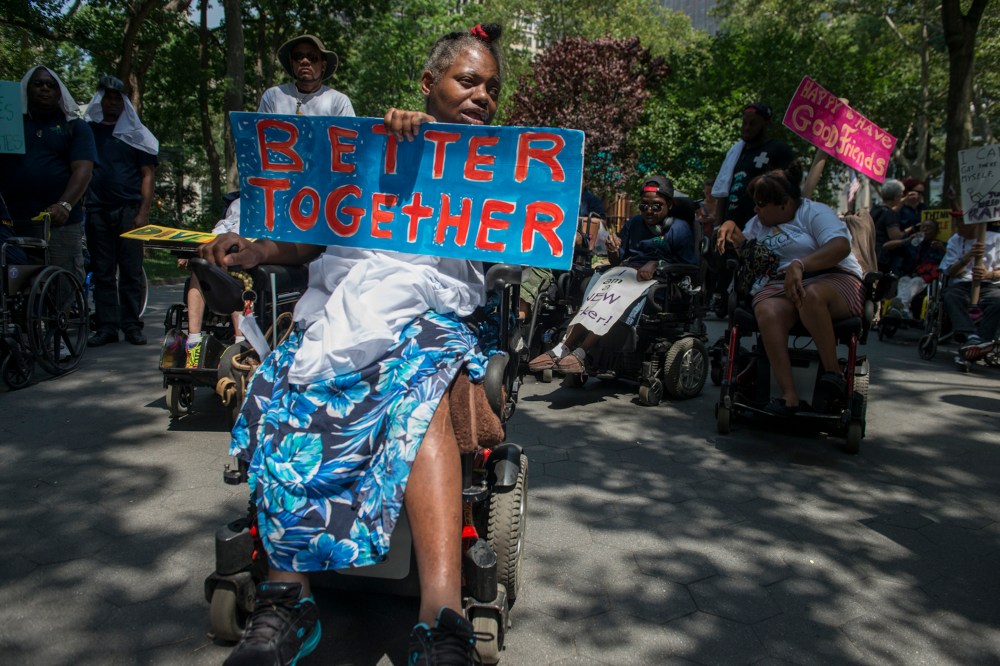
Twenty-six years ago, a Republican president signed the bipartisan Americans with Disability Act, or the ADA. That was then.
In the past year, the Republican presumptive nominee for president, Donald Trump, accused a reporter whom he had mocked of “using his disability to grandstand.” As a real estate developer, Trump’s properties have been sued several times for violating the ADA. At a rally in Florida, Trump said, “Nobody gives more money to Americans — you know, the Americans with Disabilities Act—big act. I give tens and tens of millions of dollars and I’m proud of doing it.” (On Tuesday, Trump responded angrily to reports questioning whether he had given as much to veterans as he claimed.)
Then there’s the title of his most recent book.
“When I saw Trump had a book called Crippled America, I was excited,” joked Emily Munson, a Republican disability rights activist and attorney in Indiana, about the title using a commonly pejorative term for people with disabilities. “I thought it was full of policy ideas on employment for people with disabilities.” Activists swarmed the #CrippledAmerica hashtag on Twitter, trying to use Trump’s book promotion to raise awareness.
Issues of disability have traditionally crossed party lines. But the era of Trump, along with a growing skepticism of laws like the ADA by some congressional Republicans, has many activists worried that times have changed.
This primary season, the non-partisan organization RespectAbility asked all of the candidates to fill out a detailed questionnaire on issues that affect people with disabilities. Democrats Hillary Clinton and Bernie Sanders replied in detail; among Republicans, Jeb Bush, John Kasich and Ben Carson also responded.
No word yet from Trump, whose website’s “issues” section does not mention people with disabilities, and who has gone on in little detail regarding his positions on disability-related policies.
“The nominee for a president is the leader of the party,” said RespectAbility’s president, Jennifer Laszlo Mizrahi. “And we would like to see the nominees of both parties embrace opportunities for people with disabilities.”
RELATED: Trump appears to mock a person with disabilities. Again.
Mizrahi said there are still many Republican governors whom she described as “amazing on our issues,” including Wisconsin’s Scott Walker, South Dakota’s Dennis Daugaard and Iowa’s Terry Branstad.
But Tony Coehlo, who as a Democratic congressman co-authored the Americans with Disabilities Act, and who is now advising Democratic front-runner Hillary Clinton on disability issues, sees more widespread reason for worry.
“Everything we did on disabilities was always bipartisan,” he told MSNBC. “And I insisted when we did the ADA that it be bipartisan,” with Republicans like Sens. Orrin Hatch and Bob Dole championing the 1990 law.
In 2012, the in-person appeals from Dole, the former Senate Majority Leader, presidential candidate, and disabled veteran, could not persuade Republicans to vote for a United Nations treaty on the rights of people with disabilities.
“We have not been able to get it to a committee vote since then,” Coelho said. He and other activists now fear that the ADA’s force could be diluted with a Justice Department uninterested in enforcing it, or with with business-backed bills like H.R.3765, introduced last year by Republican Congressman Ted Poe, who said its aim was to curb “abusive” lawsuits against small businesses for not complying with building regulations.
RELATED: Trump gave millions to vets groups after media report about donations
After a rocky start, Clinton has been refining her campaign’s positions on disability rights, under the tutelage of Coelho and another congressional champion of the issue, former Sen. Tom Harkin. “While she was one of the first presidential candidates to talk about disability issues, often it was done very clumsily and insensitively toward people with disabilities,” James Trout wrote in a February post on RespectAbility’s website, which detailed how Clinton referred to autism as a disease and did not include people with disabilities in her campaign launch video. Since then, however, Clinton has won praise for adding policy pages to her campaign specifically focusing on Alzheimer’s, autism and disability rights in general. She also announced that she opposes minimum wage exemptions for employers who hire workers with disabilities. Steve Bartlett, a former Republican congressman who was also a major mover on the Americans with Disabilities Act, and who like Coelho sits on RespectAbility’s board, disputed the suggestion that Republicans were abandoning disability rights. “The UN treaty, that was a bad moment,” he conceded. But while Bartlett called Trump “a person of exceptionally bad character and judgment,” and said his election would be “a disaster for the country on multiple fronts,” he argued Trump isn’t indicative of the Republican Party at large. “I think the disability community does itself a disservice if we decide to create a litmus test of the whole party based on the statements and actions of one individual,” he told MSNBC. “If it ever becomes a partisan issue, people with disabilities lose.” The issue, Bartlett argued, is that expanding opportunities and rights for the disabled “has gone cold in both parties.” Frustrations about the lack of visibility for disability-related issues in the election, including healthcare, employment and caregiving is something a lot of activists can agree on. That’s what led Andrew Pulrang, Alice Wong and Gregg Beratan to start a Twitter hashtag campaign, #cripthevote, leading up to primary debates. “People with disabilities, not all, have been using the term in an ironic/defiant way for a long time, consciously knowing they’re using a term that’s generally been offensive,” Pulrang explained, referring to “crip” or “crippled.” Of course, Trump, as a non-disabled person, can’t suggest he’s reclaiming it, though he did complain about political correctness around disability. “Never say a disabled person or the disabled, say a person with disabilities. In other words you say the other, you’re in trouble,” Trump said. “OK, never use the term handicapped parking, use only accessible parking, even though people have handicapped permits. So it’s so complicated out there, it’s tough. And we want to be politically correct, but a lot of us don’t have time to be politically correct.” Munson, as a Republican, is still hoping the campaign will decide to engage on the issue. “Disability policy issues can be very complex,” she said. “I understand if candidates don’t necessarily know the ins and outs of them. If they would make an effort to reach out to the community, I think they would find people ready and willing to offer support and advice.”
Irin Carmon Recommended


