








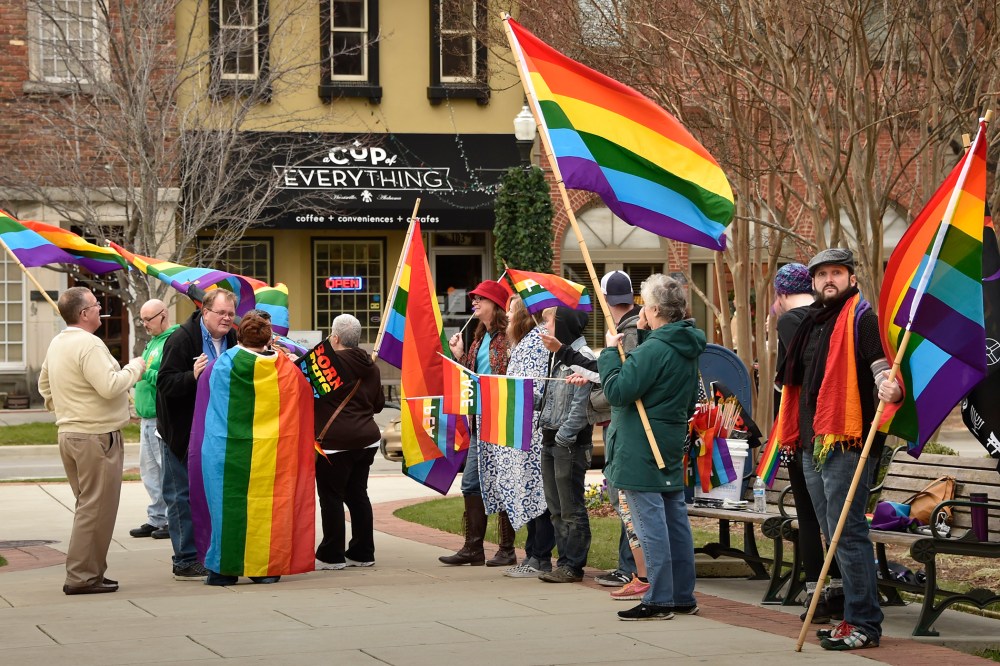
Despite an order from Alabama’s top judicial officer to defy a federal court ruling in favor of marriage equality, the vast majority of probate judges in the Deep South state are continuing to issue marriage licenses to same-sex couples.
Out of 67 probate judges in Alabama, 13 were not issuing marriage licenses to any couple — gay or straight — as of Thursday afternoon, according to the American Civil Liberties Union of Alabama’s Susan Watson. Of those 13, nine probate judges had already been denying couples marriage licenses for months, even before Alabama Supreme Court Chief Justice Roy Moore issued his controversial order on Wednesday. That means that Moore — acting in his official capacity as administrative head of Alabama’s judicial system — was only able to sway four probate judges with his instruction to uphold Alabama’s now-defunct ban on same-sex nuptials.
RELATED: Alabama chief justice orders halt to same-sex marriage
Of course, the fact that 13 probate judges aren’t issuing marriage licenses at all is a still serious issue for the couples who want to marry in those counties.
“That’s a real problem if you live in the rural, west part of the state, where three counties that are not issuing marriage licenses are contiguous,” Watson told MSNBC. “That means you have to drive 100 miles on country road to get to a county that is issuing marriage licenses.”
Wednesday’s directive from Moore marked the latest flare-up in a year-long fight between the state and federal judiciary that began last January when U.S. District Judge Callie V.S. Granade, a President George W. Bush appointee, struck down Alabama’s same-sex marriage ban in the case of Strawser v. Strange. A month later, Moore sent out a letter instructing probate judges to continue denying same-sex couples marriage licenses. Because no probate judge was listed as a defendant in Strawser, he argued, no probate judges were obligated to follow Granade’s ruling.
To clarify, Granade held another hearing in February and issued another order specifically requiring Mobile County’s probate judge to begin licensing marriages between couples of the same sex. A number of other probate judges followed suit. But some were still confused about whether to listen to Granade, or to Moore — who is essentially their boss.
That’s when the full Alabama Supreme Court got involved. In March, the state Supreme Court (minus Moore, who recused himself due to the fact that he had already taken action on the issue) handed down a ruling in the separate case of Ex parte State ex rel. Alabama Policy Institute that upheld the state’s same-sex marriage bans. According to Moore’s Wednesday order, the state Supreme Court justices are still deliberating that case, meaning their March ruling should still be in effect.
But legal experts say that interpretation fails to take into account several developments in federal court. In May, Judge Granade issued yet another order requiring all probate judges to issue marriage licenses to same-sex couples as soon as the U.S. Supreme Court ruled in the landmark case of Obergefell v. Hodges, which it did a month later, making marriage equality the law of the land. Later, in October, the 11th Circuit Court of Appeals said that the decision in Obergefell nullified the March instruction from the Alabama Supreme Court.
So why have some probate judges been able to deny couples marriage licenses all this time without facing fines or jail time, à la Kim Davis, the Kentucky clerk who spent five nights behind bars last year for a similar act of defiance? The answer boils down to a three-letter word: “May.”
Alabama law is unique in that it says probate judges “may” issue marriage licenses, not “must” or “shall.” Kentucky, by contrast, requires county clerks like Davis to issue marriage licenses. That why several couples filed a lawsuit last year alleging that Davis had shirked her official duties in denying them the licenses. Davis lost that case at the district level. And when she continued to turn couples away, she was found in contempt of court and briefly incarcerated. RELATED: Kentucky marriage licenses no longer need county clerks’ names: Governor Legal experts haven’t ruled out a similar fate for probate judges in Alabama. The “may” defense could very well fail in a court of law should couples choose to file suit. It just hasn’t been tested yet. “The fact that Alabama law says probate judges ‘may’ issue marriage licenses is a bit of problem,” Watson said. “We don’t agree with it [as a legal argument] because the Supreme Court has said marriage is a fundamental right. But it is very difficult to get at this legally. We have some great minds working on it pretty much non-stop right now.” This isn’t the first time Moore has taken on the federal judiciary. Back in 2003, during his first term as chief justice, Moore refused to comply with a federal court order that he remove a giant monument of the Ten Commandments from the Alabama Judicial Building. The act of defiance cost him his job. But after two unsuccessful bids for governor, Moore won back the office of chief justice in 2012. Some see his current resistance to same-sex marriage as the beginning of yet another gubernatorial run.
Emma Margolin
Emma Margolin is a reporter at MSNBC.com. Recommended


