








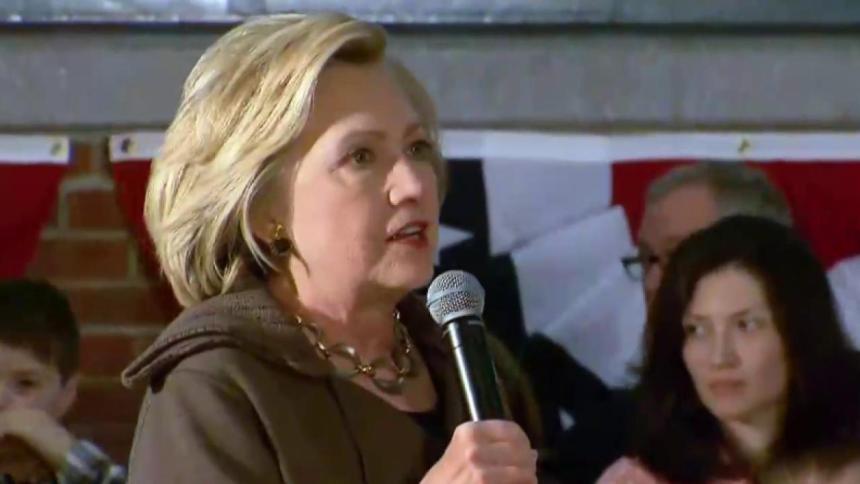
The Democratic primary is a race between the dreamers and the doers.
One of the biggest divides that has emerged during the contest between Bernie Sanders and Hillary Clinton is a split between the idealistic voices in the party, who view Sanders as a vehicle for rethinking traditional politics and policies and those who approach governing by pursing practical, achievable goals and are backing Clinton.

That was reflected in the endorsements each candidate received just this week: The former secretary of state got the backing of ex-Attorney General Eric Holder and the leaders of two major gun control groups, the Brady Campaign to Prevent Gun Violence and Americans for Responsible Solutions. Sanders, the Vermont senator, meanwhile was embraced by The Nation, a progressive magazine and the activist group MoveOn.
And it will be on display Sunday night when Clinton, Sanders and former Baltimore Mayor Martin O’Malley take the stage in Charleston, South Carolina for the NBC News-YouTube debate. Clinton is expected to attack Sanders’ proposal to create a “single-payer” government-run health care system, which is the ideal of many liberals but is very unlikely to adopted in a country with deep aversion to massive changes to existing policy structures.
Sanders tends to get support from liberal Democrats while centrists prefer Clinton, but the endorsements this week don’t fit that pattern precisely. Holder, the first-ever black attorney general, was one of the most liberal members of President Obama’s cabinet, speaking out on racial issues and gun control in ways that at times made Obama’s political aides uncomfortable. The gun control groups favor legislation to allow gun manufacturers to be sued that Sanders has opposed in the past.
But Holder has served in government for much of his life. Americans for Responsible Solutions has a strategy to push incremental proposals that can be adopted in individual states, a nod to the near-impossibility of passing national gun control laws.
That approach mirrors Clinton’s. When activists from the group Black Lives Matter confronted her last summer, the former secretary of state tried to cut short a broader discussion about racism in America. Instead, Clinton told the activists she wanted them to come up with an agenda of policy goals that Clinton and the activists could them join together in trying to get implemented.
The Nation and MoveOn want to accomplish policy goals as well. But those organizations also consistently press for broader political reform. They are intentionally not “part of the system” and often criticize Democrats who are.
The Nation endorsed Obama in 2008, but it also embraced Jesse Jackson in 1988. Both Obama and Jackson were liberal candidates, but Jackson in particular was running as a candidate to change American politics, not simply to achieve policy goals.
“He has summoned the people to a ‘political revolution,’ arguing that the changes our country so desperately needs can only happen when we wrest our democracy from the corrupt grip of Wall Street bankers and billionaires,” The Nation‘s editors wrote this week in embracing Sanders. “We believe such a revolution is not only possible but necessary—and that’s why we’re endorsing Bernie Sanders for president.”
Clinton, the magazine lamented, would be limited by her goals of “seeking common ground with Republicans and making deals to ‘get things done’ in Washington.”
The former secretary of state has argued her ability to build coalitions with the GOP is a strength, not a flaw.
Aware of this divide in the party, the two candidates are taking steps to grab parts of the other’s coalition. Sanders is increasingly referring in his public remarks to polls that show him leading in potential match-ups against Donald Trump and Republicans, an appeal to the Democrats who care most about keeping control of the White House and are perhaps less focused on a candidate overturning the system.
Clinton, in attacking Sanders for not strongly supporting greater gun control, is pushing an idealistic message, since her proposals are very unlikely to be adopted.
Polls suggest that in Iowa and New Hampshire, where Clinton and Sanders have campaigned extensively, the candidates are unlikely to change voter perceptions of Sanders as the activist and Clinton the governing expert. A recent Iowa poll, in which the two candidates were effectively tied, showed a whopping 88 percent of Democrats there felt Sanders shared their values, compared to 72 percent who said the same of Clinton. But 89 percent felt Clinton had the experience to be president and 85 percent felt she had a good chance of winning the general election, both totals more than 10 percent higher than Sanders’ standing on those questions. But if Sanders wins one or both of the first two states, this divide could get an interesting test: minority voters. Clinton has the backing of many influential African-American political leaders, from state representatives and mayors to major figures like Holder. This mirrors Clinton’s deep support among whites in the political establishment. But in theory, African-Americans could be open to a rethinking of American politics, since the current structure has resulted in blacks having disproportionately low levels of wealth and power. Sanders’ proposal for dramatic changes in U.S. economic policy has a parallel in how the Black Lives Matter movement is seeking to disrupt racial politics. While BLM activists have not endorsed Sanders, they already have some common enemies with him, such as Rahm Emanuel, the Chicago mayor, Clinton backer and longtime figure in the Democratic establishment. Clinton currently has a huge lead among minority voters overall and in South Carolina, the first primary that will have a large percentage of black voters. But polls in South Carolina shifted dramatically in 2008, once Obama won Iowa and proved he was viable. Sanders, unlike Jackson or Obama, is not an African-American presidential candidate. But his political revolution message mirrors how Jackson and Obama spoke during their runs, gaining huge black support along the way. This article originally appeared on NBCNews.com.Recommended



Perry Bacon