








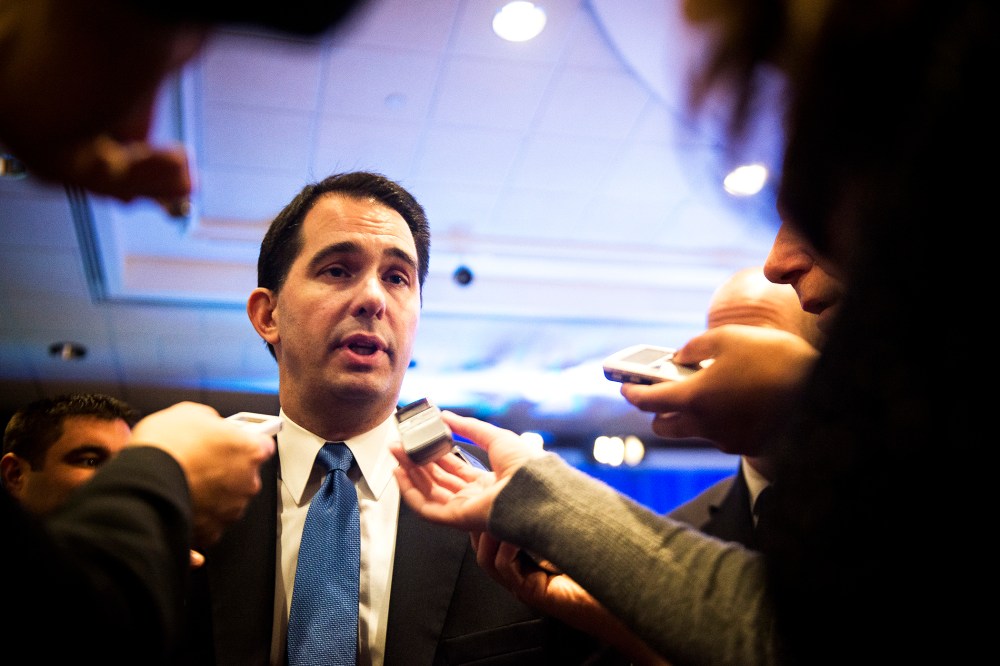
Wisconsin Gov. Scott Walker has spent much of his reelection bid fending off suggestions that he ran a less-than-clean campaign during the 2012 recall election. On Tuesday, a federal appeals court heard oral arguments about whether an investigation into Walker’s activities can continue, and the judges seemed reluctant to insert themselves too far into the case.
A 7th Circuit Court of Appeals panel heard oral arguments Tuesday from Wisconsin prosecutors and attorneys for the conservative political group Wisconsin Club for Growth State prosecutors had been investigating since 2012 whether Walker and his campaign staff illegally coordinated with conservative groups to raise and spend campaign dollars in a way that skirted state contribution limits.
According to the Milwaukee Journal-Sentinel, the three-judge panel was skeptical about whether the investigation required federal intervention. If they leave the case to be decided by state courts, it could be the end for prosecutors. A Wisconsin state judge first put a stop to the secret probe in January.
Diane Wood, chief judge of the U.S. 7th Circuit Court of Appeals, said during the hearing, “I don’t understand why the federal courts at the micro-level would be brought in.”
Eric O’Keefe, one of the directors of the Wisconsin Club for Growth, has argued that the investigation violates First Amendment protections on free speech. The groups being investigated have argued repeatedly through right wing talk radio and the Wall Street Journal that they are being unfairly targeted.
In a brief filed with the court Tuesday, prosecutors said that the investigation into possible illegal activity were focused on “coordinated expenditures – in the form of coordinated issue advocacy – that were secretly coordinated between a candidate, the candidate’s campaign committee and the candidate’s agents and various outside groups.”
Earlier this summer when documents outlining prosecutors’ legal theory that Walker’s campaign coordination amounted to a “criminal scheme” were released, an attorney for Francis Schmitz, the special prosecutor assigned to the case, said in a statement that at the time the investigation was halted, Schmitz had “made no conclusions as to whether there is sufficient evidence to charge anyone with a crime.”
One of the judges on Tuesday’s panel, Frank Easterbrook, was behind the order to unseal the documents that laid out the “criminal scheme” theory. The panel was also the same that overturned judge Rudolph Randa’s order for prosecutors to destroy evidence when he stopped the investigation.
Supporters of the conservative groups suing to stop the probe have now seized on the fact that Milwaukee District Attorney John Chisolm’s wife is a teacher, pointing to a new, anonymously sourced report she was distressed by Walker’s 2011 anti-union legislation as evidence of bias and retaliation.
“What’s at stake [in this lawsuit] is the public’s right to open transparent and accountable government. The issue here is whether candidates can work with third party groups that can take unlimited donations,” Brendan Fischer, general counsel for watchdog group the Center for Media and Democracy, told msnbc. “Now that there is actually going to be a hearing in front of judges that know the law, it’ll be interesting to see how that messaging might change. It will be interesting to see how [the judges] respond to the arguments the lawyers have been making for months.”
The Club for Growth and several other groups that are still unnamed are also asking that no more documents from the secret “John Doe” investigation be unsealed, while a collection of media groups is also trying to gain access to all of the case’s records. Hundreds of pages of documents have already been unsealed from this and an earlier secret investigation.
Said Fischer, “The public has a right to know what this investigation is about and what our elected officials are accused of. We’d be able to make a more informed judgment about whether this is the sort of conduct we want our officials to be up to.”
The extent of the possible coordination is still unclear because so many of the investigation’s records remain sealed. And while Walker and his supporters have denied that the governor did anything illegal during his campaigns in 2010 and 2012, greater transparency could sway some of the small number of still undecided voters. With less than two months until Election Day, Democratic challenger Mary Burke is in a dead heat with Walker.
Documents released in August showed that Walker’s campaign staff pushed donors to give money to the Club for Growth, and that a mining company looking to open a massive new operation in the state donated $700,000 to the group before Republicans passed legislation easing the way for the plan. And Walker allies have never denied that the campaign worked closely with conservative groups during the recall.
“Throughout his 20 year political career Gov. Walker has refused responsibility for his actions or to be held accountable for his bad decisions,” Scot Ross, One Wisconsin Now Executive Director, told msnbc. “Tuesdays court hearing will determine if the pursuit of truth and enforcement of Wisconsin’s campaign finance laws applies to Gov. Walker.” Neither the Club for Growth nor Walker’s campaign responded to requests from msnbc for comment. Republican observers say that the investigation and ethical questions about Walker won’t hurt his chances as a potential 2016 contender as long as he wins in November. But a restarted, re-energized probe into connections to conservative dark money groups could still disrupt momentum and give ammunition to Democrats looking to undo some of Walker’s most radical policies, from voter ID laws to the end of public sector collective bargaining rights in the state. According to a Marquette Law School poll, public opinion of the John Doe probe splits along heavily partisan lines, with Republicans apt to see the secret investigations into Walker’s campaigns as a political witch hunt, and Democrats more likely to see it as a serious problem. If the 7th Circuit panel decides that the investigation can continue, it will be a blow to one of the Walker campaign’s favorite defenses against allegations of illegal coordination — that two judges have already said the investigation amounted to a violation of free speech. One of those judges, Rudolph Randa, ordered a stop to the investigation in May. In addition to halting the probe, Randa ordered the destruction of documents collected during the investigation. That decision was quickly overturned by the appeals court set to hear the case Tuesday. Since then, legal experts in Wisconsin, including half a dozen retired judges and five district attorneys, have said there is enough evidence of illegal activity to continue an investigation. Randa has also come under fire from campaign finance and transparency advocates for his attendance at judicial junkets funded by the conservative Koch brothers and corporations such as BP and Exxon Mobil. According to an analysis by watchdog group the Center for Media and Democracy, no other federal district judge in the state attended those seminars. Circuit Court judges Frank Easterbrook, Diane Wood, and William Bauer will sit on the panel that hears arguments.
Meredith Clark
Meredith Clark is a freelance writer and editor. She was previously a senior news producer for "Patriot Act with Hasan Minhaj," a reporter with MSNBC.com, the digital politics and culture editor at Glamour and a senior news and politics editor at Refinery29. She has written for Vulture, Rolling Stone, Self, Marie Claire, Cosmopolitan, The Daily Beast and Bustle. Recommended


