








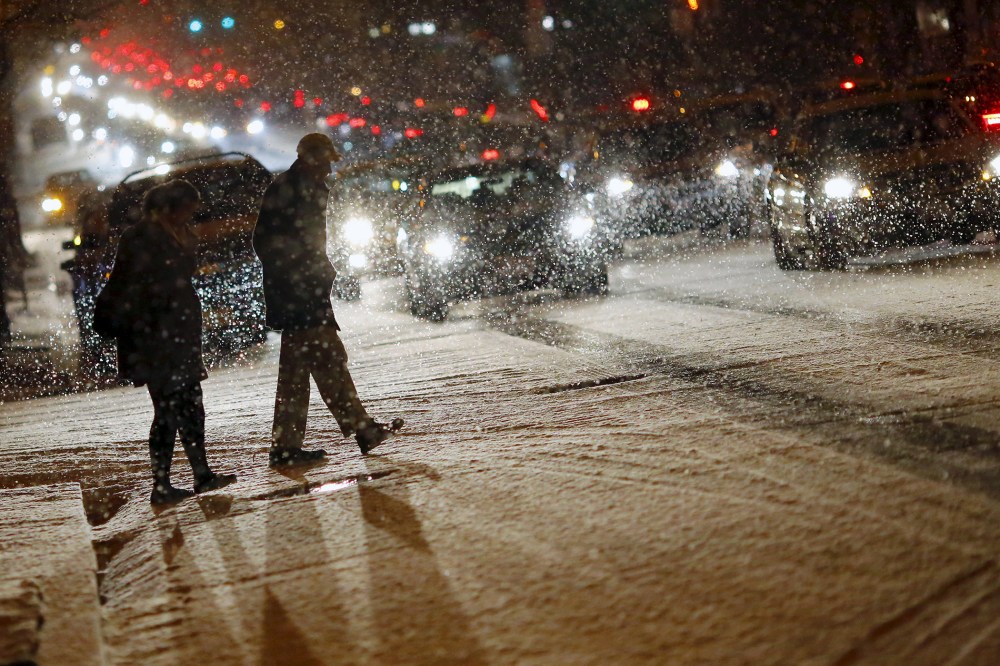
The economic impact of a major snowstorm that could bury portions of the East Coast stretching from DC past New York will likely be blunted, experts say, with people hunkered down for the weekend — but a significant chunk of the cost will depend on how cities respond.
Scott Bernhardt, president of weather intelligence service, Planalytics Inc. — which tracks and calculates the economic fallout from various severe weather events — said storms that hit on a weekend have less of an economic impact than storms that occur during a work week.
RELATED: Live updates from Winter Storm Jonas
His company estimates that with roughly 70 million people in the storm’s path, the damage will be anywhere from $585 to $850 million.
“That’s a big chunk of the nation. And what happens with storms like this is everything just kind of stops, including money,” Bernhardt said
“Obviously people go to the store this week. They’re buying the bread, the milk and the eggs, but what they don’t do is they don’t shop, they don’t go to the mall, they don’t go to the movies, they don’t go to restaurants. They don’t do the things that people normally do.”
The damage that snowstorms of this size inflict on the economy is real. In the winter of 2013 and 2014, a series of severe snowstorms helped shrink the national economy by 2.1 percent in the first quarter of 2014. And in 2015, the largest insured loss event worldwide was one of the winter storms that hit the East Coast. Insured losses were estimated at $2 billion.
Meteorologist Megan Linkin, a natural hazards expert with global reinsurers Swiss Re, develops insurance offerings that help protect government against natural disasters. She said that between 1995 and 2014, approximately 7 percent of the insured losses from natural disasters in the United States were caused by winter storms.
“Given our ever-increasing reliance on technology and interconnectedness, winter storms are going to continue to have an economic impact,” Likin said. “Government budgets are very, very squeezed – we saw that after Hurricane Sandy. Resilience is really key to make sure that individuals, homeowners, business owners, and cities are prepared and ready to face the financial impacts of these events.”
It costs a lot for cities to prepare for storms like this. In January of 2015 a report released by New York City‘s controller found that over the last 12 years it’s cost about $1.8 million in removal for each inch that fell on the boroughs.
Boston had budgeted $18.5 million for snow and ice removal over the last year’s gnarly winter, and by the time the middle of February, they had already blown through that budget, spending $35 million.
Both Linkin and Bernhardt agree — it’s not just the storm, but the response to it that matters.
RELATED: This blizzard could make legitimate history “I’m going to really be keeping an eye on power outages,” Bernhardt said. “If they spill into Monday, then I’m going to have a different number for you.” “While the snow is the blockbuster item in the news, the possibility of flooding with this storm is very much a real one,” Linkin said. “I would definitely urge people to make sure that they are prepared for flooding on the coast. This is not Hurricane Sandy — this is a very different storm. But it’s going to pack a powerful punch of winds and those winds are going to be blowing for quite some time and we are in the full moon phase so we are going to see moderate to severe coastal flooding from Maryland up through New Jersey.” While this one storm might not have the potential to cripple the economy thanks to it happening on a weekend, as Linkin points out, there’s still a lot of winter left. “We got the bulk of our winter weather after the new year last year. So, while cities haven’t had to go into their winter weather budgets quite yet, just because it’s been quiet so far, doesn’t necessarily mean it’s going to be quiet for the remainder of the winter. “ “It is only the end of January. We still have a lot of winter left.” This story originally appeared on NBCNews.com.
Marcia Breen Recommended


