








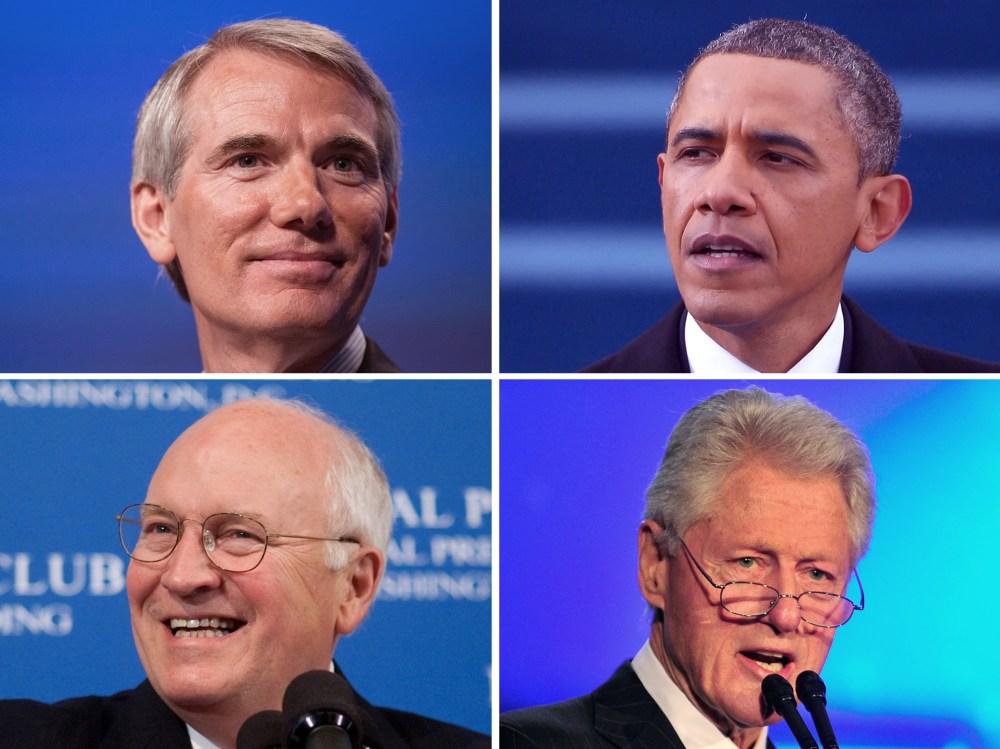
Ohio Sen. Rob Portman is just the latest politician to “come out” in support of gay marriage. Prominent lawmakers and public officials from both sides of the aisle have reversed course in recent years. And later this month, the Supreme Court will begin hearing arguments on the Defense of Marriage Act (DOMA), a law that bars federal recognition of same-sex marriages. A decision is expected in June.
Some noteworthy public figures and their public changes of heart:
PRESIDENT OBAMABarack Obama’s views on same-sex marriage have evolved continually over the years. As a senator of Illinois and a presidential candidate in 2004, he endorsed civil unions but opposed gay marriage. But in 2012, five months before he was re-elected to office for a second term as president, he told unconstitutional. Attorney General Eric Holder announced the decision in a letter to members of Congress.
Feb. 20, 2013: “The president and I have concluded that classifications based on sexual orientation” should be subjected to a strict legal test intended to block unfair discrimination, Mr. Holder wrote. As a result, he said, a crucial provision of DOMA “is unconstitutional.”
BILL CLINTONFormer President Bill Clinton signed DOMA into law in 1996 during his re-election campaign. At the time, he was 18 points ahead of Republican challenger Bob Dole.
In a Washington Post op-ed in March 2013, the former president publicly opposed the legislation he signed almost two decades ago that bans federal recognition of same-sex marriage.
March 7, 2013: “In 1996, I signed the Defense of Marriage Act. Although that was only 17 years ago, it was a very different time. In no state in the union was same-sex marriage recognized, much less available as a legal right, but some were moving in that direction…As the president who signed the act into law, I have come to believe that DOMA is contrary to those principles and, in fact, incompatible with our Constitution.”
DICK CHENEY During the 2000 presidential campaign, future Vice President Dick Cheney said same-sex marriage should be left to the states. Cheney’s daughter, Mary, is a lesbian. But while on the campaign trail once again in 2004, Cheney reversed course during an interview with msnbc to back President Bush’s call for a federal Constitutional ban on same-sex marriage.
March 2, 2004: “The president’s taken the clear position that he supports a constitutional amendment…He’s made clear what the administration position is, and I support him.”
Just months later on the campaign trail, Cheney in August reverted to his original stance that states should wield the ultimate decision on marriage rights. At a campaign rally in Mississippi, Cheney defended gay Americans, saying “freedom means freedom for everyone.”
Aug. 24, 2004: He said: “Lynne and I have a gay daughter, so it’s an issue our family is very familiar with. With the respect to the question of relationships, my general view is freedom means freedom for everyone…People ought to be free to enter into any kind of relationship they want to…The question that comes up with the issue of marriage is what kind of official sanction or approval is going to be granted by government? Historically, that’s been a relationship that has been handled by the states. The states have made that fundamental decision of what constitutes a marriage.”
Years later, while speaking at the National Press Club for the Gerald R. Ford Foundation journalism awards, Cheney stance remained relatively the same, differentiating his personal views on the freedom to marry from how those rights should be governed.
June 29, 2009: “I think people ought to be free to enter into any kind of union they wish. Any kind of arrangement they wish…Different states will make different decisions. But I don’t have any problem with that. I think people ought to get a shot at that, and they do at present.” COLIN POWELLWhen he was chairman of the Joint Chiefs of Staff, Colin Powell implemented the “Don’t Ask, Don’t Tell” policy in 1993, which prevented gay Americans from serving openly in the military. But less than two decades later, Powell joined the tide in calling for the restrictive law to be repealed. Feb. 3, 2012: “In the almost 17 years since the ‘Don’t Ask, Don’t Tell’ legislation was passed, attitudes and circumstances have changed,” Powell said in a statement announcing his support to repeal the very law he had implemented. He again changed his opinion on gay rights just two weeks after President Obama declared his support for same-sex marriage. Powell mentioned that his personal connections contributed to the change in his opinion. May 23, 2012: “As I’ve thought about gay marriage, I know a lot of friends who are individually gay but are in partnerships with loved ones. And they are stable a family as my family is. And they raise children. And so I don’t see any reason not to say that they should be able to get married under the laws of their state or the laws of the country, however that turns out–-it seems to be the laws of the state.” LAURA BUSHAfter years of not vocalizing her stance on same-sex marriage, Laura Bush told Larry King in May 2010 that she disagreed with the anti-gay marriage views of her husband, former President George W. Bush. May 11, 2010: “I think there are a lot of people who have trouble coming to terms with that because they see marriage as traditionally between a man and a woman, but I also know that when couples are committed to each other and love each other that they ought to have, I think, the same sort of rights that everyone has…I understand totally what George thinks and what other people think about marriage being between a man and a woman. And it’s a real, you know, reversal really, for [them] to accept gay marriage…I think it’s also a generational thing…that will come I think.” JON HUNTSMANDuring the 2012 presidential election, candidate and former Utah Republican Gov. Jon Huntsman supported civil unions, but not same-sex marriage. He voiced his changed opinion in a 2013 op-ed for The American Conservative. Feb. 21, 2013: “There is nothing conservative about denying other Americans the ability to forge that same relationship with the person they love. All Americans should be treated equally by the law, whether they marry in a church, another religious institution, or a town hall. This does not mean that any religious group would be forced by the state to recognize relationships that run counter to their conscience. Civil equality is compatible with, and indeed promotes, freedom of conscience.”
Michele Richinick Recommended


