








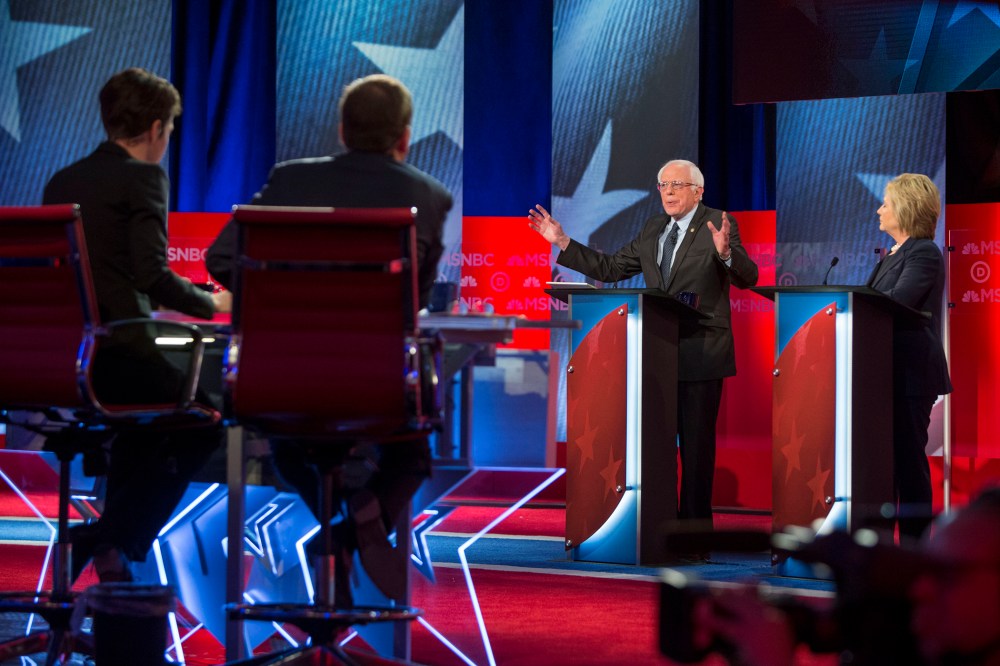
Bernie Sanders and Hillary Clinton sparred over foreign policy Thursday in their first one-on-one Democratic debate that not only highlighted a real difference in how each candidate would manage what comes next, but also pointed to a deeper rift over intangible questions of temperament and judgment.
Sanders acknowledged Clinton has more foreign policy experience, but, as he has in the past, defended himself by attacking Clinton’s 2002 vote authorizing the war in Iraq. “Experience is not the only point, judgment is” Sanders said, reminding the audience that he had voted against the war.
Clinton shot back that she advised President Obama inside the situation room during the 2011 mission to take out Osama bin Ladin – a measure, she appeared to say, of both experience and guts. “I was at that table, I was exercising my judgment to advise the president on what to do,” Clinton said, adding that her experience is “a big part of the job interview.”
The MSNBC debate in Durham, New Hampshire comes just days before the candidates head to New Hampshire for the primary election — and in a state where voters are famously independent and where Sanders is ahead in polls, it’s hard to know if Clinton’s pitch as a disciplined player on the world stage will stick in New Hampshire.
RELATED: Clinton, Sanders square off: Six promises to follow up on
The candidates also clashed over a timetable for further openings in the relationship with Iran, with Clinton arguing in favor of holding out for more concessions from the country, while Sanders pushed to move forward “as quickly as we can.”
The two presidential hopefuls are each strong supporters of the Iran nuclear deal – as secretary of state under President Obama, Clinton oversaw the beginnings of the nuclear talks.
Clinton on Thursday took credit for the role she played in arranging the nuclear agreement, which was implemented last month. But she pointed to Iran’s role backing proxy armies through the Middle East, including inside Syria, where it has also inserted its own fighters.
“You have to get action for action,” Clinton said of the prospect of opening relations with Iran. “I believe we have to take this step by step.”
Whereas Clinton called for caution, Sanders called for faith, likening the renewed U.S. relationship with Iran to the long thawing of relations between the U.S. and Cuba.
“Guess what? Change has come,” Sanders said of Cuba, with whom the U.S. restored diplomatic ties over the summer. Iran’s role as a state sponsor of terrorism needs to be addressed, Sanders said, but the U.S. should consider moving toward normalizing relations. “I would like to see us move forward,” Sanders said.
Discussions on related topics – from what to do about ISIS, to trade policy – followed a similar pattern.
Throughout the evening, Clinton pitched herself as a tough-minded guardian of tradition. She reminded the audience that President Obama turned to her to be his secretary of state after she ran a presidential campaign against him in 2008. She bragged that Henry Kissinger, a fixture of the Republican foreign policy establishment dating to the Nixon administration, approved of how she ran the State Department. WATCH: Clinton and Sanders campaigns react to MSNBC debate Sanders, who has positioned himself as the alternative to the establishment in every way, argued in favor of gut instinct. On the subject of what to do about ISIS, the candidates each said they are against committing conventional American ground troops in Iraq and Syria. But Clinton criticized Sanders for lacking a sophisticated view, touting a letter her campaign posted last month written by foreign policy experts critical of Sanders. “Questions have been raised and questions have to be answered,” Clinton said, criticizing Sanders for calling for an army of anti-ISIS Muslim countries that would include Iran and Saudi Arabia, themselves sworn enemies of each other. “I’m asking you to bring both your heart and your head to vote with you on Tuesday,” Clinton said as she offered her closing statement. Sanders, who closed out the debate, called for political revolution. “I feel it is too late for establishment politics,” he said.
Jamie Novogrod Recommended


